




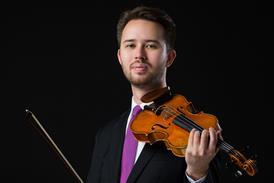



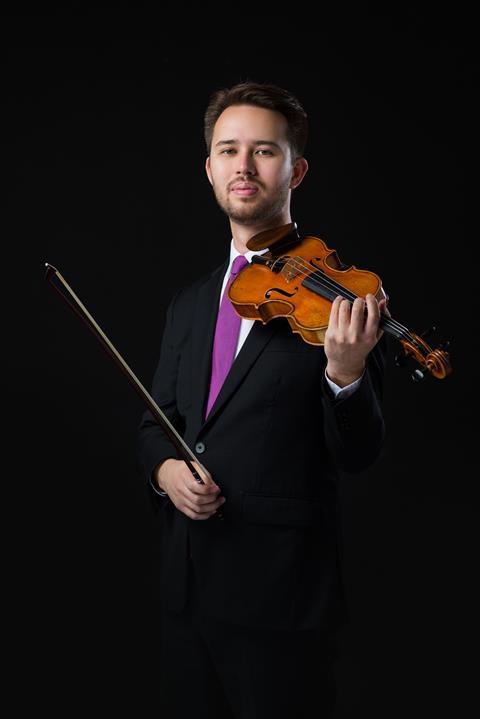
Patrick Yim discusses the close collaboration of Chinese and Western traditions for violin and viola that feature on his upcoming album of works by Zhou Long and Chen Yi
Explore more Featured Stories like this in The Strad Playing Hub
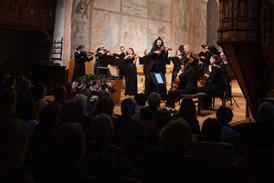
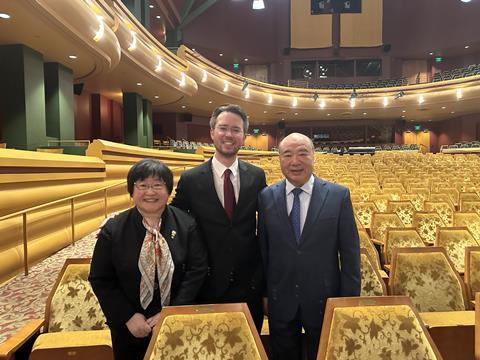
I have long admired the strikingly colourful and richly imaginative music of the Chinese-American composers Chen Yi and Zhou Long, as well as their remarkable journeys from the upheaval of China’s Cultural Revolution (1966-1976) to international recognition as two of the foremost composers of our time. It felt like a dream come true to spend time with them during a week-long residency at the University of Notre Dame. During their visit two years ago, we recorded Bamboo Grove through studio sessions and a live concert, an album featuring four previously unrecorded works composed between 1982 and 2024.
They told stories of legendary musicians they had worked with, including Yehudi Menuhin and Yo-Yo Ma, and I was struck by their encyclopedic knowledge of Chinese art, history, regional folk traditions, opera, philosophy, and traditional instruments. Drawing on their deep engagement with Chinese culture and their mastery of Western compositional techniques, refined during their doctoral studies at Columbia University in the late 1980s and early 1990s, they have created an altogether original musical language.
The ideas behind Bamboo Grove
I am animated by a belief that classical music is a living art form with new masterpieces and overlooked treasures awaiting discovery. This belief has guided much of my artistic work, from commissioning new repertoire to championing important works that deserve a wider audience. Bringing these four works together, composed across more than four decades, felt like a meaningful contribution to the recorded repertoire.
Over the course of nearly a decade, I have commissioned 24 works for solo violin (and dozens more for other instrumentations), including the title track, Bamboo Grove, composed by Zhou Long, winner of the 2011 Pulitzer Prize. His only composition for unaccompanied violin, the rhapsodic, virtuosic work is inspired by the legend of the Seven Sages of the Bamboo Grove and incorporates lively folk music elements.
The repertoire for this album was selected through conversations with the composers, whose input shaped the project from the beginning. After learning of my recent entrée into the world of the viola, Chen Yi – recipient of the Charles Ives Living Award, one of the highest honours for an American composer – suggested including two of her major works for solo viola. Both are virtuosic and demanding – it was like learning to swim by jumping into the deep end!
Learning to speak through the viola
After training exclusively on the violin, I embraced the viola for its tonal palette and rich, resonant C string and the new repertoire it offered. I quickly discovered that the viola presents its own unique challenges: its larger size demands greater efficiency, a natural use of gravity, and heightened awareness of posture and balance. The left hand must navigate a new geography: wider intervals, longer shifts, and a recalibration of the left wrist and elbow to negotiate the broader bouts of the instrument.
Furthermore, the very qualities that give the viola, primarily a tone instrument, its distinctive beauty – warmth, depth, and extraordinary range of colours – can make it challenging for solo lines to rise above a larger ensemble. Allowing the viola to project fully requires careful attention to articulation, colour, and clarity through string choice, fingering and bow technique.
Reimagining the violin: an expanded vocabulary
One of the most remarkable aspects of Chen Yi’s and Zhou Long’s music is the way they stretch the sonic affordances of Western instruments Eastward; Western instruments are made to sound like traditional Chinese instruments, and in some passages, techniques from Chinese instruments are employed on the violin and viola. Their craft reminds us that the definition of idiomatic techniques is constantly evolving and expanding.
A gifted violinist who began playing at four years old, Chen Yi served as concertmaster of the Peking Opera Troupe in Guangzhou during the Cultural Revolution, an era when conservatories were closed and Western concert music faced severe restrictions. She learnt traditional Chinese instrumental techniques by observing her fellow musicians, while Zhou Long worked as an arranger with the unique mix of available traditional Chinese and Western instruments.
In Bamboo Grove, Zhou Long reimagines the violin as Chinese instruments such as the guqin and guzheng through extended pizzicato techniques. The presto finale draws on Henan folk music through rapid pitch bends, repeated notes, and ornamented melodies.
In Xian Shi, Chen Yi draws from Chaozhou xianshi folk music from her mother’s hometown, characterised by singing melodies and rich instrumental colours. The viola evokes the yehu, a coconut fiddle, through its warm, nasal timbre and the pipa through a memorable rapid plucking gesture at the start of the cadenza.
In Tales From the Nine Bells, Zhou Long creates a timeless, mysterious sound world. The violin and viola play the role of erhu, the two-string Chinese fiddle, and guqin, respectively, through expressive glissandi and pitch-bend pizzicato, and the piano evokes the dramatic percussion colours of Peking opera through extended techniques and extreme ranges.
In the concluding Suite for Viola and Chamber Winds, each movement imagines the viola as a different Chinese instrument. The lusheng, a Chinese mouth organ, is evoked through clusters of notes and frequent double stops; the bianzhong, an ancient set of bronze bells, through sharply articulated harmonics; and the lyrical xiao, a bamboo flute, through graceful, ornamented melodies shaped by erhu-inspired fingerings. The final movement conjures the energy of a Chinese folk percussion ensemble through driving rhythms performed by the full ensemble.
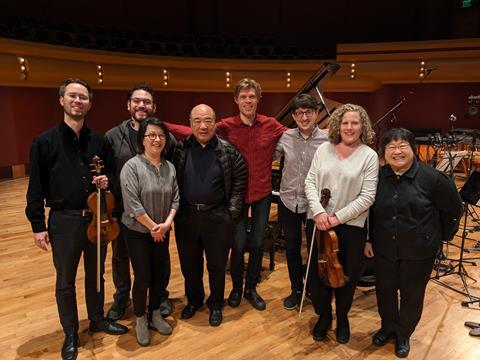
The expressive possibilities of our instruments continue to evolve through the imagination of composers willing to hear them anew. Bamboo Grove represents a living tradition, one in which artistic practices are continually renewed through collaboration, performance, and creative vision. Drawing inspiration from traditional Chinese instruments, their music expands the expressive vocabulary of Western instruments through new timbres, gestures, and techniques. It has been a profound privilege to work with Chen Yi and Zhou Long to bring these remarkable works to life. I hope this recording is a gateway for listeners and performers alike to discover their extraordinary sound worlds.
Patrick Yim’s album Bamboo Grove will be released on 21 August 2026 on Pentatone.
All photos courtesy Patrick Yim.
Watch: Video premiere: Bella Hristova performs David Serkin Ludwig’s Violin Concerto no.2 ‘Paganiniana’
Read: Australian Festival of Chamber Music: a new chapter in Cairns
Explore more Featured Stories like this in The Strad Playing Hub









No comments yet