






The violinist speaks to The Strad about his new recording of this lesser-known wartime concerto
Read more Featured Stories like this in The Strad Playing Hub
When asked to name a British violin concerto, you may cast your mind to those of Edward Elgar, Benjamin Britten or William Walton, beloved works that continue to be performed and recorded the world over.
Yet how many people are familiar with the violin concerto by Dyson?
Sir George Dyson (1883–1964) was a Yorkshire-born composer and organist. Showing early talent as an organist, he won a scholarship in 1900 to attend the Royal College of Music in London, where he studied organ with Dr William Stevenson Hoyte and composition with Charles Villiers Stanford. In 1938, Dyson became the first alumnus to be appointed director of the RCM.
Dyson’s Violin Concerto was premiered on 16 February 1942 by the eminent violinist of the time, Albert Sammons, accompanied by the BBC Symphony Orchestra under the baton of Adrian Boult. The performance was received favourably, with violinist and critic in The Musical Times, Ferruccio Bonavia, saying the work was a significant addition to the violin repertoire. However, initial enthusiasm for the work did not translate into sustained performance.
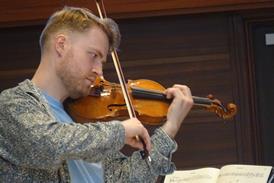
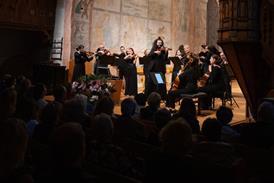
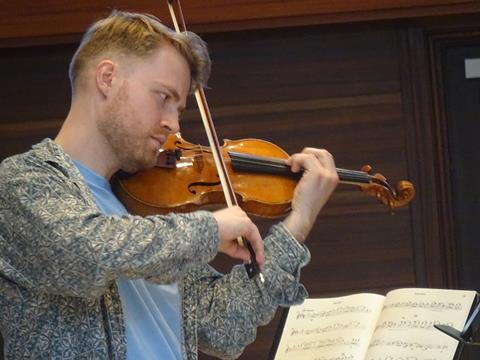
Shining a light on this violin concerto is Welsh violinist, Charlie Lovell-Jones, who performs the work on a new album of Dyson’s works for SOMM Records. Since making his sold-out Royal Festival Hall debut at the age of 15, he has appeared as both soloist and concertmaster with leading orchestras worldwide including the Sinfonia of London, BBC Philharmonic Orchestra, BBC Concert Orchestra, BBC National Orchestra of Wales, English Chamber Orchestra, as well as many other orchestras abroad.
Lovell-Jones spoke to The Strad about how he came across this neglected work, providing insights on the piece for new listeners and performers.
How familiar were you with Dyson’s Violin Concerto and other works, if at all? How did you come across this concerto?
Not at all! I’d never heard of Dyson’s Violin Concerto until Dr Andrew King of the Dyson Trust approached me about recording it a few years ago. Before that, I’d only heard of Dyson’s Magnificat and Nunc dimittis in D, a choral psalm setting. I was thrilled, then, to be greeted with this expansive, endlessly lyrical violin concerto.
From the very opening it has a monumental feel, starting with a motif that returns across its four movements and takes us to an epic conclusion. The music is by turns yearning, uplifting, sensitive, and thrilling; I think it’s a truly beautiful piece, and I’m so grateful to Andy and the Dyson Trust, as well as Jonathan Andrews, Neil Varley, Ben Hamilton, the BBC, the BBC Concert Orchestra, and the whole team at SOMM for making this happen.
Many listeners will not be as familiar with Dyson’s compositions as other British composers. How would you describe Dyson’s writing, and can you identify any clear stylistic influences in his work?
Elgar, Vaughan Williams, Holst and Delius – those are the four composers that come to my mind most on listening to this concerto. Each movement is structured quite classically, though Dyson plays around with form a fair bit. The violin’s first entry feels like an homage to Elgar’s First Symphony, the second subject glows in a Delian manner, the climax of the first movement has an exhilarating Vaughan Williams sweep to it, and the vivacious second movement is like a meeting of Holst’s Capriol Suite and ‘Mercury’ from The Planets.
The chorale theme of the slow movement also brought to mind the ‘Andante cantabile’ from Tchaikovsky’s First String Quartet. This feels like home territory for Dyson; possibly the most beautiful music in the concerto, he weaves from it a gorgeous set of variations. I also nabbed the opening tempo for the last movement’s slowly-accelerating waltz from Berlioz’s Symphonie Fantastique.
All that said, I think Dyson cultivates something uniquely his. In each movement, he makes decisions that feel new to the ear; some standouts for me include the second subject’s return in the first movement, orchestrated with a kind of heavenly top-loading, tutti violins and winds gathering just beneath the high-register soloist underscored by warm bass writing.
Overlay and interplay of thematic material in the charge toward the second movement’s rousing conclusion are so well-calibrated, and in the third movement one of the variations is suspended so beautifully between mourning and wonder that it feels like time comes to a standstill. Heart-on-sleeve sincerity, charm, and even kindness nurture an irrepressible optimism in the last movement; when that monumental, suffering-laden opening motif comes back, the music can now take it in stride toward an empowered conclusion.
As it unfolds, the concerto becomes more and more distinctive – rooted in a Romantic British compositional tradition, of course, but saying things within that idiom that no-one else quite said.
What were some musical, technical or ensemble challenges you faced when recording this work?
Technically, the piece is quite friendly - you just have to sing (and articulate!) all the way through it, which requires a lot of support and wise pacing (it’s almost 40 minutes long, after all). Speaking of pacing, the last movement features a steady, almost constant accelerando, which in the more stop-and-start nature of CD recording can be difficult to sustain.
At its peak, this accelerando transitions into the (spoilers) second subject of the first movement, so tempo relations between the first and last movement needed careful consideration. It’s quite easy for the first movement to feel either hurried or turgid, so a lot of this inter-movement calibration came as a result of finding the right feel for the first movement; of course, you only find out if it’s the ‘right’ feel in situ, with all players present. Small adaptations needed, different versions enjoyably tried.
Something I find quite unique in the first movement is that the solo violin part seems to take on a calming, reassuring role in relation to the more anxious, turbulent orchestra part. This was a wartime concerto after all, written in 1942; it’s as if the violinist is the dreamer, offering succour by recalling an idealised, pastoral, peaceful Britain, now lost irrevocably to the terrors of warfare.
The solo part can offer both grieving and healing; cultivating an organic dynamic with the orchestra along these lines was an intricate, beautiful process, for which I’m very grateful to all of my colleagues.
Do you envision yourself performing this work again in the future?
Absolutely! I’m determined to perform it again. The longer I spent with this piece, the more I fell in love with it. I’d be going about my daily life and some beautiful turn of phrase or harmony would come to mind and just take over my nervous system for a moment. Can’t imagine what my face must have looked like. I hope lots of people might come to love this music as I do.
It’s probably the yearning of this music that stays with me most. The concerto runs the gamut from sorrow to ebullience, and through it all is filled with phrases that stretch, that unfurl longingly, bittersweetly. It feels like music that was meant to inspire and uplift in a time of immense, unrelenting hardship, and I would love to offer that to as many people as I can.
The Dyson Violin Concerto with Charlie Lovell-Jones and the BBC Concert Orchestra under John Andrews is out on the SOMM label on 20 November 2026: https://listn.fm/dyson/









No comments yet