







Fresh from publishing her book Duo Gems, Jennifer Maslin outlines the myriad ways chamber music can impact overall musician training
Read more Featured Stories like this in The Strad Playing Hub
Let’s face it, there’s never enough time to cover everything we’d like in a music lesson. We could easily just focus on technique, repertoire, performance interpretation, psychology and confidence, scales, etudes, aural skills, sight-reading or theory… I could go on! Fitting in time for anything else is a rare treat.
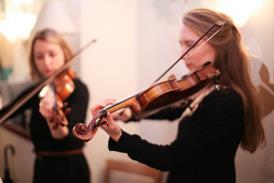
As a teenager, I was lucky my teacher saw the benefit of duets beyond a bit of end-of-term fun. And what I gained from them was so much more than that. Having recently arranged a selection of classical pieces for two violins, I’m reminded of the many benefits that duets provide for students and professionals alike.
Ear training
Perhaps the most obvious advantage is the listening skills gained. But even these can be built upon in layers. Playing in tune as a duo is a sophisticated challenge, different to that of a soloist. On a basic level, the duo needs to first tune together – and then maintain ensemble intonation throughout the piece to lock in those lovely harmonic overtones. At a more sophisticated level, nuances in timing, as well as the blending of individual vibrato, can also be considered.
A different way of learning
Much research has been done into effective learning methods and practice. Playing duets can neatly and subtly complement learning points made elsewhere in a music lesson. A student playing with their teacher will not only be able to mirror their teacher’s superior skills with limited verbal feedback from the teacher themselves, they will also learn to self-regulate their own playing by focusing more externally on – and synchronising with – another’s playing.
And for those teachers who struggle to motivate students on the topics of music theory, harmony and counterpoint, duets are a practical, immersive and fun way to discuss them – without banging a textbook over their head!
Independence
One of the aims of music lessons is surely to foster and nurture self-sufficiency in musicians. Duets provide a safe space to collaboratively explore sight-reading – with a musical buffer found in the other player when a wrong note is played or an entry missed. The clinical setting of exam sightreading tests is almost the antithesis of this. In fact, the joy of duets reminds us why we might actually want to attempt the daunting task of sightreading in the first place!
Another step down the path of musical independence, is the development of leadership. Playing first fiddle in a duet – literally or figuratively – comes with its own opportunities for conducting (of sorts); through ’counting in’ audibly; leading with a breath, the violin scroll or a bow movement; and directing with eye contact, a nod here and a smile there.
Collaboration
This independence as a player in turn leads to collaboration. It encourages a type of listening and partnership different to being accompanied: proper teamwork! Discovering that not everyone thinks – or interprets even a notated classical piece of music – the same way as you, can lead to some beautiful discussions, growth as a musician and exploration of the repertoire.
On a more practical level – and in training for orchestral and ensemble playing – duets also encourage a collaborative approach to bowing choices.
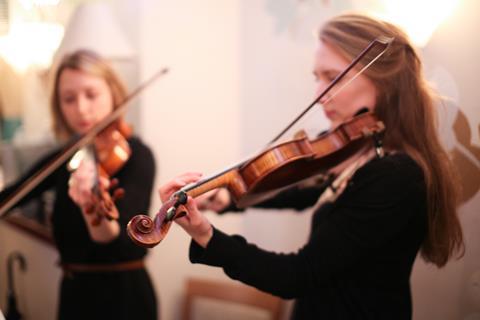
Duets encourage a type of listening and partnership different to being accompanied: proper teamwork!
Fun
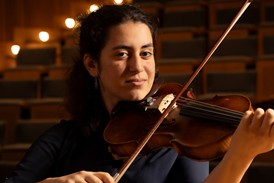
Lastly, duets are fun. They take the heat off the individual and are great for a nervous performer – the duet partner becoming a sort of musical comfort blanket and partner in crime. Duets can not only be social (and let’s face it, a giggle especially when you go wrong), they also help build musical trust among players.
7 pitfalls to watch out for:
But it’s not always a breeze. Common obstacles can be:
1. Comparison and feeling ’good enough’, especially when playing with a peer, rather than teacher.
2. Student perfectionism and fear of failure, especially when reading together for the first time.
3. An ability mismatch between two learners duetting together, causing confusion and frustration.
4. Not knowing who is leading or not having the confidence to lead.
5. Getting out of sync, with one player doggedly continuing as another pauses at a tricky passage.
6. Balance of volume and tone, especially when factoring in varying instrument quality and player experience.
7. Page turns!
7 ideas to make duets a success:
1. Model them in your lesson, first taking the primo part, then allowing the student to. Should you feel the student can hold their own independently and confidently, only then move onto student-student duets.
2. Remind your student of the benefits of duets – and why they’re fun!
3. Choose repertoire carefully, especially if the duet is student-student rather than teacher-student.
4. Discuss the count or lead in beforehand and clearly acknowledge who is giving it. This empowers the shy student to direct a peer in a student-student duet.
5. Discuss the importance of maintaining pulse and momentum. Evaluate a passage after playing together, and return to areas which need tightening up ensemble-wise.
6. Swap instruments to explore the tone and volume capacity of the other person’s instrument! How does what you discover change the way you play your own instrument on the next run-through?
7. Clearly decide together who is turning when or, for stress-free ease, choose repertoire without any page-turns (such as my new arrangements for two violins Duo Gems)!

A valuable addition
I don’t know if Henry Ford was a musician himself, but he seems to summarise my thoughts pretty well: ’Coming together is a beginning; keeping together is progress; working together is success’. Whatever you are preparing your students for – be it a life-long love of music as an amateur, a musical career, orchestral playing or gigging with a band - duets are a valuable addition to the string curriculum and toolbox of a musician. But most of all, they’re fun.
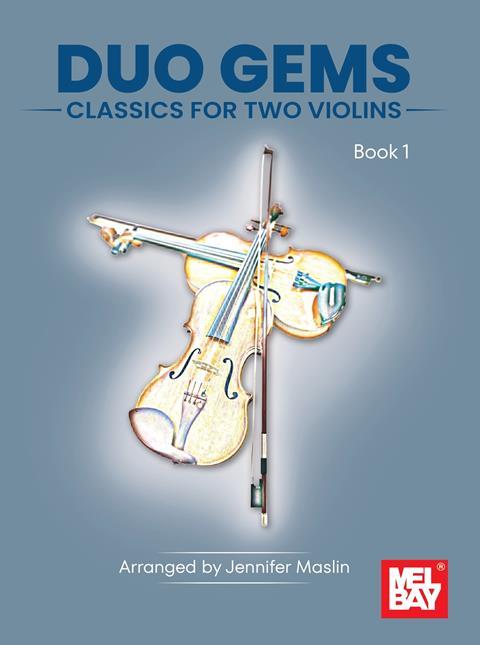
Duo Gems: Classics for Two Violins arranged by Jennifer Maslin (Mel Bay) is available in digital format and hard copy from all good sheet music retailers.











No comments yet