
![[defs use this] CelebrationByDAddario_388 pc Denny Medley Random Photography](https://dnan0fzjxntrj.cloudfront.net/Pictures/274x183/5/0/9/43509_defsusethiscelebrationbydaddario_388pcdennymedleyrandomphotography_776141_crop.jpg)





The 2026 American String Teachers Association National Conference was a bustling and inspiring event packed full of talks and performances, as Rita Fernandes and Davina Shum discovered
![[defs use this] CelebrationByDAddario_388 pc Denny Medley Random Photography](https://dnan0fzjxntrj.cloudfront.net/Pictures/480xany/5/0/9/43509_defsusethiscelebrationbydaddario_388pcdennymedleyrandomphotography_776141_crop.jpg)
Discover more Featured Stories like this in The Strad Playing Hub.
Read more premium content for subscribers here
Muted lighting, indistinct chatter and the soft hum of rolling suitcases – these things usually describe a hotel foyer. But from 25 to 28 February 2026, the San Francisco Hilton Hotel’s reception area was a hive of activity: a buzzing crowd of teachers networking with fellow educators, excitable young musicians from youth orchestras around the US, and bright-eyed conference attendees planning which talks to attend in the coming days. They were there for the 2026 ASTA (American String Teachers Association) National Conference, which this year ran concurrently with the conference of the Suzuki Association of the Americas.
If the conference’s three keynote speeches were anything to go by, this was set to be an incredibly wide-ranging event. On 26 February, Alex Laing outlined his work to create opportunities for black classical musicians through the Gateways Music Festival; on 27 February, Tina Tallon gave a presentation on how to ‘encode empathy’ in AI; and on 28 February, Alice Hammel showed how pedagogical methods can be adapted for disabled students.
Even shared between two people, the task of covering this conference was monumental. Attending back-to-back talks was relentless, but also deeply rewarding when they proved so inspirational. Each time we bumped into each other between presentations on the labyrinthine fourth floor, we were keen to share our thoughts on the one we had just attended, before setting off to attend another (we learnt to allow extra time for navigating the floor’s eerily indistinguishable corridors).
F rom among the countless talks, we each took away an overarching theme. One was a focus on how teachers can guide their students through sustaining and managing a career as a performer, both physically and mentally. In ‘Getting to the Core of Bow Strokes’, June Huang emphasised the importance of core strength. Using her exemplary students to demonstrate, she highlighted effective engagement of the latissimus dorsi, rotator cuff and trapezius muscles when approaching challenging passages in the violin repertoire.
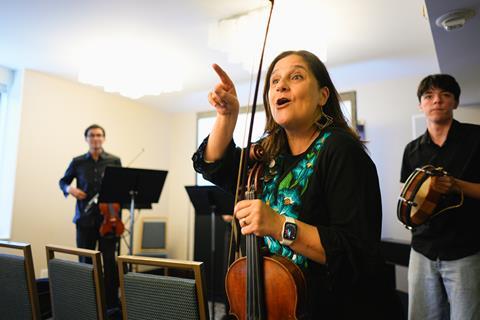
Francesca dePasquale’s presentation, ‘Understanding and Navigating Hypermobility for String Students and Educators’, explored her lifelong experience with hypermobility, including an Ehlers-Danlos syndrome diagnosis in her early thirties. She offered practical advice for teachers on recognising symptoms in students and shared targeted exercises using resistance bands, stretching routines and strength-building equipment.
Focusing on the psychological challenges that come with playing and teaching, Viviana Garcia examined how emerging educators can experience a lack of confidence, community and resilience in ‘Imposter Syndrome in the Orchestra Classroom’. Drawing on her own career path, she encouraged teachers to recognise that, despite instability, they have earned their place in the profession.
And finally, Christiana Fortune-Reader focused on the importance of defining personal success in ‘Empowering Collegiate Students to Envision Possibilities for the Future’. She observed that students often concentrate solely on developing instrumental skills, and discussed the contrast between ‘fixed’ and ‘growth’ mindsets. Her reflections on the many possible career paths within music particularly resonated with those in the audience who had ventured into music journalism from a performance background.
One theme of the talks was the re-evaluation of established approaches and traditions
A second theme was the re-evaluation of established approaches and traditions. In ‘Latin America’s Future Growth’, the inspirational Red Promesa, a group of young Latin American Suzuki teachers, presented ways to adapt the Suzuki approach to Latin American society. It was a stark realisation of how fundamentally global teaching structures are based on the socio-economic realities of the Global North rather than those of the Global South. Red Promesa is redesigning these structures so that Latin American students can benefit from systems constructed – rather than retroactively adjusted – for them.
In jazz cellist Chris Tate’s talk ‘Connecting Mind, Ear and Instrument in Improv’, the topic of ‘horizontal’ rather than ‘vertical’ left-hand thinking in string playing sparked interest. Mapping the left-hand position in a ‘chordal’ manner (like guitarists) is especially useful for improvisation, where a solid harmonic foundation is vital. If you can visualise the left hand in an ‘A major position’ and improvise across the strings from there, the efficiency gained from not having to shift vertically frees you up to concentrate on the music.
And speaking of improvisation, in her talk ‘Exploring Theatre Improv Games for Studio Teachers’, violin teacher Carmen Lasceski-Custers explained how Viola Spolin’s theatre improvisation method can strengthen teachers’ intuitive communication and responsiveness when teaching students. Participating in several improv games during the talk helped attendees to embody these concepts and also reflected the broader sense of camaraderie that ASTA so successfully fosters throughout the entire conference.
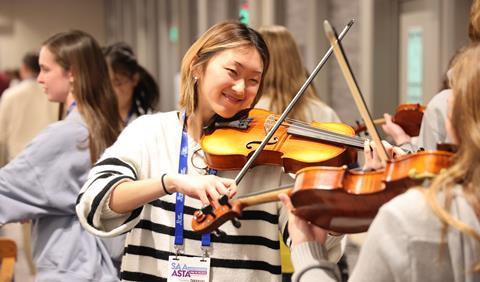
And finally, the very concept of notation was examined in ‘What, By Now, Is Going On with the Chop?’, where leading fiddlers Darol Anger, Casey Driessen and Tracy Silverman took stock of how the ‘chop’ (a percussive bow technique) has spread through string playing and teaching since its invention in the 1960s. They explored the challenge of standardising its notation, giving a rare insight into how we codify the physics of what string players do. This generated a thought-provoking discussion. Some attendees rebutted the idea of notating the technique (which began as an aural tradition), while others argued that standardisation meant greater accessibility.
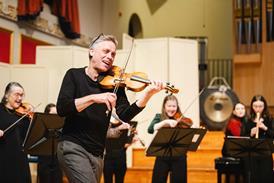
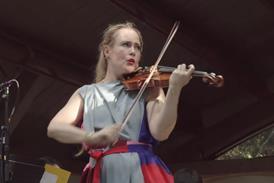
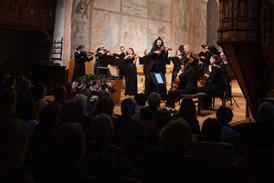
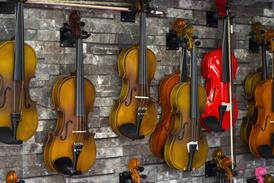
The conference also offered a wide range of performances. Highlights included the National Orchestra Festival Grand Champions string ensemble performing challenging works by Grieg and Jessie Montgomery unconducted and from memory; a viola-only group that showcased the range and versatility of the instrument; and D’Addario’s jazz event, where players were encouraged to get up and play a solo. And if that weren’t enough, the bustling exhibition hall was open every day for those wanting to explore string accessories, mingle with fellow attendees or presenters, or play on the many instruments on display.
A trip to San Francisco would not be complete without a ride on the iconic cable cars and a visit to the infamous Alcatraz Island (which was almost as unnerving as the Hilton’s fourth floor). But it was the city’s technomania – from self-driving cars to inescapable billboards advertising artificial superintelligence – that felt oddly pertinent to the conference. Not unlike Silicon Valley 40 miles away, the ASTA conference was a hub of innovation and cutting-edge thinking, led by visionary and dedicated leaders. But luckily, its attendees’ goals are unambiguously noble, showcasing the power of human connection: to educate and inspire tomorrow’s generation of string players and teachers.
Read: Postcard from Orlando: ASTA 2023 national conference
Read: Postcard from California: Music@Menlo Chamber Music Festival
Discover more Featured Stories like this in The Strad Playing Hub.
Read more premium content for subscribers here








No comments yet