
![[defs use this] CelebrationByDAddario_388 pc Denny Medley Random Photography](https://dnan0fzjxntrj.cloudfront.net/Pictures/274x183/5/0/9/43509_defsusethiscelebrationbydaddario_388pcdennymedleyrandomphotography_776141_crop.jpg)



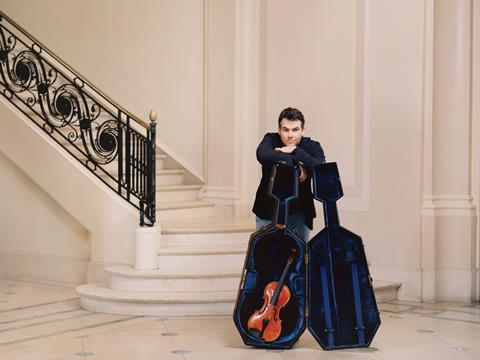
The violist shares the role Bach’s music has played in his life, and how this led to the monumental task of recording these cherished works
Read more Featured Stories like this in The Strad Playing Hub
As long as I can remember, the music of Johann Sebastian Bach was everywhere.
Movements from Bach’s violin concertos resounded from every practice room at the 3rd Street Music School in New York City. As part of the curriculum, young string players were introduced to his simpler piano works, discovering the art of counterpoint and exploring a rich world of colour, rhythm, and texture.
As a violinist, being assigned his concerti or movements from his sonatas and partitas was a great responsibility. I always felt that this music was unlike any other, demanding care, respect, and reflection that extended far beyond the practice room. Bach was, at once, both comforting and intimidating.
When I was eleven, my music school, facing a shortage of violists for the orchestra, sent out a call to all violinists, hoping to entice some of us to switch instruments. Having always admired the low register of the cello, I couldn’t resist. From the moment I dug into the low C string, eyes widening, I was hooked and wondered why I hadn’t discovered this instrument earlier.
I soon immersed myself in the world of the viola, listening to everything I could get my hands on. At the time, few violists had recorded Bach’s cello suites, and when introduced to these sublime works, I discovered a music that touched my soul deeply.
Nearly 30 years later, I decided to record all six suites on viola, and here is how I approached it.
Anna Magdalena Bach’s Role
No autograph manuscript of these suites survives. The hand-written copy by Bach’s second wife, Anna Magdalena Bach, represents interpretive challenges to musicians. Handwritten notes, bowings, staves, and titles are drawn by quill with an elegant hand, yet the common markings we see in later music are absent. Dynamics, articulations and tempo markings all seem to be missing.
Why is this?
I believe that musicians in Bach’s age possessed greater ownership and responsibility for creative expression. This era fostered a spirit of individualism and excellence in every sense. From the curvature of the note stems, the intricacy of the penmanship in the title Sarabande, to the small, ornamented design at the end of each movement, we are gifted with a living document containing just enough information to enable an artist to interpret the music with a sense of explorative inquiry, akin to how a scientist might approach a series of experiments.
My own interpretive journey with these six suites has been one of the most satisfying and challenging experiences of my life, and one which will surely continue to evolve. I hope to re-record them many years from now, not primarily to put the two recordings against one another, but to reflect on the evolution of a life in music which they represent.
Bach and the Viola
During the baroque and classical periods, transcribing music from one instrument to another was commonplace. Even Mozart and Beethoven hurried to arrange their symphonies for smaller ensembles before rival local musicians could, thereby securing performance rights and boosting their revenue.
In Bach’s era, music was to be played at the highest level regardless of the instrument. A cello was understood as a vehicle of expression rather than an end in itself. Bach’s son Carl Philipp Emanuel Bach said his father most enjoyed playing viola within an ensemble, seated at the harmonic center where he could best hear and direct all parts.
In Bach’s time, the viola was far from an undervalued instrument: the phenomenal Brandenburg Concerto No. 6 highlights two solo violas, showcasing their expressive and technical capabilities with a blend of tenderness and youthful bravado.
The six cello suites translate beautifully to the viola, which shares the same strings an octave higher. Indeed, the viola’s warm, tenoral timbre can even amplify the introspective, self-reflective qualities inherent in these works. I like to imagine that these six suites may have been conceived with the viola in mind, especially given Bach’s affinity for the instrument.
Bowings as Language
The legendary baroque cellist Anner Bylsma once told me that Bach’s bowings were more an indication of speech than of phrasing, akin to an accent or local dialect.
Having closely studied the original bowings, I now regard them as building blocks, like words, which form a sort of vocabulary for reconstructing and expressing Bach’s musical language. Drawing inspiration from these bowings and translating them into sound is a deeply personal endeavour. Interpretive choices inevitably reflect one’s individual temperament and physicality and may even be irreplicable by others.
Bach was a man of deep spiritual devotion. His human experience, well as the rich range of emotions which he portrayed, remains central to the music. These sentiments intersect with our own, allowing us to connect with the past as if through a kind of emotional time machine.
In performing these suites, I aim to capture that fullness of the human experience and help bring it to life.
The Challenge
I tasked myself with creating a bespoke technique that would imitate all the instruments Bach wrote for as well as those that didn’t yet exist. I aimed to transmit expressive commonalities that traverse generations.
As the o-so-true cliché goes, ’music describes what words cannot.’
A solo album can quickly fall victim to textural repetition, thus I insisted on introducing a wide spectrum of articulations, timings, dynamics and emotions… even some mistakes and compositional liberties.
If this music is to transcend time, then it must encompass the known and yet to be discovered range of the human experience.
The most exhausting part of the process was recording it all in just three days. From dusk till dawn I had been ’performing’ as each take receives the same energy and concentration as a concert.
Once the recording process was over, I didn’t touch my viola for a month. I had had my dose and needed a rest. A life’s work and a personal milestone completed, I’m ready for the next challenge.
J. S. Bach’s Six Suites for Violoncello on the Viola is released on Prospero Classical on 19 June 2026.








No comments yet