




![[hasnt been used much] G Hoffman - photo William Beaucardet - a](https://dnan0fzjxntrj.cloudfront.net/Pictures/274x183/0/2/9/44029_hasntbeenusedmuchghoffmanphotowilliambeaucardeta_116713_crop.jpg)









Why do we value beauty, and where does it come from? Violin maker Yoshiharu Ito traces a path from Stradivari to Japanese concepts of shadow and impermanence in search of what the violin is still capable of becoming
Discover more lutherie articles here
In 2007, Joshua Bell performed Bach in a Washington, D.C. underground station. In his hands was a Stradivari violin worth several million dollars. Almost nobody stopped to listen.
Had the same performance taken place in a concert hall, the audience would likely have sat in rapt silence.
The behavioural economist Daniel Kahneman called this phenomenon WYSIATI — What You See Is All There Is. We judge value through context, framing and authority. Without the setting of the concert hall, most people walked past something extraordinary without truly hearing it.
As a violin maker, I find it difficult to leave that experiment behind. I recognise the same mechanism at work in my own field. And it leads directly to a question that has occupied me for many years: what is the violin for?
An Answer to the Ideal
Consider the scroll. It contributes nothing to the sound of the instrument. And yet every serious maker carves one, and every serious player notices when it is done well or poorly.
The answer, I believe, lies in what the scroll originally represented. The early Cremonese makers worked within the Pythagorean conviction that the ratios governing musical harmony were not human conventions but natural laws, inscribed in the movement of strings and celestial bodies alike.
The scroll of a Stradivari encodes this understanding. It says: this instrument was made in the knowledge that form and meaning are inseparable. The maker’s task is not to produce a tool, but to reach toward truth.
The French violin maker and researcher François Denis has shown that early Cremonese proportions were anything but intuitive; they emerged from the same rational framework that shaped Renaissance architecture and music theory — a tradition in which making belonged fully to the liberal arts.
Nature never produces two things that are truly identical. If art is an imitation of nature, then true art cannot be replicated. It can only be pursued.
Each instrument was a singular act.
When Stradivari Became the Answer
In the nineteenth century, Jean-Baptiste Vuillaume systematically copied the instruments of Stradivari.
Vuillaume’s copies were themselves masterworks of craft, and perhaps inevitable, but the act of copying transformed Stradivari from a point of departure into a point of arrival. His work coincided with the Industrial Revolution’s creation of a new middle class and a new market for cultural objects.
The instrument had become an asset. Assets require stability and reproducible value. Stradivari was no longer a maker who had pursued an ever-changing ideal; he became the answer, the absolute standard against which all others were measured.
The Platonic logic that beauty cannot be reproduced, only pursued, was perhaps quietly set aside. When we decided the violin was a solved problem, or merely a functional object, the violin may have stopped thinking. By ’thinking’, I do not mean innovation for the sake of novelty. I mean the willingness to continue asking what beauty, sound, and meaning might yet become.
Most makers today, myself included, work within this inheritance. We study those instruments, refine our understanding of their proportions, and deepen our craft through that tradition. Stradivari himself did something very different. For seventy years, he continued changing his instruments — not refining a received form, but reasoning from first principles toward something he had not yet reached. What we revere as the answer was, for him, still an open question.
Different Paths, One Destination
I am a Japanese maker working in a European tradition. For many years, this created a particular kind of dissonance — not resentment, not insecurity, but something closer to an unresolved question: what does my own culture have to do with this instrument?
The answer arrived not in a workshop, but in a museum in Cleveland. A curator specialising in Egyptian archaeology looked at my work and said:
’Your culture has a sense that the divine inhabits the details of nature. That quality of attentiveness — it exists in ancient Egypt too. It is a very precious way of being in the world.’
After he walked away, I stood there for a long time.
For years, I had been taking a daily walk through a small park near my workshop. What I noticed, gradually, was that no two days were the same: the scent of the air, the particular quality of light through the leaves, the changing voices of insects from one week to the next. The leaves bud, deepen, turn, and fall. Perhaps this sounds obvious. To truly experience it is something else.
The same is true of the wood I work with. No two trees are identical. No two plates respond the same way.
What he had named in Cleveland was something I had already been living without knowing how to say it.
The Japanese aesthetic tradition does not pursue beauty through proportion and ratio. It finds beauty in impermanence, in shadow, in what is withheld.
Jun’ichirō Tanizaki, in In Praise of Shadows, locates aesthetic experience precisely where Western classical thought would not look: in darkness, in negative space, in silence.
Different paths, perhaps, toward the same question.
When I work with wood, I am aware that I am taking a life. A tree that grew for decades, absorbing light, responding to seasons, building its structure year by year, is cut, dried, and placed under my tools. There is no way to make this feel neutral. I have come to believe that the only honest response is a kind of reverence: to waste nothing, to listen carefully, and to pursue the sound that the wood and the player together might make possible.
For a long time, I had no language for this feeling beyond the work itself.
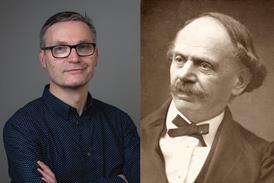
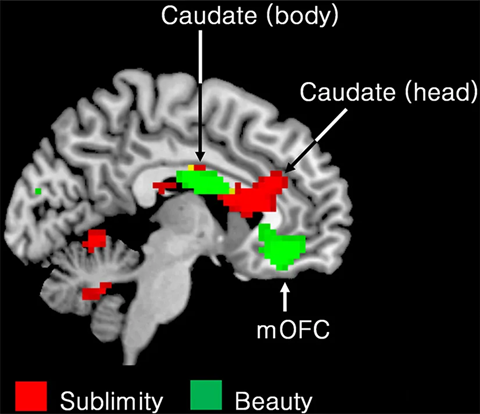
It was in conversation with Tomohiro Ishizu, professor of Neuroaesthetics at Kansai University, that I found a language for this feeling. His work explores many forms of beauty: the classical harmonies of time and space, the ethical dimensions of aesthetic experience, and the ways in which the brain responds to them. Yet what seems to draw him most strongly is the territory that resists explanation — experiences of awe, the sublime, and the Japanese concepts of mu and ma: nothingness and negative space.
When he described these as distinct modes of aesthetic experience, something in me recognised them. The feeling of taking a life in order to make something worthy of that life is not beauty in any comfortable sense. It is closer to what he calls awe.
This is where, I believe, the Renaissance tradition and the Japanese aesthetic tradition converge, not in theory, but in practice. Both ask the maker to stand before something greater than oneself.
Reopening the Question
From 27 to 29 August, I will hold an exhibition at Gallery Noyie in Matsumoto, the city in the Japanese Alps where Seiji Ozawa Matsumoto Festival has long gathered musicians. Developed in dialogue with Ishizu, the exhibition takes as its theme the encounter between these two traditions of beauty. Visitors will encounter the instruments directly — not as objects to be explained, but as questions to be heard.
I do not yet know what a violin created at the intersection of Renaissance proportion and Japanese in’ei — the hidden light within shadow, the beauty that reveals itself indirectly — sounds like. That is precisely why it is worth pursuing.
What drove Stradivari was not the approval of his patrons. Patrons, too, were subject to WYSIATI, responding not only to acoustic reality, but also to authority and reputation. What drove him was something closer to what the Platonic tradition had pointed toward: the conviction that beauty is real, that it has a structure, and that the maker’s task is to keep reaching for it.
Artificial intelligence can already analyse acoustic spectra, optimise plate graduations, and reproduce measurable properties with increasing precision. What AI cannot reproduce is the question behind the instrument: why beauty matters, and what it is for. This is what I am trying to pursue in my own work.
Not to copy what has already been found. To keep looking.
A violin is not a finished object. It is an ongoing question. The Renaissance understood this. Japanese craft understood this. Neuroscience may be beginning to provide a language for experiences that earlier cultures approached through philosophy and craft.
No two days in the park were the same.
No two trees were ever the same.
No two plates were ever the same.
That is what I am trying to make: not the same violin again, but the next one.
The violin may have stopped thinking when we decided it was complete. It can begin thinking again.
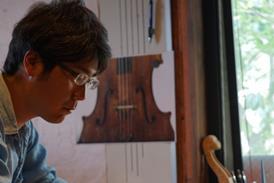
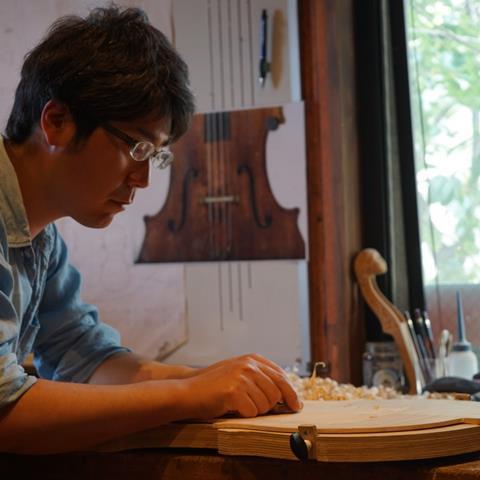
Yoshiharu Ito is an independent violin maker based in Nagoya, Japan. He studied behavioural economics at Shinshu University and trained in violin making and restoration under Tetsuya Kimura, John Gosling, and Jerry Pasewicz. He holds an annual solo exhibition at Gallery Noyie in Matsumoto, and his instruments have been played by musicians including Birgit Kolar, former leader of the Vienna Symphony Orchestra.












No comments yet