




For the 100th anniversary of the monumental Hungarian composer, The Strad recounts his musical upbringing, most influential string works and shares words from leading string players about their experiences with the composer and his music
Read more Featured Stories like this in The Strad Playing Hub
Fragments of a life in music
As György Kurtág reaches his centenary, the occasion feels curiously anti-monumental. Few composers of the past century have resisted the grand gesture as steadfastly as Kurtág, whose music is built instead from fragments, silences and moments of extreme concentration. If anniversaries usually invite summation and spectacle, Kurtág’s career suggests the opposite: an art that demands attention to the smallest possible unit of expression.
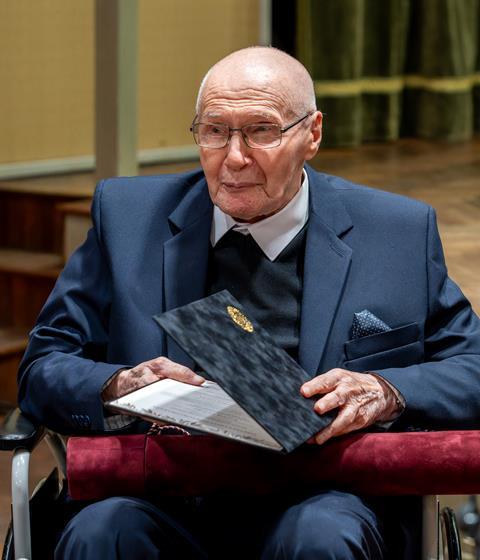
Earlier this month, Kurtág was awarded an honorary doctorate by the Liszt Ferenc Academy of Music in Budapest. The ceremony marked the formal acknowledgement of an eight-decade relationship with the institution, encompassing his years as a student and teacher, and a longer-term influence rooted in example. During nearly 20 years teaching piano and chamber music, Kurtág helped shape an ethic of listening, patience and humility that continues to resonate within Hungarian musical life. And despite the small size of his catalogue, string instruments occupy a central place in Kurtág’s musical thinking, serving as a primary site for his most searching work.
Born in 1926 in Lugoj, in what had recently become Romania following the dissolution of the Austro-Hungarian Empire after the First World War, Kurtág grew up bilingual before moving to Budapest after the Second World War to study at the Liszt Academy. There he encountered György Ligeti, a fellow student and lifelong friend, and absorbed the legacy of Bartók, whose influence is evident in Kurtág’s early reputation as a pianist.
A brief but decisive period in Paris in the late 1950s exposed him to the Western avant-garde – studying with Messiaen and Milhaud, hearing Boulez conduct the Second Viennese School – as well as to modernist literature and theatre, notably Kafka and Beckett. Just as crucial was his work with the art psychologist Marianne Stein, which helped him emerge from a profound creative crisis and begin again, effectively from scratch, with a string quartet as his op.1.
From that point on, Kurtág forged a language defined by extreme economy and expressive precision. The influence of Anton Webern’s intensely compressed, high-density musical language is often noted. Kurtág’s music, however, is shaped by exacting attention to expressive detail rather than by an overarching method. It unfolds through gestures that feel provisional, intimate and fragile, yet fully formed. His long-running piano collection Játékok (’Games’), begun in the early 1970s, reveals another side of this aesthetic — playful, exploratory and pedagogical — while functioning as a kind of personal diary.
International recognition arrived relatively late, catalysed by works such as Kafka Fragments (1985–87) for soprano and violin, one of the defining compositions of the late 20th century. Even his long-awaited operatic debut, Fin de partie, premiered in Milan in 2018 when he was 92, felt less like a culmination than a quiet continuation. At 100, Kurtág’s legacy lies not in scale or quantity, but in a body of work that has reshaped how musicians think about gesture, listening and meaning — an art that continues to speak most powerfully by refusing to shout.
Notable string works
Across his famously modest catalogue, Kurtág has repeatedly turned to string instruments as a testing ground for his most concentrated musical ideas.
-
String Quartet op.1 (1959)
Kurtág’s first acknowledged work after his Paris period and creative reset. Concentrated and searching, it marks the starting point of his mature language and establishes the string quartet as a lifelong laboratory. -
12 Microludes for String Quartet op.13 (1977–78)
A cornerstone of Kurtág’s chamber music. These aphoristic miniatures isolate specific characters, textures and modes of ensemble interaction, demanding acute listening and absolute clarity from all four players. -
Kafka Fragments op.24 (1985–87) – soprano and violin
One of Kurtág’s most influential works. Written in close collaboration with violinist András Keller, the violin part explores extremes of colour, articulation and physical presence, with bow contact and silence carrying structural weight. -
Officium breve in memoriam Andreæ Szervánszky op.28 (1988–89) – string quartet
A compact yet densely layered quartet that weaves homage, quotation and personal reflection. Fragmentary in form, it is among Kurtág’s most haunting and frequently performed string works. -
…quasi una fantasia… op.27 No.1 (1987–88) – piano and spatialised ensemble
Though not exclusively for strings, this work treats the ensemble as a constellation of chamber groupings. The string writing plays a crucial role in articulating distance, presence and fragility within the spatial design. -
Double Concerto op.27 No.2 (1989–90) – piano, cello and two spatialised instrumental groups
A major large-scale work in which the cello functions as a fragile protagonist, set against a delicately fractured orchestral environment. -
…concertante… op.42 (2003) – violin, viola and orchestra
A late, substantial work that places two solo strings in an intimate yet tense dialogue with the orchestra, extending Kurtág’s preoccupation with gesture and memory and their unsuspected resonances onto a larger canvas. -
Sinfonia breve per archi – Fried Márta emlékére (2004) – string orchestra
Kurtág’s concentrated response to the string orchestra medium: austere and compressed but elegiac, with an emphasis on transparency and collective listening rather than massed sonority. -
Zwiegespräch op.33 (1996–2006) – string quartet and electronics
This work places traditional quartet playing in dialogue with electronics, sharpening the focus on timbre, attack and the sheer physicality of sound production. -
Solo string works (from the 1980s onwards) – Kurtág’s ongoing Jelek, játékok és üzenetek (‘Signs, Games and Messages’) cycle encompasses substantial bodies of short pieces for solo violin, viola, cello and double bass, alongside the extended Hipartita for solo violin — works that have become a quiet cornerstone of contemporary string pedagogy, focused on touch, colour and listening rather than virtuosity.
String player testimonials
String players across generations, from leading international figures to emerging artists, reflect on Kurtág’s influence as a composer and mentor.
Kim Kashkashian, The Strad November 1997 issue
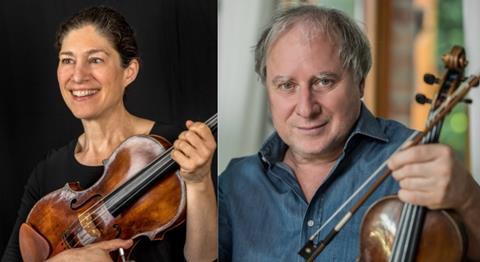
‘Kurtág is a leading figure in today’s musical world and has an uncanny gift for helping people realise what music is about, be it his own or that of other composers. He has written a number of short pieces for the viola over the years – there must be around 30 of them by now – which explore the possibilities of the viola in such a way that they could be considered a series of highlight musical études; in fact, I have used them in my lessons with astonishing results. And he is not a string player. He is a musician! He makes the instrument become so irrelevant.’
András Keller, The Strad June 2012 issue
’In 1990, after the Keller Quartet won the Evian and Borciani competitions, we received plenty of concert invitations. Composer György Kurtág suggested that we stop performing for a year in order to become immersed in our own work, and to find ourselves. I would certainly listen to him today and undertake fewer concerts. This might not be financially profitable, but it really is worth it.’
Patricia Kopatchinskaja, writing in The Guardian, February 2016
[Kafka Fragments] ‘is a song cycle in the big tradition of Schubert’s Winterreise or Schumann’s Dichterliebe. But, unlike these classical cycles, it does not tell a coherent story … but describe life’s experience as it really happens. … Kurtág took small fragments of Kafka’s diaries and other works and put them into short, utterly concentrated and wildly expressive pieces of music. As in baroque music, he describes affects and states of mind, but with a new musical language invented for the purpose.’
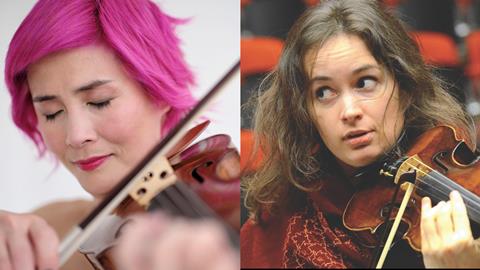
Jennifer Koh
Playing Kurtág’s music, especially alongside his longtime collaborator Kim Kashkashian, changed the way I listen and think about music. Kim’s deep understanding of Kurtág’s language guided me toward a heightened attention to sound, silence, and intention. Kurtág became a lens for me that focused my understanding of music.
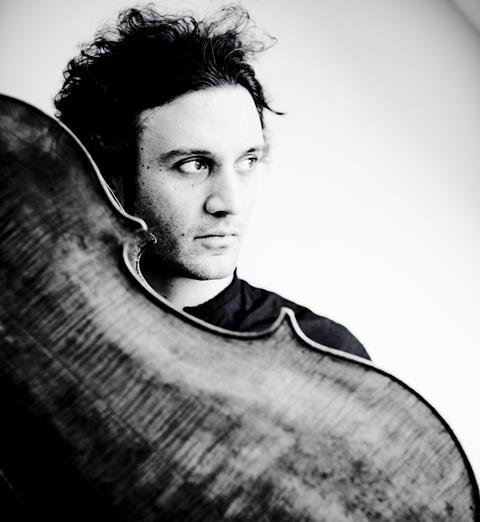
Nicolas Altstaedt
My first meeting with Kurtág goes back to 1994. I was a 12 year old listening to his work ‘Stele’ at the Cologne Philharmonie by the Berlin Philharmonic under Claudio Abbado and at that time mesmerised by what he would call ’stuttering is my native language’. The next years were not only marked by the discovery of his chamber works, but more by his teachings at IMS Prussia Cove. I think I have spent the most beautiful moments of my life listening to him sitting at the piano, playing parts from Brahms F Major sonata op.99, Schubert piano trios, Beethoven and Bartók string quartets. These were moments of utmost purity, witnessing the most uncompromising approach to what we believe music is about. I travelled later to both concerts at Théâtre des Champs-Elysées in Paris in 2010 and Queen Elizabeth Hall in 2013, where he performed with his wife Martha on the upright piano. The fact he always prefers a muted instrument unveils the often overlooked fact, that music is too precious to be screamed out. Being familiar to his meticulous approach and knowing him to be in the audience made the preparation and performance of his Double Concerto back in 2011 for his 85th birthday very inspiring and will remain 15 years later even more so.
Eliza Millett (Cellist and co-director of the Smorgaschord festival), The Strad online interview June 2024
’In my time working with György Kurtág, particularly on his Zwiegespräch for string quartet and electronics, it was clear that this was a composer who delineates meaning in gesture – a master of the miniature, no less. Short, compact ideas are to be conveyed perfectly – a sul pont or con sordino metallico must be expertly mastered to fit the whole character of the idea.’
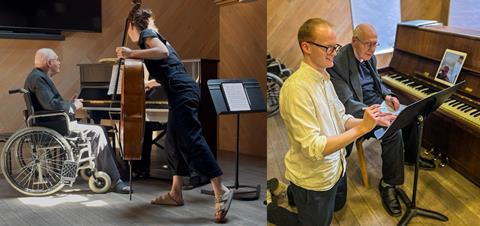
Sebastian Black (composer/pianist and co-director of the Smorgaschord festival), The Strad online interview June 2024
’The sounds in Kurtág’s string music are as extreme as anything. But, and our sessions with him confirmed this to me, his approach to strings is rooted in tradition, particularly the wonderful Hungarian string tradition, and the musicians with whom Kurtág is associated: violinists such as Sándor Végh and András Keller. Most striking was Kurtág’s approach to the idea of contact between the bow and string. In quiet music, he so often says, you absolutely must retain that contact. That way, the music will speak and will project out to the audience.It’s like he’s developed this amazing language for rehearsals that string players can relate to incredibly well and easily.’
Read: From Kurtág to Messiaen: a cellist and composer talk contemporary string repertoire
Read: ‘A jewel of a piece’: Tamsin Waley-Cohen remembers Oliver Knussen through his final composition
Read more Featured Stories like this in The Strad Playing Hub











No comments yet