
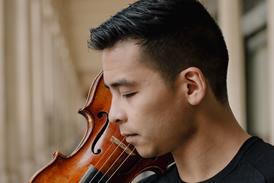
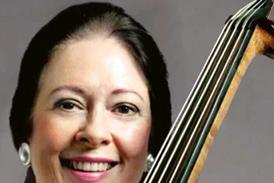
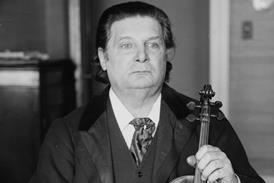


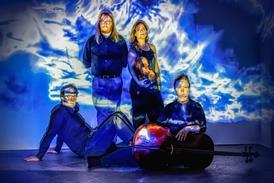



To mark the release of their new recording of Messiaen’s Quatuor pour la fin du temps, the Anzû Quartet considers how a fixed ensemble rooted in contemporary music approaches one of the chamber repertoire’s most singular works.
Read more Featured Stories like this in The Strad Playing Hub
In January 1941, in a prisoner-of-war camp in Görlitz, Germany, Olivier Messiaen’s Quatuor pour la fin du temps was first performed before an audience of fellow prisoners and guards – a work born of extraordinary circumstances and written for the unlikely combination of clarinet, violin, cello and piano. The piece has long since entered the canon, its mystical vision and rhythmic daring continuing to challenge performers. Yet the very singularity of its instrumentation has often meant that performances are assembled ad hoc, rather than sustained by a long-term ensemble identity.
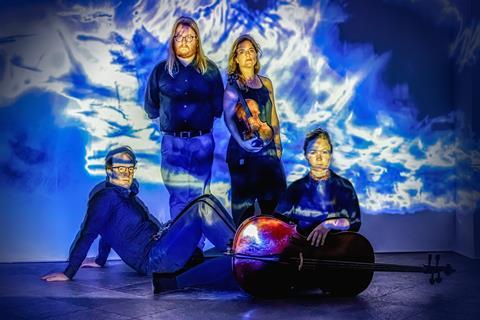
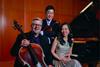
Formed in 2020 and rooted in New York City’s contemporary music community, the Anzû Quartet – violinist Olivia De Prato, cellist Ashley Bathgate, clarinetist Ken Thomson and pianist Karl Larson – places that instrumentation at the centre of its mission. Dedicated to the music of our time and the recent canon, the ensemble actively commissions and performs new works alongside Messiaen’s original masterpiece, treating the Quatuor as a living point of departure. Even the group’s name gestures towards the work’s symbolic world: in Babylonian and Sumerian mythology, Anzû is a fire- and water-breathing bird associated with both destruction and creation — an echo of the apocalyptic and redemptive imagery that courses through Messiaen’s score.
The Anzû’s new recording on Cantaloupe Music revisits the work through what its members describe as a modern lens, foregrounding rhythmic clarity and a close reading of the score while consciously setting aside interpretative habits that have accrued over decades. The release is accompanied by an analytical essay by Karl Larson and reflections from TASHI Quartet cellist Fred Sherry, drawing a line of lineage between ensembles formed around this rare configuration. A filmed realisation created with visual artist Xuan further extends the project’s scope.
Anzû’s Olivia De Prato and Karl Larson spoke with The Strad’s US correspondent Thomas May about balancing fidelity to Messiaen’s score with interpretative freedom and situating this landmark work within their contemporary musical practice.
You describe approaching Messiaen’s Quartet as a fixed ensemble, rather than as an ad hoc gathering of soloists – something that reflects the Anzû Quartet’s roots in contemporary performance practice. How did this fundamentally shape your rehearsal process and collective sound, particularly in a work so often treated as a sequence of individual ‘spotlight’ moments?
Karl Larson: I think the fundamental reason there are so many ad hoc performances of the Quatuor pour la fin du temps is that, while this work has certainly entered the standard repertoire pantheon, there is not a substantial body of other compositions for this instrumentation. Performers and audiences are drawn to Messiaen’s Quartet, but it’s difficult to build an ensemble around the instrumentation unless you’re committed to commissioning new work, which is the main thrust of our mission with the Anzû Quartet.
The fact that we are a set ensemble is advantageous for us because we know each other so well, both as musicians and as people. After years of playing together, we’re able to read one another’s musicality and gestures, and feel free and supported during our music-making. It’s also advantageous to be able to play the same piece many times with the same ensemble. We’re able to spend more time experimenting and honing our interpretation this way.
Your performance revisits Messiaen’s score as a primary source, deliberately setting aside interpretative traditions that have accrued over time. Were there specific passages where shedding inherited habits felt especially revelatory – or even risky – in performance?
Olivia De Prato: Every interpretation of any piece of music should use the score as the primary source, because it is! Not to fetishise it or worship it as some sort of sacred artefact, but as the honest initiation into the intentions of the composer. There are many beautiful renditions of this piece, and yes, some ways of playing it have become traditional over time. But music is a living art form. It happens when people perform the work in real time. If you are going to play a piece that has been played already, what else can you do but make it your own?
The sixth movement, Danse de la fureur, pour les sept trompettes, is often rendered with dramatic rubato and rhetorical pauses. Your decision to emphasise rhythmic exactitude and propulsion brings out a strikingly modern energy. How does your experience with post-war and contemporary repertoire inform this reading of Messiaen’s rhythmic language?
Olivia De Prato: Messiaen’s use of rhythm and metric modulations is one of the most striking and original aspects of his compositional style. Each of us individually, and together as a group, has played much contemporary music that is extremely rhythmic and driving, from minimalism to groove-based pieces. By emphasising the precise rhythmic energy inherent in the score itself, we highlight our own unique abilities as performers and help reveal how brilliant Messiaen is at writing rhythmically powerful music.
Karl’s booklet essay addresses the often-misunderstood meaning of the work’s title. From within the ensemble, how do you reconcile the piece’s theological and apocalyptic associations with the very physical, time-bound act of ensemble performance?
Olivia De Prato: Again, Messiaen does the work of reconciliation for us. As Karl writes, Messiaen wrote this piece before the full extent of the horrors of the Holocaust and the atomic bomb were known. It feels as though he took the opportunity to pour his whole self into this composition as a refuge from the war raging all around him, and seamlessly transformed his religious ideas into symbolic aspects of his harmonic and rhythmic language.
Messiaen is one of only a handful of 20th-century composers who has an instantly recognisable sound, yet describing it in words is very technical. By executing the score with precision and clarity, the listener clearly perceives this timeless, ultra-dramatic quality. Yet because this is a purely instrumental piece, the listener can easily take these qualities and create their own emotional connection to them, just as we do as interpreters. It’s a beautiful synthesis of spirituality and musical effect.
The inclusion of reflections by Fred Sherry of the TASHI Quartet in the booklet draws a powerful historical line between two ensembles formed around this singular instrumentation. In what ways do you see your recording conversing with – or consciously diverging from – earlier benchmark interpretations, including TASHI’s own?
Karl Larson: It’s really special for us to have Fred involved with this album. He’s really a primary source for this piece, and it’s fascinating to read about his experience working on the Quartet with Messiaen (with Tōru Takemitsu in the background!).
I think our recording is in dialogue with all the past recordings of this work. It’s interesting to record a piece that’s already been recorded by groups in the past, and it really feels more as though we’re joining a lineage. Every group that records this (or any other) work will be its own unique conduit for the music, informed by its background, tastes and musical diet. Each individual in the Anzû Quartet specialises in contemporary classical music, and our interpretation of Messiaen’s Quartet is informed by our own practices and experiences within modern music.
For us, this is the oldest piece in our repertoire, and we see it as a kind of forebear of the contemporary music we play today. We interpret the music through a modern lens, which naturally results in a different performance from that of an ensemble more steeped in older music, for whom the Quatuor pour la fin du temps may be among the newest pieces in their repertoire.
The filmed realisation of the complete work, created with new media/visual artist Xuan, offers listeners another point of entry into the work. How did the presence of a visual dimension affect your sense of pacing, atmosphere or narrative across the eight movements?
Karl Larson: We love performing the Quartet alongside Xuan’s artwork! I wouldn’t say the visual element affects our interpretation of the piece, but it does elevate the experience for the audience. The Quartet is such an expressive piece, and Xuan’s work helps to accentuate the emotional content of the music. During her creative process, we had many conversations about our shared experience of each movement, talking about gesture, mood, colour, etc. Xuan is a really gifted pianist and has also performed the Quatuor pour la fin du temps, so we were thrilled to be able to collaborate with her.
Watch: Anzû Quartet performs Ken Thomson’s ‘Uneasy’
Read: Messiaen: Quatuor pour la fin du temps; Krakauer: Akoka; Socalled: Meanwhile…
Discover more Featured Stories like this in The Strad Playing Hub








No comments yet