





Contrary to the extremes of opinion in music – loud versus soft, technique versus expression, major versus minor – violinist Hector Scott explores how meaning can be found in the tension between these dichotomies
Read more Featured Stories like this in The Strad Playing Hub
The first chord of Bach’s Allemanda in his D minor Partita BWV 1004 does not announce itself as tragedy. It does not need to. Its gravity gathers the listener. D minor is often spoken about as a mood that is dark, pained with grief and introspective, but this is a convenient shorthand, a kind of musical symbol. What matters more is the sense of inevitability that it carries, the way it feels like standing in a room where something has already happened or is about to happen. The sound of the dramatic opening ‘D’ does not explain itself, it asks you to listen. And perhaps this is where meaning begins, not in definition, but in the personal invitation to commune emotionally within the expressive world of the composer.
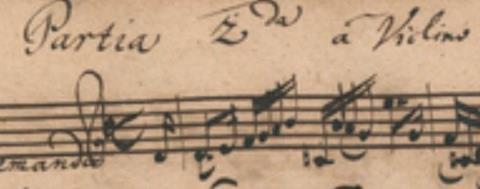
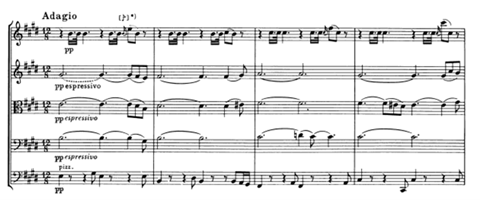
Take the D minor chord and tilt it just slightly. Bach does not collapse into abstraction with a Diminished 7th chord but rather moves the perspective to a Dominant minor 9th with a C# in the bass (A, C#, E, G, B) and rising on the 4th beat to an ‘E’ that is open, porous in its questioning quality. The chord breathes differently. It is no longer only sorrow or severity as it contains ambiguity, a reaching beyond itself. This is not the negation of D minor, but its shadow. Proof that opposites in music rarely exist as clean binaries. Minor already contains the possibility of major. Darkness implies light not as contrast, but as presence, felt even when unseen. Schubert explores this the other way in his Adagio from the String Quintet in C major, op. 163, D.956.
This idea, that meaning arises not from fixed categories but from the space between them, feels increasingly urgent when we look at how Western musical performance has been shaped over the last century. At the turn of the 20th century, something subtle but irreversible happened to music. Sound became a historical document and a definitive monument with the advent of recording.
Before this time, music lived primarily in bodies and in rooms. It was fleeting, negotiated in real time between composer, performer, and listener. A score was not a prescription but a suggestion, a set of landmarks rather than a map. Improvisation was not a genre but rather, a way of being musical. Composers performed and performers composed. The boundaries were permeable.
The advent of recording changed this ecology. Suddenly, an interpretation could be fixed, replayed, canonised. A performance could outlive the performer and what had once been a living exchange began to harden into a fixed form. For composers, this presented both an opportunity and a threat. On one hand, recording promised a fidelity that said, this is how my piece should sound. On the other, it exposed the terrifying variability of interpretation. In response, composers increasingly sought control through more detailed notation, stricter tempo markings, exhaustive dynamic instructions. The score became a site of authority rather than dialogue.
This tightening coincided with another major shift through the emergence of music conservatoires in the late 19th and early 20th centuries. These institutions formalised musical training, but they also accelerated specialisation. One became a composer or a performer or an improviser. The older, integrated model of musicianship where technique, imagination, and lived experience were inseparable, began to fragment.
Uniformity crept in quietly, under the guise of excellence.
In many conservatoire traditions, technique came to be treated as a foundation that was neutral, objective, and universal. First you master technique; then you make music. This logic feels sensible until you notice how rarely technique is questioned, contextualised, or personalised. It is passed down like an heirloom. My teacher taught me this, so I dutifully teach it to you. But technique is never neutral. A fingering choice, a bow stroke, a breath; all of these carry aesthetic assumptions, historical biases, and cultural values. To present them as fixed truths is to quietly strip students of agency.
Dynamics are a perfect example. From the earliest lessons, students are taught that ‘piano’ means soft and ‘forte’ means loud. On the surface, this is harmless. But it can quickly become absurd, like seasoning a soup before tasting it, convinced that flavour is something added from the outside rather than discovered within. What if ‘piano’ and ‘forte’ are not instructions, but invitations? What if dynamics are not levels, but energies? To play dynamically is not merely to vary volume, but to engage with tension, weight, direction, and intention. When dynamics are understood as being dynamic, rather than obeying symbols, an entire world opens. The same is true of rhythm, articulation, tone. Technique, when divorced from meaning, becomes a cage. When reconnected to lived experience, it becomes a language.
When dynamics are understood as being dynamic, rather than obeying symbols, an entire world opens
This raises a question that sits uncomfortably in many pedagogical systems. Where does meaning come from?
Too often, meaning is treated as something external to the student, being located in the composer’s intentions, the historical period, or the ‘correct’ interpretation. The student’s role is to reproduce meaning accurately, not to generate it. However, meaning does not work that way in human experience. We do not understand the world by receiving it fully formed but rather we understand it by relating it to what we have lived. Music is no different.
This is why the creative imagination must be nurtured early. Scientific evidence suggests that the developmental arc of a child’s creative ability increases up to the age of twelve, occurring before technical competence emerges and self-consciousness calcifies into fear. Children are naturally experimental, not being aware of the concept of mistake until they are institutionalised around the age of 5. They improvise not to be original, but to make sense of sound, and they explore extremes, contradictions, and ambiguities without needing permission. When this impulse is suppressed in favour of correctness, something vital is lost. The child learns that music and learning are about compliance rather than curiosity. Later, we call this “lack of expression” and attempt to fix it with metaphors, when what was really needed was space.
The relationship between major and minor offers a powerful metaphor here. They are often framed as emotional opposites, i.e. happy versus sad, but this is a simplification bordering on myth. Major can be brutal. Minor can be tender. More importantly, each contains the other. To be in D minor is to feel the pull of its dominant, sub dominant or relative major in the same way that to stand in light is to know where the shadows fall. This is the logic of Yin and Yang. Not in opposition, but interdependence. Each side carries the seed of the other. Neither exists alone.
Why, then, do we so often live musically in the extremes of opinion? Why do we rush to define, categorise, and stabilise, rather than inhabit a place where tension is unresolved and meaning is still forming? Perhaps because this tension is uncomfortable as it resists certainty and asks us to listen more closely.
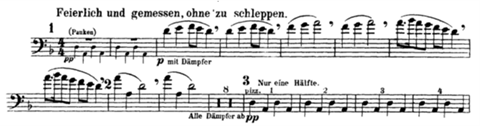
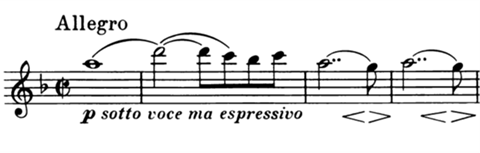
In performance, this middle place might look like resisting Mahler’s intention for the double bass solo to be played with a heavy, grotesque, broken sound in the third movement of his First Symphony. Similarly, violinists often play the opening of the Brahms Violin Sonata no.3 in D minor in a singing style that does not capture the ‘sotto voce’ or whispering sound quality which would allow ambiguity to speak.
In teaching, it might mean offering perspectives rather than prescriptions, trusting students to find resonance between the music and their own lived experience. If technique is a framework for meaning rather than a foundation beneath it, then the role of the teacher must change.
The teacher is not the guardian of truth, nor the final authority on interpretation. Instead, they are a guide who opens doors, offers tools, and asks challenging questions. Their task is not to replicate themselves in their students, but to help students discover their own musical narratives.
This requires humility as well as trust. Trust that students, when given space and perspective, will find meaning that is authentic rather than merely correct. A dynamic partnership replaces hierarchy and allows the exchange to become alive. The teacher brings experience and the student brings immediacy. Together, they negotiate meaning. This approach does not abandon rigour. On the contrary, it demands more of it. Technique becomes something you return to repeatedly, each time with deeper understanding. A scale is no longer an exercise, but virgin ground. A chord is no longer a label, but a question.
Returning, finally, to Bach in his D minor partita. What makes this music endure is not its perfection, but its openness. Beneath the counterpoint and structure is a profound generosity. Bach demonstrates a willingness for both performer and listener to hold multiple truths at once. Joy and sorrow are not opposites here; they are partners in conversation.
To play this music as if it has a single, correct meaning is to miss its invitation. Bach does not demand obedience; he demands presence.
Perhaps the real task of modern musicianship is not to recover some imagined authenticity of the past, but to reclaim what was lost in the rush toward control and uniformity. To explore with courage and to stand in uncertainty, to improvise meaning, to live in the middle place and enjoy the mysterious telos of our life.
Between D minor and its shadow. Between soft and loud. Between teacher and student. Between Yin and Yang.
This is where music breathes.
Read: In pursuit of meaning: why music matters
Read: Beyond the practice room: how musicians and music schools must evolve to thrive in a changing world
Read: Breaking the sounds of sameness: why music education must resist global uniformity
Read more Featured Stories like this in The Strad Playing Hub











No comments yet