


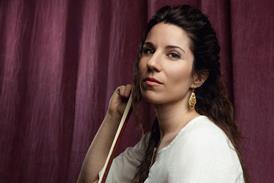


Anthony Arnone profiles Spanish‑American composer and cellist Andrea Casarrubios, tracing her journey from world‑class performer to one of today’s most sought‑after voices in string music
Read more Featured Stories like this in The Strad Playing Hub
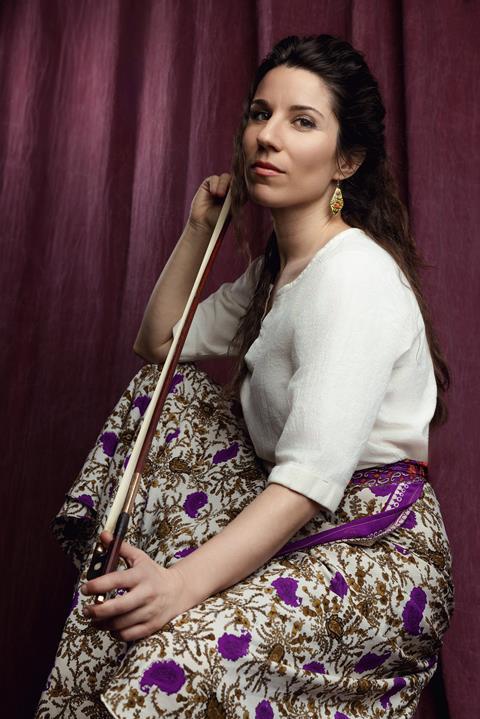
In the classical music world, it can often take years to find your ’voice’ on an instrument. But in the case of Spanish-American composer and cellist Andrea Casarrubios, discovering her voice took her from being a world class cellist to becoming one of the more sought-after composers in the string world.
In recent years, Casarrubios’ compositions have been programmed by organisations including Carnegie Hall, the Chicago Symphony, Indianapolis Symphony, and they have been broadcast on NPR and national radio stations around the world.
Recent works include Afilador, commissioned by the CSO, and Herencia for String Orchestra. The latter was premiered at Carnegie Hall’s Stern Auditorium in 2023 and featured on Sphinx Virtuosi’s 2025 album American Mirrors, released on Deutsche Grammophon.
But it was her acclaimed piece SEVEN, which was written in 2020 during the pandemic as a tribute to the essential workers, that brought her to a new level of recognition as a composer. SEVEN, which was nominated for a Grammy Award in 2025, has been performed in more than 36 countries and has already worked its way into becoming part of the standard repertoire for solo cello.
Her performance career is equally impressive, with recent performances at Carnegie Hall, Beijing’s National Center for the Performing Arts, and the Ravinia and Verbier Festivals.
Even as a very young musician, there were hints of where her musical life would take Casarrubios. She studied both cello and piano through her college years, but started composing and improvising on the piano for fun while still a child in her hometown of San Esteban del Valle in Spain. She started on the piano at age two and added the cello at age five, when her older brother, a violinist, convinced her to play the cello so they could play together.
Tragically, her brother died in a car accident a year later, and Casarrubios credits him for the reason she continued to play the cello. Her piano teacher, Maria Escribano, introduced her to improvisation, which sparked her interest in eventually composing. While learning music theory was also interesting to her, it was never a fulfilling way for her to approach writing music.
’Music theory was just a way to explain it. I still don’t like to think about the numbers.’
Improvisation became her safe space. While practising at home, Casarrubios would improvise on themes from pieces she was studying. The experience of improvising would give her a chance to reset and come back to her pieces with a different perspective and freedom.
’The process of writing has always been the space where I can process everything – my own life and the lives of others. It helps me transform, grow, dream, and release.’ She would often write down some sketches for herself, but it wasn’t until much later that she would perform completed works in public.
When Casarrubios was 18, she left Spain to study cello and piano at the Peabody Institute of the Johns Hopkins University. She then moved to Los Angeles, where she obtained a master’s degree in cello at University of Southern California. While studying in Los Angeles, she started playing more concerts nationally and would often include one of her own compositions at the end of recital programmes.
It became almost expected. ’That seemed to be a turning point for me, as people would hear my music and then ask if they could play it. Many pieces hadn’t been written down yet, so I had to get organized and start writing them down.’
The next few years brought Casarrubios’ first ’official’ commissions – about one piece a year. ’I honestly didn’t think at that point that I could have a career through composing.’ These first published pieces all involved the cello, with Casarrubios performing. Maktub (2013) was a small commission for three cellos that was asked for by the Festival Luigi Boccherini in Spain.
The following year, she wrote Caminante (2014) for cello and choir. One composition led to another. These pieces were often written for festivals where she was already performing, and Casarrubios would get paid a bit more to compose something as well. 24 Mozas (2017) for cello and piano, was written out of necessity. She was playing a programme of folk music and wanted to end with a piece by another composer, but the music wasn’t available.
’I decided it might just be easier to write my own piece rather than transcribing the other one.’ It wasn’t until 2018–2019 that she started to compose more consistently.
Then, in 2020, Casarrubios wrote SEVEN. It was the tipping point in her composing life. Not only has SEVEN been performed in over 36 countries (and is now taught at most conservatories in the US), but was also nominated for a Grammy Award following its release on the 2024 album of the same name, which featured Casarrubios as cellist and composer in seven of her most recent works.
Since then, Casarrubios has slowly but surely shifted her balance from performing to composing. However, this transformation has not been easy.
’If I didn’t have the commissions, I would not be writing the music. It takes a lot out of me. It’s like squeezing my soul.’ Casarrubios now has to reserve months out of her life to compose in the way the music deserves. That means she is playing fewer concerts.
She admits that performing and composing compliment each other. ’I learn so much about composing by playing with other people. Performing is a very different energy. It is an energy that I give to everyone else. Composing is completely solitary. My life is very extreme, but I love it.’
’I learn so much about composing by playing with other people’
Casarrubios credits many different teachers when she talks about her journey as a composer, though most of these don’t fit into what we might consider the traditional definition of ‘teacher’. Perhaps her biggest teacher has been her experience as a musician.
’Everything I have learnt about composition is through my playing career. Curiosity and patience are your main teachers. Listening to as much music as you can. Going to concerts. You learn what speaks to you and why it does. The biggest influences have been the people I have played with over the years. I learnt by “doing”. And composition has helped me become a better cellist. I can better understand the creative process by the composer.’
When she got to work with prominent American composer John Corigliano while getting her DMA at City University of New York in 2017-2018, he confirmed for Casarrubios that she had something worth saying. Corigliano would share his music and they would talk about their creative process.
’Above all, he gave me the confidence to write. He believed in my voice and my music. I think for me, that is what I needed at the time – to see that someone like him was 100 per cent behind what I was doing.’
As with every composer, the process of writing and finding one’s voice is unique. Does Casarrubios have a voice that is unique to her? ’I hope so, although every piece is different, but I don’t think of my earlier works as “early works”. I hear those pieces with my voice in them.’
Before she writes her first notes for a piece, Casarrubios does what she calls her ‘research’. She keeps a little notebook with her at all times and listens to every recording she can find for the person she is writing for. What is their sound like? What are the strengths in their playing? She is very interested in the people behind their instruments. Pieces can start anywhere. Ideas might come to her on an airplane, where she is far away from everyone, or they could come while listening to a concert she is attending.
Before writing Sonia (2023, cello and piano) in honor of Supreme Court Justice Sonia Sotomayor, she did a lot of reading. She read Sotomayor’s book, My Beloved World, in both English and Spanish.
’I wanted to get to the essence of her personality, discover the soul of who she is. She is a person with so much humanity, generosity, and strength. I wanted a sense of force and determination right from the beginning.’
Casarrubios tends to be at the piano when she composes, especially when she writes for cello and piano, and she will often sing while playing. She records longer improvisations, so she can be free to just play without the task of having to stop and notate her ideas.
’I think for that piece (Sonia), I started at the beginning, which is rare.’ Harmony is always the most important thing for her music. ’It is the seed from which everything blossoms. It’s almost like I have to find the center, and the columns and once I find that, I can work around it.’
There is always a very specific emotional goal for each section of a piece to help guide Casarrubios as she composes. The poignant chords at the end of Sonia were written while she was home in the countryside of Spain with her parents.
’Going home to Spain is always meaningful and has a different kind of silence. Everything just makes sense. It balances out the individualistic lifestyle we have in cities. I find it timeless and yearn for that simplicity.’
Casarrubios is most thankful for her parents, who have sacrificed so much for her. ’The amount of hardship they have gone through to allow me to pursue my dreams is so meaningful. Every value I have learned is from them without a doubt. It always gives me perspective being home, and I will forever remember finishing those last chords of Sonia with my dad sitting on the couch.’
It’s worth noting that the premiere of Sonia took place in Washington D.C., with Sotomayor in attendance. ’It was very moving for me, as I had heard her voice for many months, but never in person until the premiere. When I heard her speak in the same room, it gave me chills.’
How does Casarrubios know when she is done with a composition? Sometimes it’s immediate, but finishing can often be the hardest part.
’Sometimes I will think about the music before I go to bed, and then often things ”solve themselves” in my sleep. I will wake up, and in this haze, there is an idea.’
There is a point in the process where she always feels very stressed and something doesn’t feel right. She has learnt that, when that happens, it is a good sign. She is getting close to the finish line.
’Transitions are really important in any piece. Sometimes they don’t feel right and I know it. It’s a mix of instinct, a lot of listening, and lots of actual hard work to get it done. Sometimes if I listen closely, the music will guide me. Very much like life, you can’t force things, and that takes time to accept that.’
The journey from inspiration to a finished composition is an interesting one for Casarrubios. ’I always start writing by hand, and then I go to software, and then to my editor. My sketches can look extremely messy to anyone but me, but that’s because the sketches are maps for me to understand – and luckily I do. They are a space where I write thoughts down.
’Everything I hear in my head seems so clear, and I need to write it rather quickly. Therefore, it often looks incomplete and will have wrong rhythms or notes. That’s because I know which ones are the correct ones I meant to write. I don’t need the handwritten score to have everything perfectly set up, those are just details that I will write later on.’
Casarrubios will also often include very descriptive instructions in her scores. In Sonia, for example, she included the words ’resounding,’ ’listening, observant,’ ’blossom,’ ’generous,’ ’intimate,’ ’with courage,’ ’immense,’ ’patient, with perspective,’ and ’with gratitude.’ She writes these descriptive words to give inspiration and guidance to the performer.
She has also become more detailed about tempi and ritardandos. ’I write a lot of “circa” (approximately) for my metronome markings. The music should breathe.’ She finds that in general people play her music slower than it should be played.
’If you play my music too slowly, it lacks the purpose and direction. There is a linear aspect to music making. There is a lot of information on the page that is there for a reason. It’s so helpful for performers to get more information as they learn a piece. These things often don’t happen unless I write them in.’
Equally important to Casarrubios is the chance to guide people that are working on her music. She tries to offer coachings for performers who are playing her music whenever she has enough time.
’I have been fortunate to have heard many people, in recordings or videos, play my music for me to critique, which I think is critically important, since I am alive. What I write on the page, even if I try to be detailed, is not enough. And when I try to communicate it through sound in a coaching (in person or online), the change and understanding is immediate for whoever is playing.’
Casarrubios has recently taken on composing projects involving bigger ensembles. With the added challenge of more instruments comes the joy of getting to use more timberal colours in her composition.
One of the pieces she is most proud of is her Piano Quintet (2023). Before writing it, she found the idea quite challenging.
’I wanted the work to have four movements and for all four to feel necessary and to meet the level I always aspire to. I remember going through all the piano quintets I had played or knew about – both well known and lesser known – and spending a lot of time thinking about which parts or movements in each felt strong or weak to me, and why. I learned a great deal through that process. Eventually, I let all of that go while writing my own, but those early “research” listening sessions helped me develop a clearer sense of what I wanted – and what I did not want – to experience while listening to or playing the piece.’
Her works for full orchestra are also on the rise, with the recent commission of two new cello concerti; one was commissioned for Amit Peled and the other for Gregorio Nieto. Her first cello concerto, MIRAGE (2025), was one of the few compositions that Casarrubios revised after a first performance.
’I wrote a completely new third movement in 2024, and changed the second half of the fourth movement in 2025. That’s the version I played with the Charlotte Symphony Orchestra in 2025. I did this, because I wasn’t happy with the way it was before. Usually, I don’t heavily revise my own pieces, because I often feel like the final version is ready when I deliver the score.
’This concerto, however, was the one work that kept changing with me, for the past few years, as a mirror of my life perhaps. It was an uncomfortable feeling, and although I welcome feeling uncomfortable, it was in the back of my mind at all times to revise it. I have written many endings to it and I really hope this is the last one.’
She is also very interested in exploring even bigger forms, including opera. ’I am certainly interested in writing an opera. I have always thought that if I write one it will have to be about a relevant topic and I will certainly need to reserve a lot of time for it. All I can say right now is that an opera is on my radar!’
In the meantime, Casarrubios will continue to write her music and share her voice and love of what she does. I think what motivates her says a lot about the kind of person she is:
’The people who care are what motivates me: the performers and listeners who genuinely want more of my music. The process of writing has always been the space where I can process everything – my own life and the lives of others. It helps me transform, grow, dream, and release. I like to think that some of my music can hold space for reflection, or offer a sense of freedom to those who want to listen to themselves through it, using it almost as a mirror. And I have finally come to learn that my voice matters.’











No comments yet