







Spanning composers from Hildegard von Bingen to Jessie Montgomery, the Brompton Quartet’s debut album explores how women’s voices resonate across nearly one thousand years of music making
Read more Featured Stories like this in The Strad Playing Hub
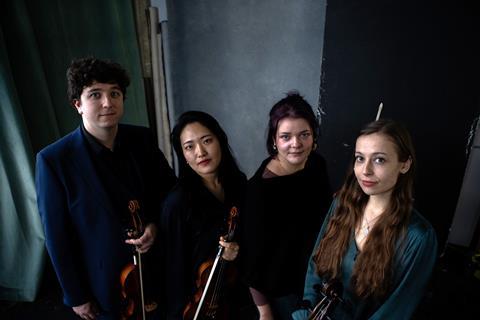
On 6 March, the Brompton Quartet releases its album, Constellations, on Platoon. The album traces a musical journey through almost a millennium of music by six female composers – Hildegard von Bingen, Jessie Montgomery, Dobrinka Tabakova, Grażyna Bacewicz, Barbara Strozzi and Isidora Žebeljan.
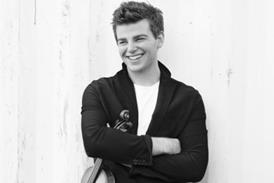
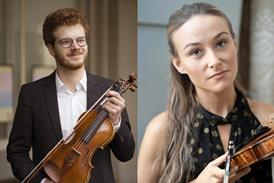
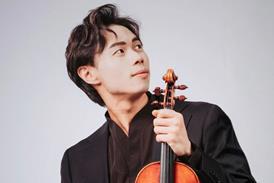
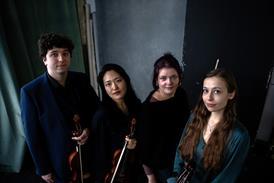
Constellations marks the debut recording for the quartet – comprising violinists Maja Horvat and Mee-Hyun Esther Park, violist Edward Keenan and cellist Wallis Power – which formed at the Royal College of Music in 2017, going on to win the 2019 St Martin-in-the-Fields Chamber Music Competition and being chosen as a Park Lane Group Artist in 2020.
The members of the Brompton Quartet chat with The Strad about the connections between these chosen works that highlight women’s artistry through the ages, and how platforming these voices invites listeners to explore repertoire beyond the familiar string quartet canon.
Your album treats the repertoire like a gallery, inviting listeners to make connections across centuries. How did you decide which works belonged in this ‘constellation,’ and what guided your sense of which pieces would speak to each other?
Wallis Power, cellist: Constellations is our debut album, so we wanted the repertoire to partly reflect our journey as a quartet since forming in 2017, and also to bring a wide range of styles and voices into dialogue with one another.
The six pieces on our album speak to one another in the way stars form a constellation – separate, yet connected. Each one is self contained, but together they tell a larger story of women in music.
Grażyna Bacewicz’s String Quartet No.3 is a work we’ve lived with for several years and have returned to often in concert. We admire the composer’s bold, virtuosic voice and would encourage listeners to explore her wider output, especially the other six quartets. Maja introduced Isidora Žebeljan’s Dark Velvet to the group and we were immediately captivated by its immersive harmonic language.
Other favourite discoveries made their way into the mix – we were drawn to the filmic, folk-inflected colours of Dobrinka Tabakova’s The Smile of the Flamboyant Wings and to the driving, rhythmic energy of Jessie Montgomery’s Strum.
Alongside these are reimagined works from the 12th and 17th centuries, opening doors into entirely different worlds and traditions. We purposely chose not to order the pieces chronologically. Instead, we wanted the centuries between works to dissolve into one another or collide.
Each work demands a distinct playing style – from Hildegard von Bingen’s meditative simplicity to Montgomery’s percussive pizzicato in Strum. How did you approach adapting your technique for each piece, and what did those shifts reveal to you about the music?
Maja Horvat, violin: Moving between these pieces felt a bit like changing languages while staying in the same conversation. With Bingen’s O Virtus Sapientiae, we stripped everything back – lighter bow, slower or no vibrato, really focusing on the purity of line. It’s deceptively simple music, folky in a way, so any excess feels intrusive. The challenge was to let it breathe and trust the stillness.
Then jumping into Montgomery’s Strum was like plugging into an electrical socket. The pizzicato and rhythmic drive demanded a much more physical approach – closer to the bridge, more bite, really embracing the feeling of ’being cool and edgy’. It reminded me how string instruments can be rhythmic engines as much as lyrical voices.
With Tabakova and Žebeljan, colour became everything – experimenting with contact point and weight to find those shifting shades. Barbara Strozzi asked for a more vocal sensibility, shaping phrases as if singing text. And Bacewicz brought a kind of steely clarity and precision. There are lots of brilliant and very comfortably written technical tricks which are very satisfying to play!
Adapting like this revealed how technique isn’t separate from expression – it’s the doorway into each composer’s world.
You’ve assembled nearly a millennium of music by women. Did placing these composers side‑by‑side change the way you understand their contributions, and what do you hope listeners learn about the continuity of women’s artistry?
Edward Keenan, viola: Combining the music of women composers through history has been a clarifying process. We often think of figures such as Hildegard von Bingen, Barbara Strozzi or Grażyna Bacewicz as exceptional presences in their eras. Working on this album has shifted that perception for me. Heard together, they feel less like isolated anomalies, and more like part of a long lineage.
What is striking is not the vastly different contexts in which they worked but the consistency of imagination. You can hear the influence of religion and spiritual experience through Bingen; followed by the more provocatively secular music of Strozzi (radical in 17th-century Venice); through to the 20th century with Bacewicz, who wrote her third quartet in 1947 Paris, in a Europe coming to terms with the devastation of the Second World War.
The circumstances change dramatically, but the creative ambition does not. This becomes even more tangible in our album when historical voices sit alongside contemporary composers such as Jessie Montgomery, Dobrinka Tabakova, and Isidora Žebeljan. Each composer speaks in an entirely individual voice, yet together they form a conversation across centuries.
I hope listeners come away with a sense of continuity. Women’s artistry in classical music is not a recent addition to the canon; it has always been present. By placing these voices in dialogue, we are not constructing a narrative – we are revealing one.
This album positions you not just as performers but as curators, storytellers and archivists. As your debut album, how has Constellations shaped your identity as an ensemble - and does it point toward future projects exploring unconventional or overlooked repertoire?
Mee-Hyun Esther Park, violin: We were fortunate that for our debut recording, we were given a brief that was both focused and liberating at the same time: to create a programme exclusively of works by women. That openness allowed us to think not only as performers, but as curators – considering how these voices might speak to one another across time, geography and their aesthetic language.
As a quartet, our journey has always balanced deep engagement with the core string quartet repertoire – the architectural brilliance of Haydn, the emotional and structural daringness of Beethoven – with an equally strong commitment to the music of our own time.
Collaborating with living composers, including premiering and recording new works such as those by Angela Slater and Anibal Vidal, has shaped our understanding of the string quartet as a living, evolving medium rather than a fixed historical form.
Creating this album affirmed for us that the quartet literature, and the world of music, is far more expansive than the traditional narrative suggests, and that there are extraordinary works still waiting to be heard. We hope to continue amplifying voices that deserve a wider platform.
Above all, we hope Constellations invites listeners into a space of curiosity – encouraging them, as it has encouraged us, to look beyond the familiar and discover the richness that lies just outside the established constellation.
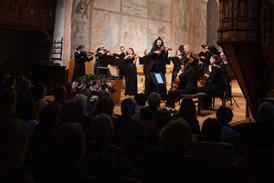
Constellations is released on Platoon on 6 March. The Brompton Quartet will perform in a launch concert at St Pancras Clock Tower, London, marking International Women’s Day on 8 March.










No comments yet