
![[defs use this] CelebrationByDAddario_388 pc Denny Medley Random Photography](https://dnan0fzjxntrj.cloudfront.net/Pictures/274x183/5/0/9/43509_defsusethiscelebrationbydaddario_388pcdennymedleyrandomphotography_776141_crop.jpg)




This 2025-26 season marks a personal milestone I wanted to honour in two ways.
In September, I became a tenured member of the Vienna Philharmonic, the first Asian American woman in its 183-year history. From my earliest days as an Academist in 2019, I felt a deep connection to the way music is made here, the particular weight and warmth of the orchestra’s sound, shaped over generations. The album, Wiener Violinsonaten, is my response to that sound, recorded through Mozart, Schubert, and Brahms, three composers whose names are inseparable from Vienna’s musical history.
I also wanted to honour the other institution at the centre of my Viennese life: the State Opera. I had trained as a soloist at Juilliard before moving to Vienna and pivoting to orchestral life, and I wanted to create something that brought those two worlds together, utilising a piece that spoke to both my solo training and my life inside an opera house.
Carmen felt inevitable. It is one of the great staples of the operatic repertoire, and the Carmen Fantasie Brillante is one of the great staples of the violin showpiece tradition. I chose Jenő Hubay’s transcription specifically for its connection to the Austro-Hungarian musical world: he premiered Brahms’s D minor Violin Sonata, one of the very works on my album. Ultimately, the deciding factor was musical: the piece opens with the Don José theme, a dramatic declaration that felt right for what I wanted to say visually as well as sonically.
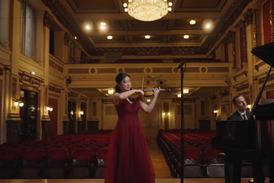
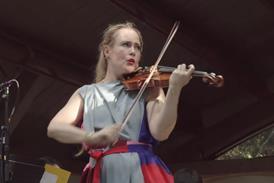
That theatrical opening shaped my visual concept. My decision to film it came more instinctively than deliberately: I knew the piece’s drama would translate visually, and I’m also aware of how people listen to music now, as video has become part of how music reaches an audience. But the sound remains the foundation. The camera doesn’t replace it and instead gives people another way in: a red dress, a real theatre, music that is being performed rather than simply played.
Vienna made the choice of location easy. The city is extraordinary for how many of these Palais still survive, each carrying its own layered history. As artistic director of the project, I wanted the setting to function as more than backdrop: Palais Ehrbar became a second performer in the frame, its rooms carrying the same weight of history as the music itself. Working with the Sohot production team, we built a visual language around that idea: the red dress against the gold and red of the hall, the performance inhabiting the space rather than simply being filmed in it.
This is the first chapter of what I hope will become an ongoing series: filming more works transcribed for violin and piano, each set against the backdrop of a different Viennese Palais. I want to keep building a visual record of this repertoire and this city together, performing music that has always lived between the concert hall and the opera house, captured in the rooms that have witnessed both.







No comments yet