





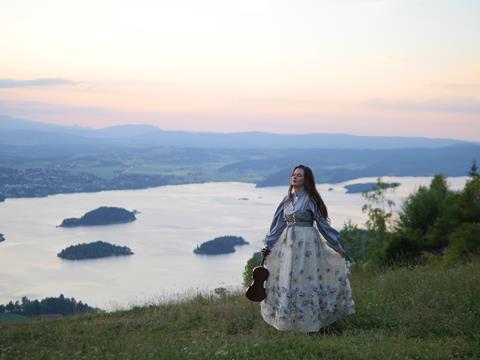
From a childhood lullaby to the concert stage, the violinist-composer performs her own works, transforming personal grief into a shared musical experience
Discover more Featured Stories like this in The Strad Playing Hub
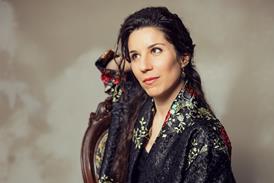
I could say this project, the most personal of my career, started about four years ago when I began recording my compositions with the Norwegian Radio Orchestra. But it actually began when I was a child.
One time, on a visit to the Norwegian countryside, I found – tucked in the sheet music of exercises for a beginning violinist in my childhood bedroom – a single piece of paper. On it, I had written a piece to play and sing for my little brothers. I titled it ‘Vuggesang for sol, måne og stjerne’ or ‘Lullaby for sun, moon, and star.’ On the bottom I signed it, in blue ink, ‘Helena, seven years old.’
Now having performed on major stages, across three continents and in scores of cities, I began to hum the innocent melody of a child. And I was surprised to hear that it bore the same qualities and emotions that inform my current work. I decided at once I would return to it and bring it to a full orchestra.
Which I’ve done. It’s called Berceuse and it opens my album Nordic Lullabies. I love drawing a line between my artistic preoccupations as a composer and violinist and the pure instincts of a child. I’ve always written lullabies for people I love, trying not just to soothe them but to capture their essence – even what their soul sounds like. I love how the simple form of a lullaby can grow into something complex, layered and contemporary.
I have always been fascinated by how the great composers performed their own music – Bach at the organ and harpsichord in Leipzig; Mozart at the piano in Vienna; Paganini on the violin in Milan.
As a kid I daydreamed about performing my own pieces in cities like Vienna, Berlin or New York City – just like my musical heroes. But unlike previous centuries, where composers were embedded in the performance ecosystem and publications were limited, today’s classical field tends to segregate composition and performance. Each are distinct professional tracks. And orchestras tend to privilege interpretation of established works over composer-led performance.
As classical musicians we’re taught to play other people’s compositions which – don’t get me wrong – is always an honour. But for me there’s a quality of vulnerability and connection to play my own work before an audience. As a composer playing live, I really feel them responding and interacting with what I’ve made. There’s a reason why this tradition stays alive in jazz and pop and, along with many of my colleagues, I feel committed to exploring it in my own tradition. For me releasing my music is quite vulnerable, but performing it adds even another layer. It really feels like opening the hidden parts of my soul and then, somehow, it’s not only mine anymore, not exactly, but a shared experience in the room.
This album was born from the darkest time in my life – losing my little brother, and the unbearable grief that followed. His loss changed me like nothing else ever had and my life has never returned to normal. I decided to dedicate the album to him, and to try to create something beautiful out of the pain. I look at it like a transformation of energy. For me, composing is like crying – you feel better afterwards.
Every piece on the album has a story connected to that journey from darkness toward hope, born from these lullabies I created for my loved ones. Perhaps the most important piece on the album is Fragments – the only solo piece without orchestra, and a raw account of the years surrounding my brother’s passing. It began as an assignment from my therapist. Talking about what happened was too difficult, so they suggested I compose about it instead.
Fragments was created over a year of difficult writing and improvising on the violin. I wanted it to be technically demanding and sometimes painful to play – just as that time was. It is built on the form of the golden ratio, and you can hear near the end a glimpse of hope: a turn from minor to major, from darkness toward light, before the darkness returns.
The final piece, ‘Håp’ – ‘Hope’ in Norwegian – is meant to give comfort to anyone going through loss or difficult times. I know many of you can relate to that often confusing feeling of light at the end of the tunnel, after years of grief. When the Sterling Ensemble choir enters at the end, it represents exactly that – the first light. That’s also how I end my album.
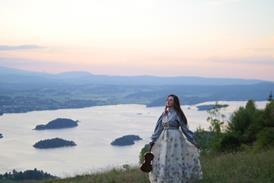
Throughout the album I also try to capture the sound of where I come from – Norway’s wild, contrasting nature, the darkness and cold before the midnight sun.
This album is dedicated to my brother, and to everyone who has loved and lost. I hope it gives you somewhere to put what is hard to say.
And to the young musicians reading this: I know how difficult and risky it feels to create something from the deepest part of yourself and offer it to the world. I think it’s the most important form of artistic courage. Your art matters, your playing matters, and the world needs it. Music is one of the few things that still connects us, in body and soul. That has always been true.
Read: How violinists can integrate composition into their practice: Helena Maria Falk
Read: ‘Grief isn’t clean or perfectly in tune, it has rough edges’: cellist Tamar Sagiv on her new album
Discover more Featured Stories like this in The Strad Playing Hub







No comments yet