

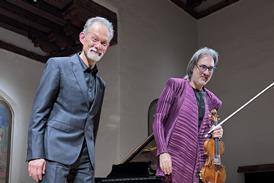




Ahead of a Fringe Preview show, violinist Rita Fernandes breaks down how her classical training and the sonic possibilities of string instruments inform the comedy improv show she’s bringing to the 2026 Edinburgh Fringe Festival
Read more Featured Stories like this in The Strad Playing Hub
’Comedy’ and ‘improv’ are all but synonymous with the Edinburgh Fringe Festival – ‘classical music’ and ‘string instruments’ not so much.
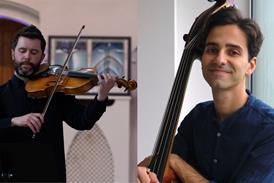
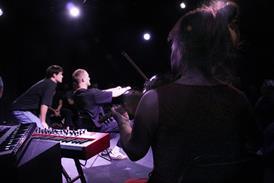
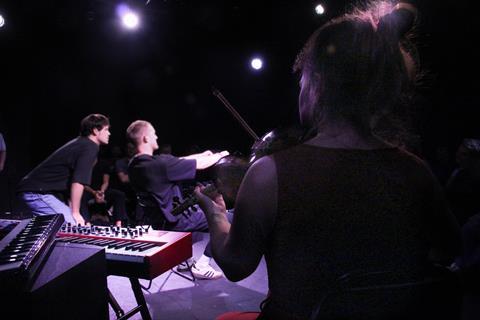
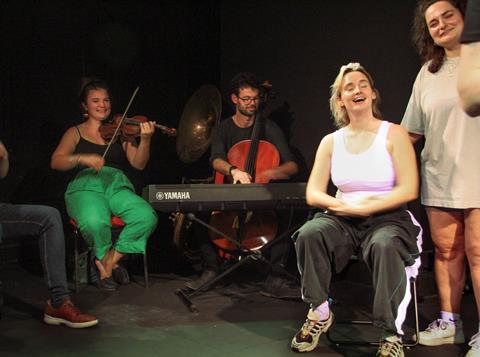
For over three years now, I’ve been part of the comedy improv group Dream Machine, a team of actors and musicians (myself on violin and Sam Whitby on cello and piano) that improvise long-form comedic plays based on one audience member’s dream. Sam and myself improvise a real-time ‘soundtrack’ to what the actors are themselves improvising. As we refine our show in advance of our Edinburgh Fringe run, I’ve been reflecting on how much my and Sam’s musical approach to the show has evolved. Yet one thing has remained integral to this far-from-traditional act: our classical training.
At the mercy of our incredibly creative actors’ whims, these plays can be set virtually anywhere and contain just about any theme or character. One show included a shark couple working through their divorce in the frozen aisle of a supermarket on Mars. For that reason, we need to have every type of musical genre and sound effect ready to go at a moment’s notice. It would be impossible to be experts in every style, so it takes a process of abstraction and analysis (much of which has been done in rehearsals outside of the show) to make it work. What really makes something sound like a Irish folk song, without it being one that already exists? What melodies immediately evoke a Floridian beach? And more fundamentally: What makes a melody sound plausible? Why does this harmony sound melancholic?
To answer these questions and create the sounds that most meaningfully enhance the drama onstage, we must draw on all the theoretical, technical and even historical classical training we’ve had. We must also take full advantage of the wonderful range, timbre and sounds the violin–cello formation offers. Here’s a taster of how it all works.
‘Classical’ music in improv
The minority of what we play actually sounds like ‘classical music’. And even if we do, it will mostly be non-diagetic (not playing within the scene itself), and used to amplify or comment on the scene’s emotions. For example, lush Tchaikovsky-like harmonies could accompany the culmination of a love story, even if the scene is set in a Berlin nightclub. This is not disimilar to how movie scoring works. After all, even though John Williams composes using classical music fundamentals, Harry Potter doesn’t take place in Carnegie Hall.
And yet the principles we learnt in our classical training are present in almost all the music we play, regardless of style. By deconstructing and examining concepts such as counterpoint, melody, phrase structure and harmony, we can then reconstruct them to fit whatever is happening on stage. Here are just two examples.
Counterpoint
We love playing two intertwining, equal lines between the violin and cello. Stripped of harmonic and structural pillars upon which to depend, these meandering lines can easily mould themselves to what is happening on stage. Because there are only two voices, each holds immense power over the direction of the line. Even just a semi-tone change in one instrument can change the mood dramatically. If, say, the violin goes from E to F while the cello plays a C, you’ve gone from a jovial major third to an unsettling tritone in under a second.
This stripped back accompaniment also reduces information overload for the audience. As long as we stick to the essence of, say, a perfect cadence (for example in C major, one instrument going from B to C and the other F to E), we are giving as much information as we would with full chords, while not overpowering the actors.
Melody
When a full melody is warranted, it is a great ‘cheat’ to use the basics of Classical (large C) melodies, mostly because of how simple they are. If we take a basic four-bar melody, we can subdivide it into two groups of two bars. The first group will end with some sort of question, while the second will feel finalised. Another feature is some kind of repeated motif, maybe a rising third. It makes the melody feel more plausible and less improvised.
These concrete rules are very comforting within the void of free improvisation. And even if the melody is more dissonant than a Classical one, just the knowledge that a repeated rhythmic motif will help create a genuine sense of melody is helpful to grab onto. It’s just one less thing to conjure up from thin air.
The violin–cello duo: made for improv
Range
A violin–cello formation’s range goes from the cello’s low C open string to infinite violin screeching. This gives you endless possibilties in terms of voicing; even with the same melody, it will feel and mean something different if the violin or cello is playing it.
This range is also useful for accompanying actors. Human speech falls somewhere around the mid range of the cello or bottom range of the violin (roughly from the cello’s open G string up to middle C). This large range means you have options outside these notes to avoid muddling with the actors’ voices.
In moments where the music is centre stage (maybe during a scene change) this middle range is an asset, and in my opinion one of the most beautiful ranges for the two instruments. It’s where they meld seamlessly to create a rich and harmonised sound. It presents the audience, who may not usually listen to these instruments, with the unique expressiveness of strings.
Timbre
The manipulation of bow speed, pressure and placement gives you extroardinary timbral options. In both being string instruments, the violin and cello can easily mix to create a unified timbre and voice. But given their obvious differences – range, size and so on – contrasting timbres can also be created. In the same way a slight change in an actor’s expression can change the scene’s mood, so can the slight twisting of the bow.
Effects
At the end of the day, we are not just creating a musical soundtrack, but organising sounds. And that includes sound effects – something strings are particularly versatile at. A knock on your violin mimics a knock at the door or an overly-pressured glissando creates a sense of unease. A particular effect I like is placing the middle of the bow on the string, putting extreme pressure so that the stick of the bow touches the string, and then twisting the bow away from you, creating a crunching sound. It sounds exactly like someone walking over leaves in a forest. We can’t create every sound on Earth, but it is just another way we can help to create the most convincing world possible for the audience.
The Dream Machine’s London preview will take place on 24 July and its Edinburgh Fringe run from 22-29 August at the Pleasance Courtyard









No comments yet