









As Lotte Reiniger’s pioneering 1926 animated feature The Adventures of Prince Achmed celebrates its centenary, violist and composer Hugo Max explores the challenges of creating a live soundtrack for modern audiences

Discover more Featured Stories like this in The Strad Playing Hub
Decades before Disney’s Fantasia (1940), German animation pioneer Lotte Reiniger (1899-1981) realised a number of films in her signature silhouette style that visualised narratives drawn from musical compositions. Often employing the work of composers renowned for their operas, including Bizet’s music in Carmen (1933), Mozart in Papageno (1935) and Offenbach in Helen La Belle (1957), Reiniger also highlighted the influence of ballet in her approach to filmmaking and the precise movements of her characters.
This year marks the centenary of Reiniger’s only feature-length film, The Adventures of Prince Achmed (1926), a sweeping amalgamation of tales from the Arabian Nights.The BFI Southbank commissioned me to create a new soundtrack with my regular instrumentation of solo viola and percussion for a screening this summer. While I have previously elucidated my process of scoring silent cinema, devising the soundtrack for Prince Achmed proved especially challenging in light of Reiniger’s unique relationship with music and the complex nature of her storytelling style.
An original orchestral soundtrack by Wolfgang Zeller survives, meticulously composed in collaboration with Reiniger. The manuscript was annotated with illustrated frames from the film to aid synchronisation between music and movement. Nevertheless, it is customary to present Prince Achmed with live contemporary music. The film draws on a selection of well known tales from the 1001 Nights including Aladdin and The Ebony Horse. Music-making revitalises these stories for new generations of viewers. Usually branded a ‘children’s film’, the live score experience offers a suitable introduction to the cinema and concert hall for the young and uninitiated. Reiniger also noted that her operatic films allowed first-time concertgoers an entry point to understand and enjoy classical music.
Eastern traditions of shadow puppetry fascinated Reiniger. Her exotic portrayal of Baghdad and China in Prince Achmed is steeped in Orientalism while originating from a place of affection for her source material. Contemporary musicians have reframed the film by offering an alternative to Zeller’s Western Classical symphonic textures, for instance Bill Ware’s effective incorporation of a gimbri within an intimate chamber ensemble and The Khoury Project’s striking synthesis of Turkish and Middle Eastern music, jazz and flamenco in their score.
Full of fearful and frenzied gestures from the viola, my soundtrack offers a darker reading of Prince Achmed, acknowledging that the Expressionist movement reached maturity as Reiniger began cutting out her silhouette figures. At the beginning of her career she was taken under the wing of towering German filmmaker Paul Wegener who would utilise the trick effects of early cinema within a narrative context to make some of the most popular Expressionist films.
My trusted diet of Second Viennese School composers felt like an appropriate language
Reiniger’s silhouette method distills a similar command of shadows visible in his films and works such as Robert Wiene’s The Cabinet of Dr Caligari (1920). My trusted diet of Second Viennese School composers felt like an appropriate language with which to unpick the grotesque and erotic images usually brushed over in this ‘family film’. Dissonant harmonies informed by serialist compositional techniques illustrate the distance between the creative landscape of the film’s conception and the romanticised locations depicted on screen.
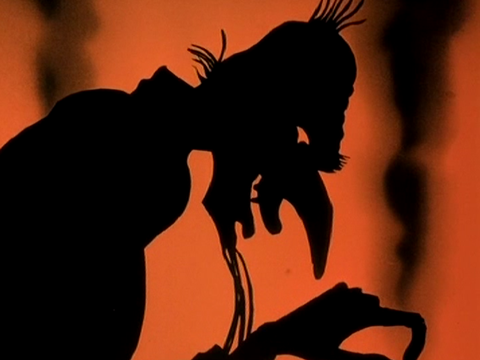
Reiniger opens Prince Achmed by introducing the audience to each of her six protagonists/antagonists; a welcome opportunity to announce musical motifs that will populate the score. I approached these archetypal characters as sets of doppelgängers: the heroes Prince Achmed and Aladdin, damsels Dinazarde and Peri Banu, the magical Witch and Sorcerer. Each is embodied in a short melody that is inverted for their symbolic double, interwoven throughout the film in the manner of Scheherazade’s stories. Amid these motifs are disguised quotes from Rimsky-Korsakov and Ravel’s evocations of the Arabian Nights, subverted via the solitude of the viola.
In many of the Expressionist films that I have soundtracked, tension builds towards a moment of explosive drama after which a lassitude of dreamlike strangeness prevails. There are few subdued episodes in Reiniger’s feature. After our eponymous hero sets off on the magic horse, danger escalates towards a battle at the film’s mid-point that continues incessantly until the final curtain.
Despite being one of the shortest films I have accompanied, lasting only an hour, the virtuosic characterisation of Reiniger’s puppets demands the utmost concentration in every frame, carefully pacing musical ideas throughout. This score necessitated an intense scrutiny in the practice room of my motifs and their possible iterations. While my eventual improvisation might be a more visceral interpretation of Prince Achmed than often performed, the leitmotivic structure acts as a guide for the audience throughout the exhilarating adventure.
It might sound implausible to accompany an epic with only the viola to hand. I find that there is a productive dissonance between this string instrument and Reiniger’s stringless puppets brought to life via the magic of stop-motion animation. Observing footage of Reiniger crafting her cutouts was a key inspiration for my soundtrack, the rhythm of her cutting and the detail of her figures informing musical phrases and effects; lyrical passages juxtaposed with soaring harmonics to mimic the arc of her scissors.
The viola’s chameleonic responsibility within the string family not only facilitates empathy with the film’s protagonists but captures the fervour of Reiniger’s creative process. When scoring silent film, the accompanist must remain in complete service of narrative events. I think that it is also our responsibility to get under the skin of the filmmaker’s method and explore their intentions, to materialise the act of film-making in the present through music-making.
I’m delighted to be accompanying the prince on his upcoming adventures at London’s Prince Charles Cinema, Southampton’s Turner Sims, Tywyn’s Magic Lantern Cinema and Clevedon’s Curzon as part of my fifth UK-wide tour this October-November, allowing the soundtrack to transform at each iteration.
Book Tickets: hugomax.co.uk/scoring-silent-cinema
With thanks to Tashi Petter, Reiniger scholar and curator of 100 Years of Prince Achmed .
Read: Thriller night: improvising scores for silent cinema on the viola
Read: Opinion: Theatre improv games in teacher training
Discover more Featured Stories like this in The Strad Playing Hub









1 Readers' comment