
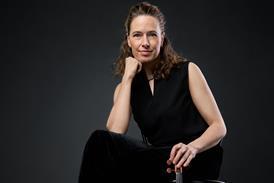
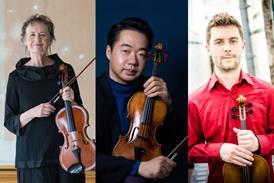

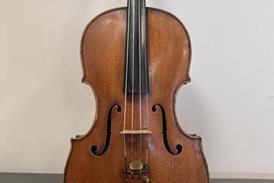

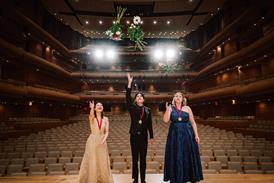

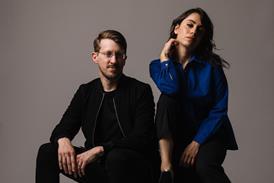






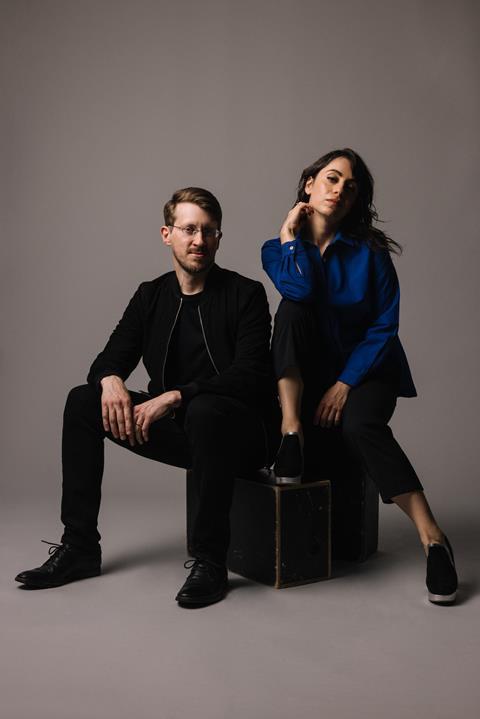
Composer Lembit Beecher and cellist Karen Ouzounian built their project Mayrig around the voices of Ouzounian’s mother and grandmother, creating a work in which three generations sing, remember and make music together. They share their insights on curating their most personal programme yet
Discover more Featured Stories like this in The Strad Playing Hub
Karen’s mother, Lena Ouzounian, is a force of nature, full of fire, charisma and an infectious love of music. She was born in Lebanon, into an Armenian community of survivors of the Armenian Genocide (which had reached its apex in 1915-1917).
When she and Karen’s father immigrated to Canada in 1981 during Lebanese Civil War (a re-diasporisation experienced across the Armenian community) one of the first things they did was to rent an upright piano.
Music, which was always central to Armenian culture, had become a critical means of building community and establishing identity for the hundreds of thousands of Armenians, many of them orphans, who found their way from their former homes in Anatolia (now central Turkey) to Beirut.
Lena’s world in Beirut, the one she brought with her to Toronto, was at its core Armenian, but was also a multilingual and multicultural one (she grew up speaking Armenian, French, Arabic and Turkish). Musical traditions, food, fashion, and language were mixed, borrowed and lent.
In creating our show Mayrig, which is the Armenian word for ’mother,’ we wanted to invite the audience into this one family’s world, giving the audience a sense of a particular historical and cultural moment of Armenian life in Lebanon in the 1960s and 70s.
And at the same time, we wanted to make a show that responded in a universal way to the fractured way we all live in the contemporary world, carrying with us not a single narrative of culture and identity, but a whole host of stories, associations, memories and music.
As we began developing Mayrig, we thought about the musical and sonic environment of family, beginning with Karen’s mother’s and grandmother’s voices. In 2021 we had undertaken a series of interviews with Karen’s mother, Lena, grandmother, Sirvart, and father, Zareh, delving into family history and questions of identity. The more time we spent listening to these interviews, the more the rhythm and music of the voices clarified themselves to us.
We wanted to make a show that responded in a universal way to the fractured way we all live in the contemporary world, carrying with us a whole host of stories, associations, memories and music
Lena’s voice in particular is so full of humour and warmth, even in the description of traumatic events. There is also a clarity and universality in her dreams and wishes for her family and for the world. For Mayrig we excerpted four short audio stories about her coming-of-age in Beirut; though brief, they are surprisingly nuanced and allow the audience to understand her as a person who is more than just the events that happened to her.
Additionally, we created four audio collages of voices – layered and multilingual, these collages mimic the hubbub of intergenerational kitchen table conversations, combining multiple voices with recorded, sustained cello notes.
In Mayrig, Lena’s storytelling culminates in the piece ’Green Line,’ composed by Lembit. Written for solo cello and sampled audio, the piece weaves Karen’s cello with Lena’s voice, as she shares her memories of a dramatic day in 1981 during the Lebanese Civil War, when she had to cross the Green Line – a demarcation line between East Beirut and West Beirut – in order to reach the Canadian embassy. In performance the audio is triggered live by Lembit in short samples, allowing for an incredibly tight synergy between voice and instrument. We begin to hear spoken language as music and music as language.
Building around Lena’s voice, we began to fill out the musical world of the project: we arranged two family favourite Armenian popular songs from the mid-20th century, ‘Sari Sirun Yar’ and ’Mardigi Yerke’ as well as the Charles Aznavour song ’La Mamma,’ that Karen and her mother used to blast at full volume in the car on the way to school.
We also looked further back in time, transcribing a 1917 recording of the 19th Century Anatolian-Armenian song ’Eghin Havasi’ (Melody of Egin), performed on Columbia Records by singer Kemany Minas and violinist Harry Hasekian. Originating from a town not far from the homes of some of Karen’s ancestors, the song is sung in Turkish but Kemany Minas inserts one word in Armenian: ‘mayrig’ (mother). Karen’s Curcuna from her composition Songs of the Sap, based on the curcuna usul (rhythmic mode), a lively and infectiously off-kilter 10/8 in Anatolian music, also channels the Anatolian world of her ancestors.
Works by our friends Layale Chaker and Niloufar Nourbakhsh allowed us to expand the world of Mayrig to our contemporary musical community. Lebanese composer Chaker’s ‘Before Bloom,’ composed during the Sheikh Jarrah troubles in Palestine in 2021, channels the power and resilience of the land as it bears witness to people’s suffering yet continues to bloom at the start of every spring. And Iranian-American Nourbakhsh’s ‘Veiled’ for cello and electronics features the recorded voice of the Iranian singer Solmaz Badri in a piece that transforms Niloufar’s sense of rage into a tribute to Iranian women.
We also wanted to include music that didn’t need a programmatic justification for inclusion but that instinctively felt right to us, music that left space for contemplation and for the audience to fill in their own stories. Mayrig features two movements of Lembit’s ’Music for the Passing of Days,’ fleeting meditations on the passage of time, each composed within the span of a single day, and his Lament from ’Suite (of Childhood Learning)’ which captures the tenderness of a child’s early encounters with sadness.
Early in our process we decided to open and close the programme with Marin Marais’s ’Les Voix Humaines’ (The Human Voices), mimicking the sound of a chorus, which felt like the perfect, warm musical invitation into the world of the show.
With this wide array of repertoire, transitions became a key focus for us. We spent a long time thinking through the structure of the programme, finding ways to create organic, gentle and thoughtful transitions between stories, audio collages, and music. For example, as the final chord of the opening Marais sounds, Lembit triggers the first audio collage, and a texture of voices and echoes of the final chord gradually overtake the live cello sound before subsiding like a wave of memory. Suddenly the meaning of Marais’s final note is altered, as it introduces voices and characters who will now become a recurring part of the evening.
Throughout the programme, which is performed without pause, these audio collages act as structural guides, marking the beginning of new sections. While Lena’s stories carry a sense of narrative through Mayrig, the layered audio collages create a non-linear sense of order, their continual return mimicking the circular and insistent nature of memory.
The visual world of Mayrig depended on a chance encounter. In 2023 Karen was in a Paris bookstore and happened upon a book signing by the celebrated graphic author Charles Berberian who had just released his most recent graphic novel Une Éducation Orientale. Charles was born the same year as Karen’s mother and spent his adolescent years in Beirut, and his autobiographical work was so deeply and immediately expressive, depicting his childhood in Lebanon and his beloved Yaya (grandmother) in the most tender and beautiful ways.
Karen’s emotional response to this book stayed with her for two years and as we began to think about adding a visual element to the world of Mayrig, we immediately dreamt of working with Charles. Through the help of the Ravinia Festival’s Steans Institute Alumni Catalyst Fund, we commissioned Charles to create a collection of illustrations for Mayrig, which are both projected during performance and printed as a mini graphic novel for audiences to take home. Based on both family and archival photos, the nature of the illustrations creates a deeper sense of storytelling and universality, expanding beyond the archives and memories of one particular family.
Initially it was jarring to perform Mayrig and hear one’s own mother’s voice in the context of a concert hall. But in performance the experience has ultimately felt freeing musically and expressively. One of our favourite moments in Mayrig, and one of the more difficult ones to perform, is our arrangement of the Armenian song ’Mardigi Yerke.’ It is sung from the perspective of a soldier, expressing a deep nostalgia for his village and mother.
Our arrangement begins with a spontaneous recording Karen captured on her grandmother’s 95th birthday of her grandmother and mother sitting on their couch singing the song. In performance, Karen adds bass notes and harmonises with her grandmother before taking over the song herself, singing with pizzicato accompaniment. This moment of three generations singing together, passing culture from old to young, feels like the perfect encapsulation of Mayrig.
- Lembit Beecher and Karen Ouzounian
Mayrig will be performed as part of Rhiannon Giddens’s Reflektor Festival at the Elbphilharmonie Hamburg on 28 November 2026, before travelling to the Arvo Pärt Centre in Laulasmaa, Estonia, for a performance presented by the centre on 5 December 2026.










No comments yet