
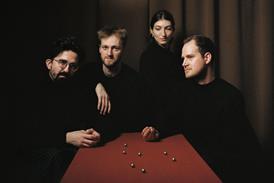
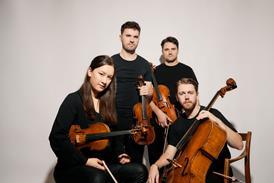
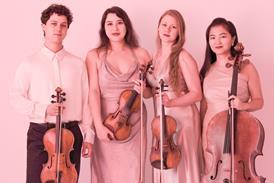



Composer Alex Mills explores the emotional immediacy of string writing in the works collected on his debut album Look How Brightly
Read more Featured Stories like this in The Strad Playing Hub
So much of the music I write is about channelling raw emotional expression. Not a depiction of a mood or emotion, but a space where feelings are experienced and embodied in sound. This means I’m constantly asking myself the same question: ’what kind of sound can carry raw human experience in the most direct and immediate way?’
I’ve been returning to this question repeatedly over the past decade and, for me, the answer is almost always strings. My debut album, Look How Brightly (Delphian Records), brings together a selection of pieces exploring a variety of responses to it, recorded by CHROMA ensemble and featuring contralto Jess Dandy.
It’s often said strings are particularly emotive because they resemble the human voice. But what does that actually mean? For me, it is not just that they can ‘sing’, but that they expose so vividly the act of sounding itself. It’s possible to hear the friction of the bow, the instability of pitch, the weight and resistance of the string. The sound can crack, thin out, push, resist. It can feel as though it is being held together in real time, just like a voice on the edge of breaking.
That spectrum of vulnerability is what draws me in. Strings sit close enough to the human voice to feel instinctive, familiar and expressive, but they remain abstract enough for us to project our own emotions onto them. The result is something powerful: we are carried through an emotional landscape without needing it to be explained, often without even realising it is happening. This was my aim for many of the pieces on my album.
Strings sit close enough to the human voice to feel instinctive, familiar and expressive, but they remain abstract enough for us to project our own emotions onto them
Strings Attached is a delicate unison ritual for violin and piano. On paper, it is the simplest thing imaginable: two players sharing a single line that unfolds slowly. In reality, it demands an extreme level of attention, empathy and trust. Every nuance has to be negotiated together. Unison writing, which has become a preoccupation of mine, puts a microscope over the emotional vulnerability of the quiet, sustained violin notes and fragile harmonics. You feel the tension in the players as they try to stay together, and in the sparse landscape of the piece even the smallest deviation feels emotionally seismic.
In One is Fun, this same idea becomes explosive. Two violins are bound in unison, pulling against each other, desperate to separate but unable to let go. Again it sounds simple, but that simplicity, combined with the full expressive range of string articulation, heightens the emotional stakes. You sense that something has to give, and you are drawn into the moment where the line finally splinters apart.
The tension between unity and fracture runs through lots of my pieces. In Fragment, a string quartet breaks into shards that collide, disperse, and gradually learn to coexist, not by resolving into one voice, but by accepting their contradictions. There is a constant play between the idea of the quartet as a unified body and the individual expressivity of its players, each pushing forward with yearning pitch slides, urgent repeating motifs, soaring melodic lines and abrupt staccato interruptions.
This deeply expressive pushing and pulling brings to mind another reason I always return to strings: my fascination with music as a way of processing experiences that resist language. That is what drew me to vocal keening traditions, forms of lament where grief is not explained but released and processed through sound. Repetition provides structure, while improvisation allows emotion to surface in its rawest form.
That influence is most direct in Three Dirges for the Living for violin and cello, the first piece of mine to be premiered as a professional composer. The three movements move through different phases of grief with a musical vocabulary only possible on strings: sighing pitch bends, bittersweet quarter-tone motifs, lucid evocations of wailing, percussive outbursts and long, searching lines.
After the premiere in Paris, a woman came up to me and told me that her husband had died in a road accident the year before and that the piece had expressed emotions she had been carrying ever since but had never been able to articulate. In that moment she gave me the greatest gift I could imagine: confirmation that music – here rendered in deeply expressive string writing - can carry and communicate raw human experience in a profound way, even when addressing the most complex of emotions.
Since then, I have continued to think about music as a kind of ritual. Not in a formal or religious sense, but as a structured space where emotional transformation can happen.
In BARDO, I was drawn to the idea of the ’intermediate state’, a space of transition between life, death and rebirth in Buddhist philosophy, and to the idea of sound as a guide through that space. The second half of the piece includes a breath chorale for string quartet and voice, where performers move according to their own breathing rather than a fixed pulse. Time loosens. The music becomes free, vulnerable and exposed, and so too do the performers. It’s a completely different way of composing, performing and experiencing music where we hear yet another side of the strings, completely aligned to the rise and fall of human breath.
In The Body Keeps the Score, inspired by Bessel van der Kolk’s writing on trauma, a viola traces transcriptions of an archival recording of a Gaelic keener. Through these raw lines and the repetition of stark, primal motifs, the instrument mirrors the way traumatic experience is imprinted in the body and repeats until it is worked through. It becomes a kind of musical process of working through that, for me, is something only the immediacy and intensity of a solo string instrument can evoke. Even within mechanical repetitions we can hear an endless variety of expressive musical mark-making.
In Scapegoat, for string quartet and kick drum, where the energy comes from a driving, club-inspired pulse, I’m interested in music as a shared act of release, tension and confrontation with complex emotions. The quartet chases itself through looping fragments, building towards a kind of ritualised frenzy that reflects collective anxiety and misplaced blame. Again, the symbolism of a unified string quartet adds to the emotional weight of what the piece is communicating as its internal energy fractures and turns in on itself.
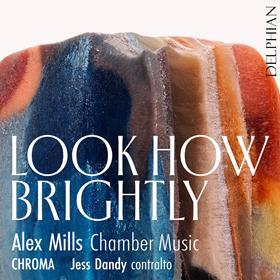
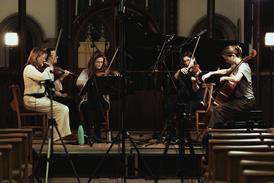
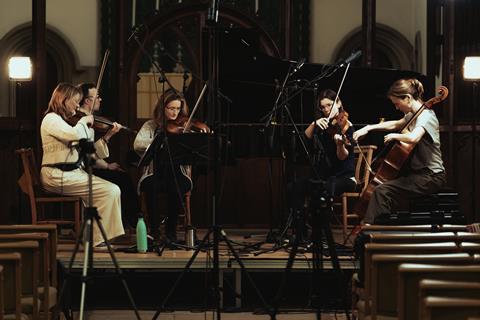
Across all these pieces, the almost limitless expressive potential of string playing remains fundamental. I am deeply grateful to the musicians of CHROMA, Caroline Balding (violin), Natalie Klouda (violin), Kay Stephen (viola) and Clare O’Connell (cello), for bringing so much sensitivity - and so much of themselves - to the playing and interpretation of these works. For me, they achieve what draws me back to writing for strings again and again: the possibility of reaching a point where music stops merely describing human experience and begins to truly embody it. We need more of that in this world.
Listen to Look How Brightly by Alex Mills on all streaming platforms and read more background about the pieces on the album on the composer’s blog.










No comments yet