

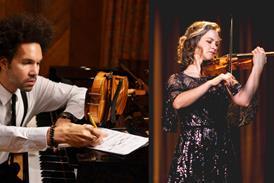




Composer–violinist Scott Tixier traces how influences from French impressionism to jazz improvisation coalesce to create a unified compositional voice in his new work for violinist Hilary Hahn, Ressemblace
Read more Featured Stories like this in The Strad Playing Hub
The world premiere of my work Ressemblance, commissioned by Tippet Rise Art Center and written for Hilary Hahn, will take place within a programme of French works including Maurice Ravel and Claude Debussy. The piece appears directly after Ravel’s Violin Sonata no.2, followed by Bun-Ching Lam’s Solitude d’automne, Debussy’s Violin Sonata in G minor, Boulanger and Fauré.
This placement creates a natural continuity in the way time, colour and structure are approached, within which the piece situates itself. Its construction, from melodic movement to harmonic language, reflects a close relationship to these composers. At the same time, my own path, rooted in jazz and improvisation, informs how this material is structured. It explores how these influences, French impressionism and jazz improvisation, can coexist within a single compositional language, not as contrast but as continuity.
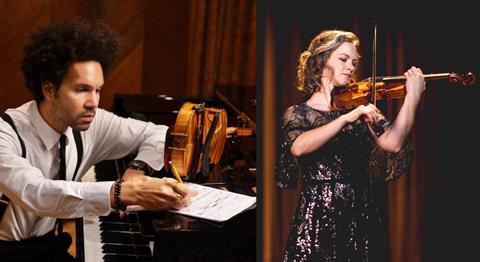
The title Ressemblance does not refer simply to similarity, but to proximity between elements that may appear close, yet remain fundamentally different. This operates across multiple levels in the piece: between violin and piano; composed and improvised language; and, more personally, between individuals, such as the relationship I share with my twin brother, a pianist. It is also a dialogue between different ways of organising sound: between vertical and horizontal writing and between immediacy and reflection. As with Debussy and Ravel, often perceived as contrasting voices, these are not opposing systems, but different perspectives on the same material. What connects them is not identity, but a space of interaction, where resemblance exists alongside difference.
The opening of Ressemblance is reminiscent of Debussy’s treatment of time, where gesture and colour often precede metric definition. The piano functions as a resonant space rather than a rhythmic anchor, and the violin line exists within that space rather than against it.
It starts with a sustained C in the piano, held with pedal. It does not function as a harmonic center in a traditional sense, but as a field. The violin enters above in pizzicato, marked ’quasi rubato, liberamente, fuori misura’. At this stage, there is no pulse. The form is defined by spacing, resonance and decay. The material behaves as if it were improvised, but it is fully written. What is not fixed is not the structure, but the way time is experienced.
The music then moves toward pulse. Though this pulse appears as something unstable that is forming rather than already established. This transition is central to the piece. It reflects a process closely related to improvisation, where structure emerges from the material itself rather than being imposed in advance. It is not a contrast between freedom and structure, but the moment where one generates the other.
A clearer hierarchy is then established and, for the first time, the music aligns more closely with formal classical thinking, where line and accompaniment interact to create trajectory. The violin takes on a leading role, presenting a more continuous melodic line, while the piano more explicitly articulates harmonic movement.
Harmonically, the piece sits between Debussy’s fluid harmonic fields and Ravel’s more controlled, structurally defined language. While Ravel’s Violin Sonata no.2 maintains a clear rhythmic and formal identity even in its most flexible passages, Debussy often allows structure to dissolve into gesture. Ressemblance moves between these two approaches, not by opposing them, but by allowing one to evolve into the other. And harmonically, its extensions and alterations destabilise any clear tonal center, allowing tension to accumulate without immediate resolution.
As the work develops, the texture compresses around a sustained harmonic point in the piano, creating a suspended zone of tension – a space closer to Debussy’s sense of harmonic field than to functional progression. The violin introduces pitches that function as extensions against the underlying sonority, producing an altered harmonic field. The effect is not progression but intensification.
What follows is not a development in a classical sense, but a recontextualization of material under pressure, closer to an improvisational process where material is reshaped rather than formally expanded. The interaction between the instruments becomes denser and the distinction between roles dissolves. Both occupy the same register and density, creating a friction where earlier material reappears but cannot fully stabilise.
The texture eventually reduces, isolating the violin line. When ’le temps est libre!’ appears, it does not return to the opening state. The music has already passed through a more defined structural phase. This return to freedom is no longer generative, but reflective, closer to a composed memory of improvisation than to improvisation itself. It is no longer exploratory, but suspended, almost fragile.
In the final section, the relationship to improvisation changes. A cyclical harmonic framework emerges, related to a minor blues form. Earlier, the material behaved as if it were generating its own form. In this section, the form exists, and the energy comes from navigating within it.
This shift reflects two different relationships to time. One is immediate and generative. The other allows distance. Composition creates that distance. It gives the possibility to reshape and reconsider material that, in improvisation, would exist only in the moment.
Toward the end and as in many classical structures, elements from the opening return: resonance, fragmentation and suspension of pulse. But they do not function in the same way. What was initially an open field is now heard through everything that has taken place. The return is not circular. It is transformed.
Ressemblance, commissioned by Tippet Rise Art Center will be premiered on 13 May at Wigmore Hall, performed by violinist Hilary Hahn and pianist Tom Poster. This will be followed by an international tour in Dublin, Homburg, Toronto and Chicago
Read: World record smashed: ‘Macdonald’ Stradivari viola sells for millions
Read: ‘Hold on, do what you can!’: Peter Sheppard Skærved on Michael Hersch’s ‘Zwischen Leben und Tod’
Read more Featured Stories like this in The Strad Playing Hub








No comments yet