






Benjamin Shute questions our assumptions about contemporary instrument set‑up and the idea that period instruments are merely specialist equipment
Discover more Featured Stories like this in The Strad Playing Hub.
Read more premium content for subscribers here
What is a violin? This may seem like a question one should resolve before contributing to The Strad. But sometimes meaningful considerations hide in plain sight. What I’m getting at is the normalisation, in today’s orthodoxy, of the term ‘violin’ to refer to an instrument in contemporary set-up; whereas an instrument deviating from this norm requires a modifier: ‘period’ violin.
But in the sweep of history, how normal is our ‘normal’? Our orthodoxy, paradoxically, is shallow. For instance, many experienced violinists seem unaware that Jascha Heifetz played on plain gut middle strings into the 1980s, or that the synthetic strings nearly ubiquitous in today’s mainstream (and which, in my opinion, define many points of contemporary technique) were only invented in the 1970s.
It’s fair that common practice of our time should define our concept of ‘normal’ – except that this isn’t at all how we tend to approach the music we play. Our concept of the norms of ‘classical’ music tends to be defined by the likes of Bach, Beethoven and Brahms, with contemporary music being the fringe or speciality item. This incongruous normalisation of the instrument set-up and performance practice of today, but the repertoire of the past, perhaps explains the extent to which we assume that the two go hand in hand.
Is that a fair assessment? Consider: are we comfortable with the commonplace scenario of someone using a default instrument in contemporary set-up to play an array of repertoire, most of it predating that contemporary set-up? After all, we might say, the instrument is just a vehicle of interpretation, and it’s actually more historical to have a default instrument than to use different equipment for everything one plays. That’s all well and good; but then would we find it freakish, provocative, or simply unacceptable if someone’s default vehicle of interpretation were deemed in too early a set-up for some of the repertoire they play? If so, that may illustrate my point.
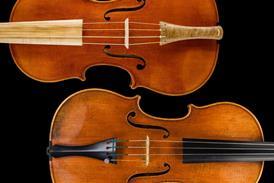
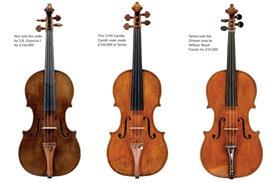
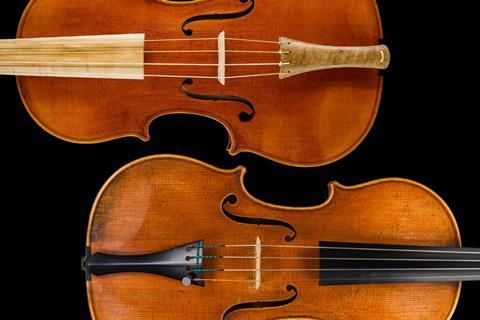
Let me muddy the waters further. While the longer and more angled neck and larger bass-bar that significantly distinguish ‘modern’ from ‘Baroque’ set-up became the norm in the 19th century, instruments in the older set‑ups were made into the mid-1800s. I have seen one such English instrument from 1863, when Brahms was 30. Moreover, the 1735 Guarneri ‘del Gesù’ played by Jan Kubelík and Michael Rabin was discovered only in 1975 to have retained its original ‘Baroque’ bass-bar and a less angled neck.
And bows are no less messy: as late as 1800, then-old-fashioned bows could be found side by side with a host of Classical models, alongside the recent Tourte design that would become the modern standard. There’s a painting of Giovanni Battista Viotti made later in his career, after Tourte’s innovations, in which he is holding a distinctly Baroque bow, which we might infer he used when directing from the violin. And even long after Tourte’s design had swept Paris, it (being French) was resisted in parts of non-Napoleonic Europe into the mid-19th century.
The upshot? My opinion here is an enacted one: I increasingly find myself turning to my contemporary copy of the ‘Vieuxtemps’ 1741 Guarneri ‘del Gesù’ in ‘Baroque’ set-up for repertoire through the 19th century and sometimes beyond. For post-Baroque music I typically pair it with an open-frog, swan-head, Dodd-model bow in snakewood that represents a contrasting contemporaneous alternative to the Tourte model, because it pairs especially well with my instrument. Is that freakish? Provocative? Unacceptable? I suppose it depends on what we mean by ‘violin’.










No comments yet