

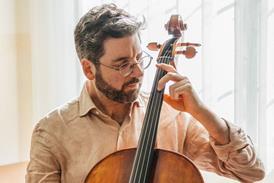






Fleet fingers may be the ultimate goal for string players, but it’s the larger muscle groups that form the foundations of solid technique, says cellist Davina Shum
Discover more Featured Stories like this in The Strad Playing Hub
Read more premium content for subscribers here
People often say that string players are the Olympians of the small muscles, a description that comes as no surprise, as we do spend a lot of time honing the skills of our digits on both hands. Think back to your training and the hours of drills, exercises and etudes aimed at optimising your dexterity and agility, as well as expanding your sound palette, largely operated by the fingers, hands and wrists of both arms. Bernhard Cossmann’s furious left-hand finger drills no doubt feature in any cellist’s training, while the numerous etudes by Otakar Ševčík will be in the arsenal of any string player. David Popper’s Elfentanz features delicate passagework high up on – and off! – the cello fingerboard where space is at a premium, requiring hours of delicate, precise training to pull off effectively.
But how many string players can say that throughout their conservatoire training they gave the same amount of attention to the larger muscles of the body? By larger muscles, I mean those that support core function, from which your extremities stem. Think the trapezius, the latissimus dorsi, the glutes, and the rotator cuff and erector spinae groups, to name a few. Often these terms don’t come up in a musician’s vocabulary until they sustain an injury.
When speaking of bowing, the great cellist and pedagogue William Pleeth used to say that the arm is the ‘lung’ while the hand and fingers are the ‘lips, teeth and tongue’. If we take this image and translate it to a more athletic context, how far would a sportsperson get without healthy lungs? A small cardiovascular capacity would obviously limit one’s athletic abilities – think about the endurance and stamina required to play a tennis match, perform a triathlon or row six miles.
I’ve found it incredibly helpful to check in regularly with a physiotherapist
When you are breathing, your diaphragm acts as the major muscle that supports respiration, sitting as it does below the lungs. Within the analogy whereby the arms are the lungs, it’s important to think about those muscles that support the arms. You may have toned biceps, triceps and forearm muscles, but if you don’t have the foundational strength to hold up your arms for any length of performance, you won’t get very far. Ask any singer, wind or brass player, and they will vouch for the importance of having support from the diaphragm.
As string players, we concentrate on developing the dexterity and agility of the small muscles in our hands. It’s something we can control, through the exercises we choose and the time we dedicate to them; it’s literally in our hands! So why don’t a lot of musicians take the same approach when it comes to understanding and using the larger muscles that support us, and our playing?
In the same way that you build up a repertoire of technical drills and exercises, it’s a good idea to build a complementary toolkit of physical exercises. Look at muscle groups that you’d like to target and explore what role they have in your playing. Personally, I became increasingly intrigued by the latissimus dorsi, which led to exploration of the erector spinae and rotator cuff groups; everything is connected, after all. Once your curiosity is sparked, you can find targeted physical exercises. Essential exercises for me now include seated rows, lat pull-downs and trap bar deadlifts, to ensure that I have the capacity and physical strength required to support the load of sitting through a two-and-a-half-hour performance.
I’ve found it incredibly helpful to check in regularly with a physiotherapist and talk openly with fellow musicians. These conversations have not only given me a wider range of exercises to support my body and improve my playing, but they’ve also created space for honest discussion about something that has for too long felt neglected. I hope that changes.
Read: Not just the notes: the missing links in injury prevention for musicians
Read: Muse Muscle: A Revolutionary Approach to Musicians’ Health and Performance
Discover more Featured Stories like this in The Strad Playing Hub
Read more premium content for subscribers here












No comments yet