





Musicians, airlines and policymakers are now driving a unified effort to make flying with instruments safe, consistent and drama‑free, following a meeting in Brussels on 23 February
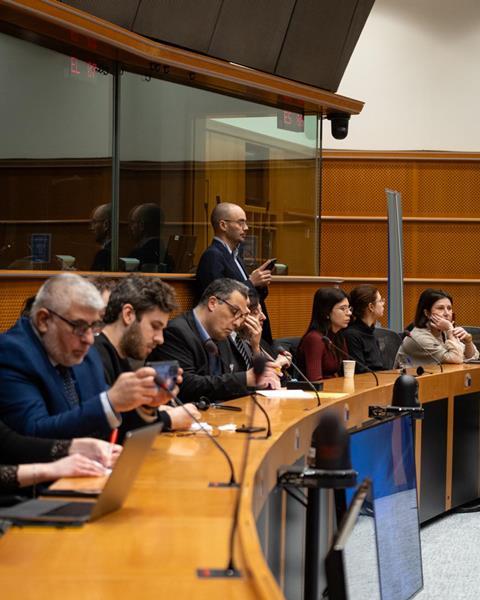
On Monday 23 February, Members of the European Parliament hosted a dedicated event in Brussels addressing the air transport of professional musical instruments, marking a decisive step toward potential European-level regulatory clarity for cultural workers.
Entitled ‘Air Transport of Musical Instruments: Rules, Risks and Best Practices for a Culture‑Driven Economy’, the focus of the discussion was the call to recognise professional musical instruments not as standard luggage, but as essential working tools.
The meeting brought together over 150 stakeholders from the music and air transport sectors, as well as MEPs and representatives of the European Commission, to confront the long-standing inconsistencies musicians face when travelling with instruments, and to begin shaping a shared European framework to safeguard artists’ rights and mobility.
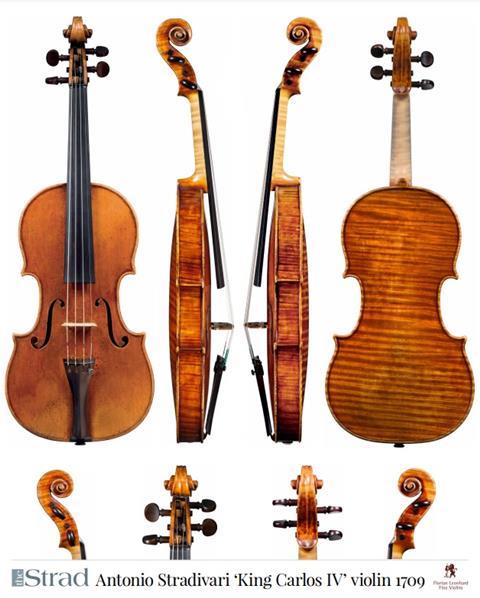
Numerous recent events have ignited renewed pressure for clearer, fairer air‑travel rules for musicians across Europe. Last December, Carolin Widmann was forced to carry her bare Guadagnini violin on her lap during a Lufthansa flight after difficulties at the boarding gate – an episode that drew widespread outcry within the international music community and prompted Lufthansa to reassess its handling procedures for instruments.
MEPs Nicola Zingaretti and Matteo Ricci, from the Progressive Alliance of Socialists and Democrats (S&D) Italian delegation hosted the event, with Zingaretti stressing that common rules were essential to ensure musicians are treated fairly across all EU member states.
‘Rights remain rights only if they are shared,’ he said, warning that without consistent protections, cultural workers risk being left behind.
Musicians’ lived experiences featured prominently in the meeting. Double bassist Valentina Scheldhofen Ciardelli, who leads the ‘My instrument is not luggage’ campaign, detailed the uncertainties, last‑minute conflicts and financial risks musicians routinely face at airports.
Anita Debaere, director of the Performing Arts Employers Associations League Europe (Pearle), reinforced the scale of the problem across Europe’s touring sector.
From the transport side, Antonio Buhagiar from the Italian Association of Airports and Airports Council International Europe, presented a model implemented at London Heathrow in cooperation with the Musicians’ Union, cited as a template that could be adapted across Europe.
Airlines also took the floor: David Grivet from the International Air Transport Association and Elena Jaraiz from Airlines International Representaion in Europe outlined current industry efforts and acknowledged the need for improvement, noting the changes Lufthansa has begun implementing since the Widmann incident.
The debate highlighted the critical issues around the topic, emphasising the need to balance the needs of musicians with airport safety and operational efficiency criteria. Zingaretti reiterated that cultural life can only flourish if societies create the necessary conditions.
‘If art dies, our world will be poorer,’ he warned, stressing that this commitment concerns not only musicians, but ‘all of us as European citizens’.
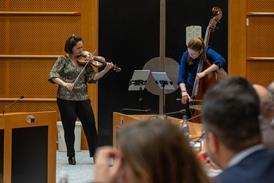
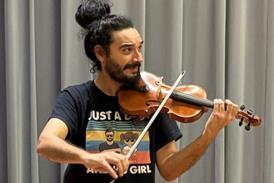
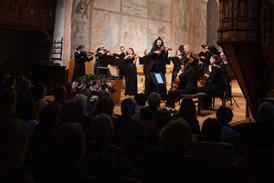
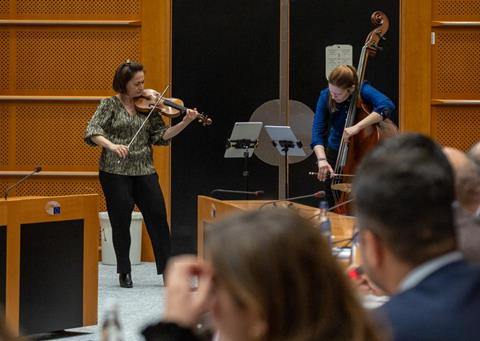
The meeting additionally contained a short musical performance of Vissi d’arte by Puccini, by Scheldhofen Ciardelli and violinist Emi Ohi Resnick.
Further technical developments and follow-up discussions are expected in the coming months.
Read: Lufthansa Group changes hand luggage rules following negotiations with violinist Carolin Widmann











No comments yet