








Cecilia Tan reports back on the Boston Pops’ 2026 season opener, headlined by violinist Ray Chen in a programme drawn from film and game soundtracks
Read more Featured Stories like this in The Strad Playing Hub
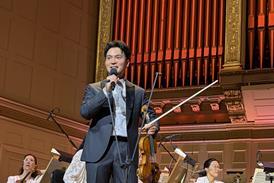
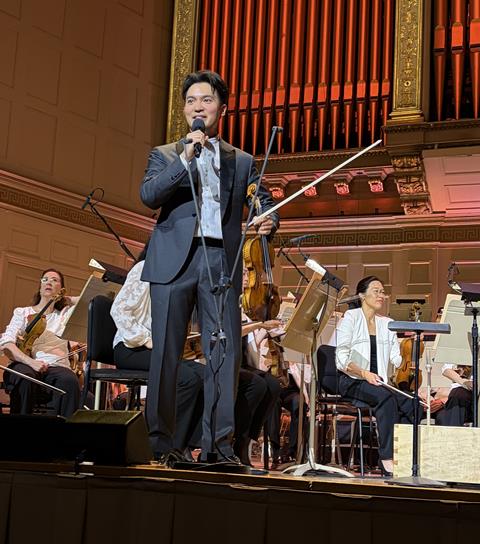
On Friday, 8 May, the Boston Pops kicked off their 2026 season – the orchestra’s 140th – with a programme featuring violinist Ray Chen, and the debut of a new suite for him commissioned by the Pops.
Chen has previously appeared as a soloist with the Boston Symphony Orchestra, but this was his first collaboration with ‘America’s Orchestra.’ Chen might have seemed a prosaic choice for the Pops, famously known for collaboration with those outside the classical realm, such as upcoming dates with movie and Broadway stars Hugh Jackman (Wolverine, The Greatest Showman) and Cynthia Erivo (Wicked, The Color Purple), and a ’symphonic exploration’ of the late Jerry Garcia (of 1960s psychedelic rock band The Grateful Dead). But Chen, like the Pops, is unafraid to discard convention and embrace new vehicles for the enjoyment of classical music.
The Pops has always centred enjoyment – rather than ‘appreciation’– of music, dating back to its founding in 1885 as an off-shoot of the BSO. For the Pops, Symphony Hall arranges chairs around cocktail tables rather than rows, and waitstaff serve champagne and fruit punch, cheese and sandwiches.
Arthur Fielder, conductor 1930-1979, established the Pops’ international fame through bestselling records on RCA Victor of both classical repertoire and popular music ranging from the Beatles to disco (Saturday Night Fiedler). The Pops also has a long association with film soundtracks, beginning in Fielder’s time, but notably via emeritus conductor John Williams, whose Hollywood scores (Star Wars, Jaws, Schindler’s List, etc.) have garnered over 50 Academy Award nominations. An all-Williams film programme is a Pops staple.
The film-classical connection made Chen a natural fit for the Pops. His 2024 album on Decca Classics, Player 1, marries theme music from television and films (How to Train Your Dragon, Squid Game) with film composer pioneer Erich Wolfgang Korngold’s sweepingly cinematic violin concerto.
Prompted by conductor Keith Lockhart to say a few words onstage about Player 1, Chen spoke about discovering the ‘power of music’ when his mother admonished him as a child to turn the volume down on his GameBoy.
‘I was playing a game while waiting for a violin lesson and it was just blaring out… I turned it down and, wow, I was suddenly no longer immersed.’ Recorded with Cristian Măcelaru and the Royal Philharmonic Orchestra, Player 1 is Chen’s love letter to the music that mesmerized him as an admittedly ‘nerdy’ youth, including video game themes (Pokemon, The Legend of Zelda) and anime (Naruto).
Lockhart has conducted the Pops since 1995 and Friday’s opening night bore his stamp. Lockhart’s selection of pieces set the sonic stage perfectly. The programme opened with Ginastera’s Malambo (from the 1952 ballet Estancia), a piece every bit as energetic and whimsical as any Disney animation soundtrack, followed by Copland’s El Salón Mexico, another evocative and cinematic piece.
Lockhart had no hesitation in taking up the microphone to tell the audience about both pieces and the importance of these new world composers, but his patter felt not like a ‘lecture’ on classical music so much as an enthusiastic chat among friends. Lockhart revealed himself to be knowledgeable about the anime world, as well, saying he chose the two pieces that would follow because they featured prominently in Your Lie in April, an anime series about two young classical musicians.
Then came a pleasurable rendition of Debussy’s Claire de Lune: the orchestra sounding as light as air, the music floating like the cherry petals still falling outside in Boston’s chilly spring – so entrancing that the sipping and snacking of the audience ceased.
The first half of the concert concluded with Chen playing the Saint-Saëns Introduction and Rondo Capriccioso in A Minor, op. 28, an apt vehicle for Chen’s well regarded technical chops and energetic presence. The violinist was at first a bit taken aback by Lockhart’s chattiness (‘I’m just taking your lead here.’ ‘Oh, you don’t know how much we conductors love to hear you say that.’) but as it was all in service of making the music accessible and adding charm to the evening, Chen quickly got into the spirit.
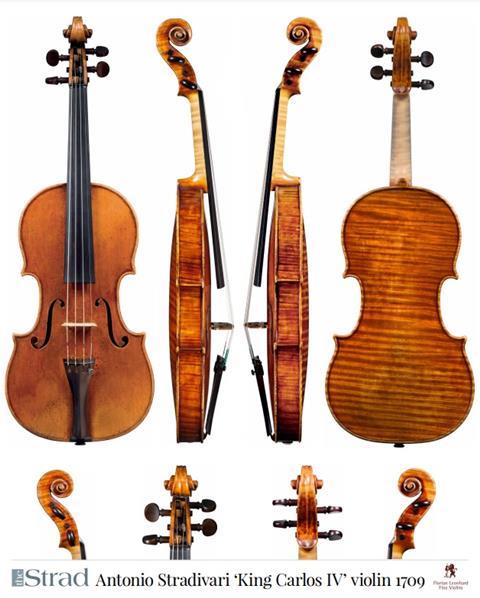
Then Lockhart prompted him for an unplanned encore. ‘I have to confess here, you totally caught me off guard,’ Chen said before pulling Ysayë’s Sonata no. 2, Prelude, out of his proverbial pocket. The piece quotes Bach’s Partita no.3, but ranges through several evocative themes. Chen’s playing was by turns fiery and silky, holding the entire hall rapt like a master storyteller using a 1727 Stradavari as his voice.
After intermission, the orchestra brought the audience into the modern media era with a rendition of the main theme from the video game Final Fantasy, readying the ears for the new selections. Chen emphasised that it was his first time presenting pieces from Player 1 with an orchestra.
‘The Boston Pops made it really enticing, not only to say, hey, come and open the season, which is already in itself an incredible honour, but to [feature Player 1]. I’m fully aware of the responsibility I have with the [many] young people who look up to me, and to be able to send a message that says… you can play the music that you enjoy. It can be Mozart, it can be Bach… but you can also play Naruto. You can also play Zelda. Young Ray is having his dreams come true.’
‘Romantic Flight’ from How to Train Your Dragon is a quintessential triumphant soundtrack selection – one the Pops will play later in the season in a live concert screening of the film – which had the orchestra hitting their panoramic peak. Other selections were more contemplative, including ‘Sadness and Sorrow’ from the anime Naruto and ‘I Remember My Name’ from Squid Game, painted with a sonic palette of loss and grief.
‘I love being able to wear my emotions on my sleeve,’ Chen said after the concert. ‘I think I excel at that type of music.’
’You can play the music that you enjoy. It can be Mozart, it can be Bach… but you can also play Naruto and Zelda’
The evening capped off with the world premiere of the Arcane Suite, commissioned by the Pops for Chen. Chen’s involvement with the Netflix animated series Arcane (based on the League of Legends video game) included him serving as a music consultant, playing both violin and viola on the soundtrack, and playing himself as an animated character in a few scenes. Incorporating the music of composers Alexander Temple and Andrew Kierszenbaum, arranger Tim Davies has refashioned the themes into a three-part work for solo violin and orchestra.
The opening section is moody and darkly textured, progressing to a second movement that provides a more nostalgic tonal landscape. Part two was capped off by an epic crescendo that provoked applause, and prompted Lockhart to quip, ‘As they say on TV: but wait, there’s more.’
The third section is the longest and most expansive, moving through sinister, underworld themes reminiscent of the dissonance in Stravisnky’s Rite of Spring, a Mahler-esque battle theme, a minimally accompanied cadenza, and then through a folkloric-tinged section with the soloist accompanying the orchestra through arpeggios reminiscent of the Mendelssohn violin concerto. The suite is an apt vehicle for Chen’s evocative style, showcasing his talents quite pleasurably.
The Pops spring season runs at Symphony Hall until mid-June, when the action moves to Tanglewood. After a brief stop at London’s Royal Albert Hall on 12 May to play the Korngold, Ray Chen can be found on a recital tour throughout Asia 16 May through 20 June.










No comments yet