
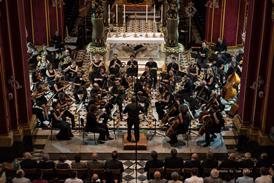

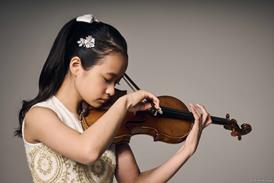


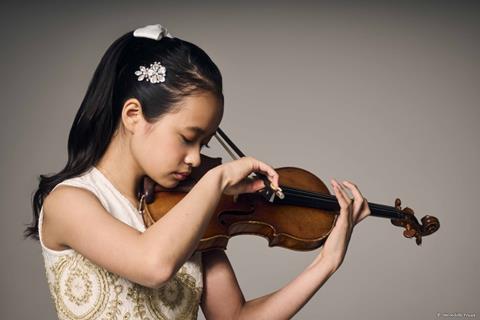
Jiro Takahashi reflects on Bruch’s Violin Concerto no.1, following a performance by 14-year-old violinist Himari with the Chicago Symphony Orchestra and conductor Jaap van Zweden on 15 February
Read more Featured Stories like this in The Strad Playing Hub
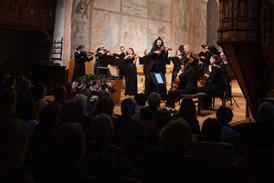
As destiny would have it, on the final weekend before the Lunar New Year – the Year of the Fire Horse – young violinist Himari appeared at the lakefront to perform Bruch’s Violin Concerto no.1 in G minor. What emerged was not mere display, but a reading charged with contained flame: magnetic in pull, volatile in gesture, yet governed by a striking internal poise.
The opening Vorspiel unfolded less as preamble than as emergence – its first phrases searching, then gradually gathering warmth, as if form were being coaxed into light. Less than a year ago she had taken on Henryk Wieniawski’s First Concerto with the Berliner Philharmoniker under Sebastian Weigle – becoming, at 13, the youngest soloist in nearly a century to appear in the orchestra’s principal season.There, brilliance and athletic precision were the measure.
Here, however, Bruch’s expansive Romantic architecture demanded something different. Where Wieniawski glitters, Bruch sustains. Where one dazzles through velocity, the other tests the breadth and integrity of line. It is here that the soloist’s deeper resources became evident.
The Vorspiel, conceived not as a formal Allegro but as a threshold, depends on continuity and inward tension. It does not assert identity; it seeks it. Its harmonic searching, its suspended cadences, make the soloist’s task architectural rather than athletic.
The Adagio stands at the concerto’s moral centre – not as indulgent reverie, but as counterweight. Written in a century newly conscious of motion and mass, it does not yield to propulsion; it steadies it. If the first movement gathers torque, the Adagio answers with breath. Bruch, master of choral contour, treats the violin as bearer of sovereign cantilena.
There is no grand cadenza; virtuosity is absorbed into continuity. The challenge lies not in brilliance but in the endurance of tone – in sustaining a phrase so that it unfolds with inevitability rather than urgency. In the soloist’s hands, the line doesn’t just sing – it supplicates.
When G major breaks through at last, it does not blaze indiscriminately. The horn’s three-note ascent – half call, half whistle – sounds less like triumph than announcement.
If the Adagio gathered breath, the finale exhales it into motion. Mist does not vanish; it thins. Flame does not rage; it steadies. What unfolds here is not mere spectacle, but form revealed – dawn not as an eruption, but as a far-reaching, shining signal.









No comments yet