
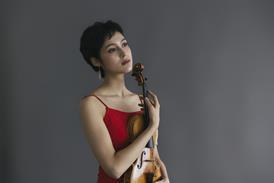
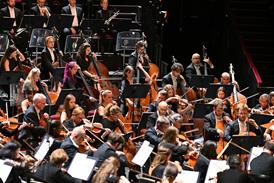
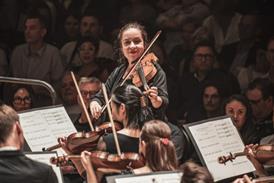
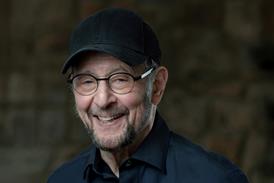
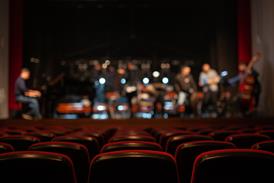

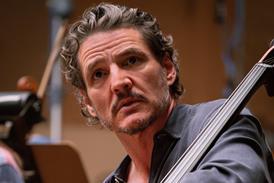
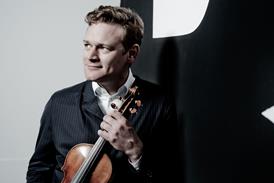
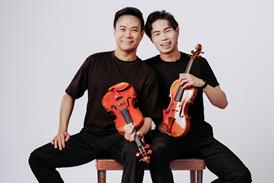


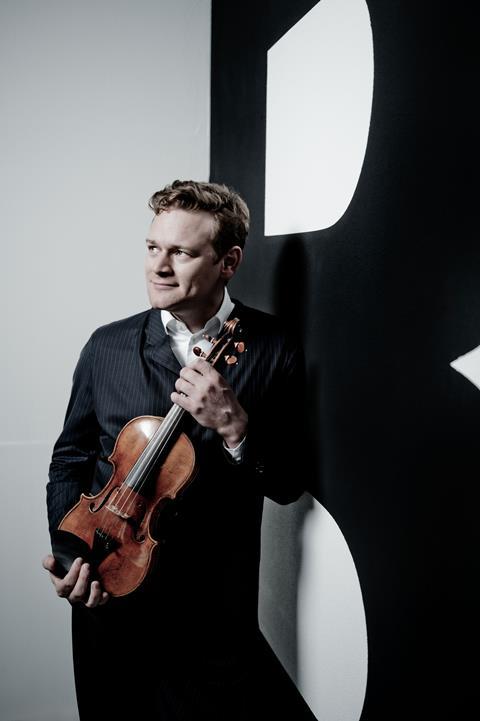
Sebastian Bohren talks about his new recording of Magnus Lindberg’s First Violin Concerto with Sergej Bolkhovets and the Swedish Chamber Orchestra, discussing the work’s colours, balance and physical demands
Discover more Featured Stories like this in The Strad Playing Hub
Magnus Lindberg wrote his First Violin Concerto for unusually lean forces. New York’s Mostly Mozart Festival, which commissioned the work, stipulated an ensemble of the size Mozart would have known. The concerto has now been recorded by Swiss violinist Sebastian Bohren with Sergej Bolkhovets and the Swedish Chamber Orchestra, one of its original co-commissioners, for a digital-only EP on Avie.
Premiered in 2006 by Lisa Batiashvili, with Louis Langrée conducting, the concerto is cast in three movements. ‘The orchestra is my favourite instrument,’ Lindberg has said, and here he explores what could be achieved with a deliberately restricted ensemble: just pairs of oboes, bassoons and horns, along with strings – no flutes, clarinets, trumpets, trombones or percussion. The Scotsman described its sound world as ‘a mesmerising landscape of icicle sharp glissandi and shimmering crushed glass’.
In his liner notes to Bohren’s recording, Andrew Mellor describes how the reduced forces allowed Lindberg to pursue clearer, more translucent textures, while retaining the characteristic profile of his orchestral writing. Mellor also points to the small group of recurring motifs from which the concerto is built, whose transformation carries the music through ‘periods of fulsome drive, violence and lyrical flight’. He describes the relationship between soloist and orchestra as tense and even confrontational at first, becoming increasingly collaborative as the work unfolds.
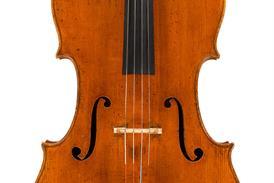
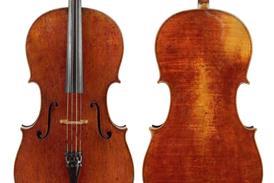
Bohren, who has recorded Bach, Beethoven and Mozart for Sony, RCA and Avie, plays the 1761 ‘Wanamaker-Hart’ G.B. Guadagnini. He spoke to The Strad about Lindberg’s orchestral colours, the physical demands of the solo writing and his experience recording the concerto.
What first drew you to the piece – and why did you want to record it?
Sebastian Bohren: I had known the concerto for many years through Lisa Batiashvili’s recording. I never thought then that I would one day play it myself! When an orchestra asked me to learn the piece in 2020, I took a closer look and was absolutely intrigued by Pekka Kuusisto’s interpretation. As I worked on it, I could feel the inner strength and power of the piece, and I was hooked.
Lindberg uses a relatively small orchestra. Does that change the way you approach the balance between soloist and ensemble?
Bohren: Even though the orchestra is small, the concerto is quite challenging in terms of balance. Perhaps it is meant to be that way. What I find really fascinating about the orchestration is the range of colours Lindberg finds with this Mozart-sized orchestra, especially in the way he combines the woodwinds and horns with the strings and solo violin. Those colours are a big part of the identity of the piece: rich and dark. I try to match those sounds in my playing, sometimes by using less vibrato, for instance.
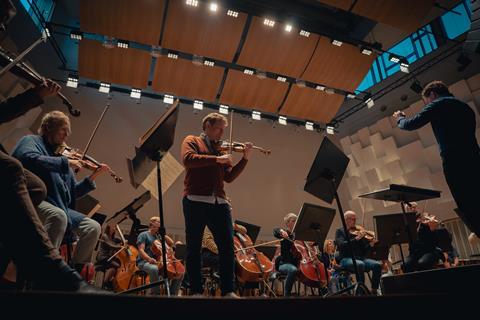
How does Lindberg’s writing actually feel under the fingers? Are there aspects of the violin writing that are especially characteristic – or especially challenging – in this concerto?
Bohren: He writes very well for the violin, so it isn’t particularly difficult. However, there’s a lot of work for both the left and right hand, so you do have to build stamina before performing it in concert. There are several passages quite high on the E string, so when practising the piece I had to be careful not to develop tendinitis!
The cadenza in the second movement is unusually large in scale. What are its particular technical and expressive challenges, and how do you approach them?
Bohren: In the cadenza, the composer gives us a lot of freedom. He doesn’t give many indications beyond the notes themselves, so I try to bring many different colours and shades to my playing and give the cadenza the best possible structure. I play it rhapsodically, almost as if improvised. Towards the end of the cadenza, a solo double bass joins the violin. That’s a powerful moment.
What was it like recording the concerto with Sergej Bolkhovets and the Swedish Chamber Orchestra? Did working with them change or deepen your interpretation of the piece?
Bohren: This was my first time working with the magnificent Swedish Chamber Orchestra, but Sergej Bolkhovets and I worked together on the world-premiere recording of Pēteris Vasks’s Second Violin Concerto, In Evening Light, with the Münchener Kammerorchester. We have been friends for years, so the process was very easy. His reading of the score is very meticulous, and I think we complement each other very well.
Read: The Strad Recommends: Sebastian Bohren: In Evening Light
Read: Swiss Violin Making School Foundation awards Golden Bow to Sebastian Bohren
Read:The Strad Recommends: Lawrence Power: Lindberg
Discover more Featured Stories like this in The Strad Playing Hub











No comments yet