









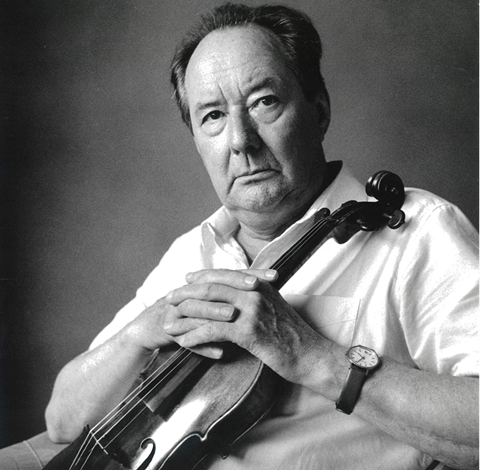
The violinist and pedagogue Igor Ozim died on 23 March 2024. Two years on, Dijana Ihas writes about his legacy to commemorate a teacher whose seven‑decade career shaped generations of musicians through his analytical clarity, uncompromising discipline and deep commitment to musical expression
Read more Featured Stories like this in The Strad Playing Hub
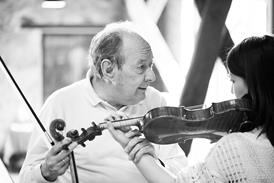
On 18 June 2022 in Salzburg, I had the rare privilege of interviewing the Slovenian violinist and pedagogue Igor Ozim, one of the most influential violin teachers of his generation. The interview took place in the presence of his wife, Wonji Kim, a respected violin professor at the Mozarteum. Despite his advanced age and frail appearance, Ozim’s mind was strikingly lucid, animated by the intellectual precision and curiosity that had defined his musical life. This conversation would prove to be his final official interview before his death on 23 March 2024.
Born on 9 May 1931 in Ljubljana, then part of the Kingdom of Yugoslavia, Ozim developed a rare dual career as an internationally recognised performer and influential violin pedagogue, remaining active across more than seven decades. His first teacher, Leon Pfeifer – the foremost pedagogue in former Yugoslavia – had studied with Otakar Ševčík, and through Pfeifer, Ozim absorbed the rational and analytical principles of the Ševčík school.
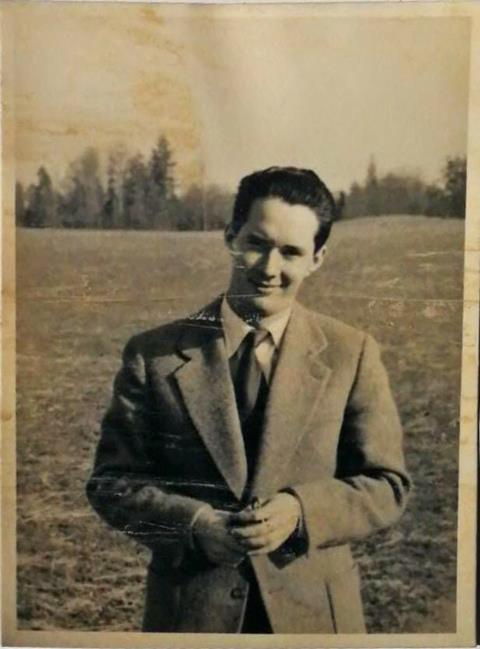
In 1949, Ozim arrived in the UK on a British Council scholarship to study at the Royal College of Music. There he studied first with Albert Sammons, a leading advocate of Elgar’s Violin Concerto, before spending two formative years with the legendary Max Rostal. Reflecting on Rostal’s influence, Ozim said: ‘The most important thing I gained from studying with Max Rostal was an outlook on music–responsibility to the composer and honesty with the text.’
Ozim’s performing career gained swift international recognition when, in 1951, at the age of 20, he won the Carl Flesch Competition, performing Brahms’s Violin Concerto and Bach’s Sonata in D minor, as he recalled during our interview. Two years later, he won the ARD International Music Competition in Munich. Over subsequent decades, he performed throughout Europe, North America, Asia, Australia and New Zealand, earning a reputation for impeccable technique, stylistic integrity and intellectual rigour.
Alongside an extensive solo concert career that encompassed some 60 violin concertos, he maintained an active career in chamber music, championed contemporary music, and authored Anleitung zum zeitgenössischen Violinspiel, a guide to modern violin techniques still regarded as a comprehensive reference for the performance of contemporary works. He remained committed to composers of his native Slovenia and made extensive recordings with the Slovenian Philharmonic Orchestra.
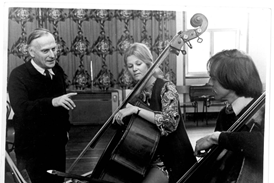
Complementing his performing career, Ozim sustained a parallel teaching life of exceptional breadth. He held professorships at the Hochschule für Musik in Cologne, the University of Bern, and later the Mozarteum in Salzburg; gave masterclasses worldwide; and served frequently on major international competition juries. Unlike many virtuoso teachers, he welcomed students of all levels, cultivating an inclusive yet disciplined learning environment.
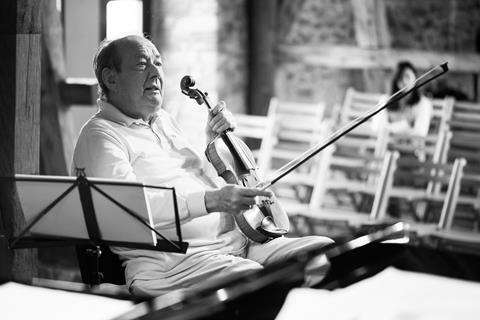
This article examines Ozim’s pedagogical practices and draws on interviews with Ozim, his wife Wonji Kim, and three former students and assistants: Gorjan Košuta, who left Ivan Galamian’s studio in the United States to study with Ozim and later became his colleague; Helfried Fister, also a former student and assistant; and Volodja Balžalorsky, who studied with Ozim for several years.
Teaching Philosophy
Those who studied with Igor Ozim describe a teacher of exceptional intellectual breadth and clarity, whose teaching extended well beyond the violin itself. Košuta recalled, ‘He really had an incredible knowledge and analytical mind… he could explain acoustical phenomena on the violin and was very knowledgeable about the body of the violinist.’ Fister added that Ozim’s German and English were ‘accent‑free and perfect,’ allowing precision of thought and expression across cultures.
Equally central to Ozim’s artistic identity was his passion for teaching. As Balžalorsky observed simply, ‘He loved pedagogy; he loved passing on knowledge.’ Košuta likewise emphasised Ozim’s total commitment in the studio, noting that ‘when Ozim was teaching, he was 100 per cent in – you could see that his whole body and mind were involved.’
His lessons were explicit and demonstrative, often reinforced by concise annotations written directly into the score. These included both technical and musical remarks–corrections and suggestions – and were accompanied by clear explanations, supporting the development of an independent musician. As Košuta recalled, Ozim typically demonstrated his ideas on the violin and could, at any time, illustrate passages from the vast violin repertoire.
At the heart of this clarity lay analytical rigour. Fister emphasised, ‘He never taught anything he could not analyse or prove,’ guiding students to build music ‘from the basics… not from dreams or images.’ Students learned not only their own parts but also the harmonic context, often through Ozim’s demonstrations at the piano.
Discipline and organisation were fundamental: Balžalorsky recalled a cabinet of meticulously organised scores, complete with fingerings and bowings, and described ‘extraordinary discipline and organisation–no minute was wasted,’ while students proposing alternative solutions were expected to justify them.
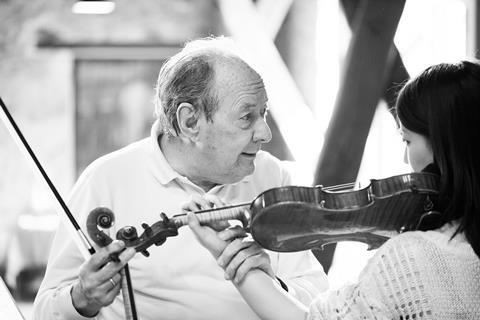
Ozim treated all students equally, investing the same care in the less advanced as in the most gifted. ‘I learned perhaps the most by teaching the weaker ones,’ he told Košuta, ‘because I had to find ways to explain how to overcome difficulties of which others were not aware.’ His commitment to students was unwavering: even during concert tours or while serving on competition juries, lessons were never cancelled–only postponed and conscientiously made up, as Fister noted.
Despite his stature, Ozim remained humble and curious, open to new ideas, even when they came from his students. His mentorship also extended beyond the studio, with books lent and careers quietly supported, and Balžalorsky described him as ‘a synthesis of artist and pedagogue,’ embodying integrity, consistency, and care as the foundation of his authority.
Pedagogy in Practice
Teaching Foundations
Unlike many high‑level teachers, Ozim helped students develop violin technique not simply by identifying problems, but by patiently guiding and monitoring their progress over time. His approach to foundational technique was governed by relaxed, natural principles. To discourage unnecessary tension, he encouraged students to walk while practising scales.
In later years, he played without a shoulder rest, supporting the violin primarily with the left hand while remaining open to its use when better suited to a student’s physique; those transitioning away from it were advised to do so gradually. Left‑hand set‑up emphasised a relaxed thumb near the second finger and a stable three‑point frame, reinforced through extensive use of double‑stop exercises.
Left‑Hand Technique
Left‑hand technique–shifting, harmonics, vibrato, double stops, and intonation–was built on principles of relaxation and clarity. Shifting and harmonics were introduced early, and Ozim recommended learning second and fourth positions from the outset. Košuta described Ozim’s self‑developed exercises for so‑called ‘exchange shifts,’ in which the fingers ‘cross over,’ as particularly effective. Ozim predominantly used wrist vibrato but allowed pupils to develop their own. As Košuta noted, ‘He wanted students to be able to play different vibratos, not just one.’
Ozim’s economy of language was memorably expressed in what he humorously called the Vibrato Prayer, a concise mnemonic addressing common vibrato challenges: ‘Grant me that I vibrate: all first and fourth fingers, the first short note after a long note, the last note before a shift, the first note after a shift, when crossing a string, and in diminuendo. Amen.’
Double stops were introduced early, often through Ševčík Op. 1, reinforcing left‑hand shape, intonation, and ear training. Intonation was developed relentlessly through careful listening and the use of combination tones, and Ozim’s pitch accuracy was widely regarded as exceptional.
Right‑Hand Technique
For Ozim, the bow was central. Košuta recalled a sign in his Cologne studio quoting Viotti: Le violon, c’est l’archet (‘The violin is the bow’). He emphasised a balanced and flexible bow hold, with all fingers actively engaged and a supple right thumb, allowing the transfer of arm weight into the string. Students developed systematic control of the whole bow, learning all its divisions and a wide range of strokes. While straight bow formed the technical foundation, Balžalorsky noted that Ozim encouraged thoughtful exceptions in response to musical phrasing and tonal colour.
Strokes were taught sequentially. Detaché came first, which Ozim referred to as the ‘grandfather of bow strokes,’ with careful attention to a steady lean into the string, followed by legato, then martelé, collé, and spiccato.
In martelé, preparation–allowing the weight to settle on the string–was considered as important as the stroke itself. Collé, executed with flexible fingers and a slight lift‑off while keeping the hand relaxed, was practised throughout the bow, often using exercises such as Kreutzer No. 7.
Spiccato was approached as a light, controlled detaché off the string, typically using the lower arm. Staccato was introduced gradually through small groups of fast, connected martelé strokes, later expanded into longer sequences.
String crossings were taught early, with slow movements from the shoulder, medium from the elbow, and fast from the wrist – in Ozim’s words, ‘Big joints for big movements, small joints for small movements.’
Chords began with a slow bow speed and an increasing lean towards the centre of gravity to avoid what Ozim, in his humorous way, called a harsh ‘karate’ sound. Tone quality was refined through son filé, using long sustained notes with alternating forte and piano, starting with eight beats per bow and gradually increasing.
Musical Expression and Interpretation
For Ozim, technique existed primarily to serve musical expression. He urged students to ‘read the music,’ insisting on responsibility to the composer and the score. He distinguished clearly between bowings and articulations, stressing that bowings are technical, while articulations are fundamentally musical. Interpretation, he believed, should be guided by the teacher yet ultimately discovered by the student.
In our interview, Ozim suggested that students develop their phrasing by listening to good singers as well as great pianists, particularly Horowitz. Košuta recalled, ‘He always taught phrasing from the harmony – the violin part alone was never enough.’
Ozim’s approach to historical performance practice evolved over his lifetime and was influenced by figures such as Reinhard Goebel, resulting in what Fister described as an ‘almost 180‑degree’ shift, evident, for example, in his approach to chord playing.
Legacy
The qualities that defined Ozim’s performing and teaching careers–rigorous discipline as a precondition for expressive freedom, responsibility to the composer, and the inseparability of technique from musical meaning – are carried forward by his students in their professional practice. They hold positions of artistic leadership and responsibility as soloists, chamber musicians, concertmasters and orchestral players, as well as teachers and pedagogues.
In these roles, they apply and transmit Ozim’s approach to music and teaching, in which technical precision serves musical expression and is supported by intellectual honesty and disciplined execution.
An important facet of Ozim’s legacy is his Urtext work for Bärenreiter and Henle. Moving beyond traditional editorial practice, he introduced a three‑part format–piano as written, a violin part with editorial guidance, and a completely clean violin part–reflecting his lifelong commitment to the composer and to the integrity of the score.
Ozim’s final thoughts
I concluded our interview in June 2022 by asking Ozim what advice he would give to young musicians. His responses reflected his lifelong commitment to honesty in music and to playing with a focus on musical expression. He emphasised, ‘Play the music, not the notes. When playing the notes, play them in time and play them beautifully.’
Admiring artists such as Kreisler for their musicality, Ozim added, ‘Good music means to me… Kreisler used to play good music, not always right notes. Never just the notes.’ He also highlighted the interpretive role of the musician: ‘Interpreter is like a translator. One has to speak both languages.’
Epilogue
Patricia Kopatchinskaja, one of the most original and innovative violinists of her generation and a former student of Ozim, wrote in her memorial letter: ‘My time with him shaped me not only as a musician but as a human being. His logic, discipline, and attention to every detail in music and life will continue to guide generations of musicians.’
Grounded in the same principles of clarity, responsibility to the composer, and dedication to the musical text, Ozim’s teaching continues to inspire musicians today and will do so for generations to come.
Photos courtesy of Wonji Kim












No comments yet