








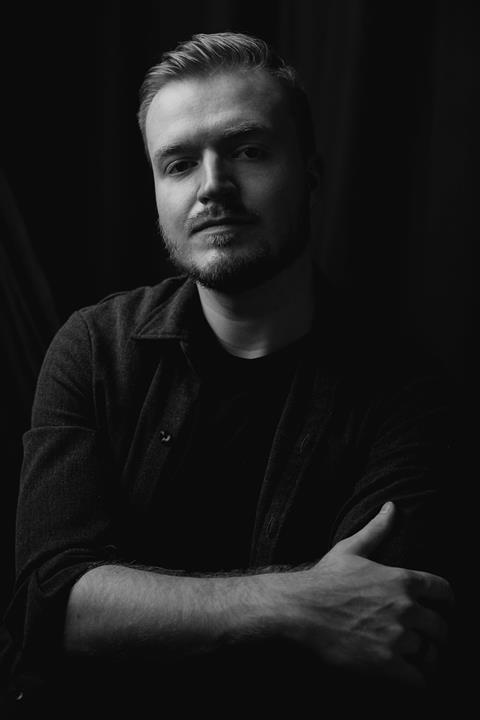
Ahead of the premiere of his prize-winning work Au delá de la Voûte étoilée (‘Beyond the Starry Vault’) at the Green Mountain Chamber Music Festival, the composer shares insights on the quirks and challenges of writing for strings, as well as why it’s necessary to dismantle a work and start from scratch
Read more Featured Stories like this in The Strad Playing Hub
Composing for strings opens up a technical emporium of sound and a capability for the composer and players to express themselves in unique ways. When I sat down to compose my work, String Quartet no.1 - Au delá de la Voûte étoilée (‘Beyond the Starry Vault’), this treasure trove of sound was at the forefront of my mind and process.
This string quartet is the culminating work of my time at the Juilliard School, technically a rewrite of a piece I composed for a music festival a few summers ago, which marked my first attempt at the form.
Strings were a point of discomfort for me at the time. I had written for cello and piano, piano trio, even orchestra, but I was treating strings purely as a pitch medium. In that first version, I wanted to lean into harmonics and explore an unfamiliar technical-physics space.
As a wind player and vocalist, breath is intimately familiar to me – but the physics of strings took time to internalise. The piece fell short of its ambitions. The extended techniques were inconsistently and poorly deployed; a stunted dynamic range limited its overall impact. I played it too safe.
Nearly a year after its second performance, I decided the revision couldn’t be a spot-check of the existing score. It needed to be a full dismantling and rebuild from fragments, a way of thinking that would later become a thematic touchstone for the work itself.
What went first was the concept. The original piece touched on human themes, ideas of emotion and change, elasticity. I didn’t realise at the time, but I limited myself with movement structure that was overtly specific before I began the process. I decided what to conceptually provoke before I even put a note down, and it sterilised my writing. I started again, thinking about one overarching thematic pull that could be interpolated in different ways.
My new title, Au delá de la Voûte étoilée was a play on a similar title from an orchestral work by Charles Koechlin, Vers la Voûte étoilée. I didn’t want to be derivative in any matter musically, but his tone poem ’Toward the Starry Vault’ presented a thematic idea I wanted to play with in ’Beyond the Starry Vault’. Not as if stuck and reaching, but already there, and curious at the scene of the stars, and looking backwards to where we came from instead of away from it.
I took themes from my first version and transformed their musical DNA so-to-speak, stretching and contracting their ideas to meld into new thoughts and musical fragments. Musical cohesion was missing in my original, and I focused on that heavily in this new version – the main thematic idea persists throughout various modulations, inversions, retrogrades, etc.
The cello displays an instance, the viola recalls and extends it, the ensemble displays it as a composite unit, a spectral manifestation. String instruments excel in spectralist music, as their sense of sustain is not inhibited by the human capacity to breathe – I think this (late) realisation was where my attention turned for the better.
String instruments’ sense of sustain is not inhibited by the human capacity to breathe
The process of composing this work was sporadic and new for me in many ways. The premiere performance of it at Juilliard was with a group playing historical instruments, tuned to A=415. When stuck at my desk composing, not knowing what to write next, I thought I’d re-tune the file in my computer to that baroque tuning and see what sparks flew. Thankfully, it was many – this opened a whole new world of harmonic relationships in this way.
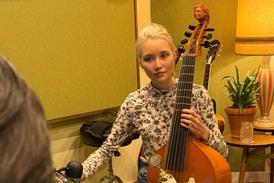
As well, rehearsing with these instruments informed much of the desired sound world for this piece – the depth and warmth the gut strings added to the effect has been baked into the score since then, and their fragility in moments of lingering was something I latched onto and implemented within the music itself. I’ve never experienced a compositional process like this before, and I continue to pinch myself that it seems to have enjoyed some success.
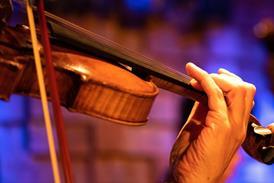
In the piece, I rely on effectual and shimmering textures in the strings to produce characterisations of sound, of the idea of these things in our gaze. The stars, the deep, hazy space between them, the silent violence that occurs every second in the sky. Using string harmonics in various ways allowed me to shift context without shifting character in the music and leaning on false harmonics to fill in the gaps aids in the sort of otherworldly sound that I can achieve here.
The first, second and third movements show off many of these technical challenges in the work – the first movement (’Tapestry in the night’) shows a more spectralist edge of the quartet, with many sustained harmonic tones, and pulses of shimmer, star-shine.
There are abrupt moments of motion punctuated by sharp pizzicato, as if a galaxy had been born before your eyes, and various interluding sections of sul ponticello pulsing, tremolo, stasis and calm.
The second movement (’Glinting light’) agitates the stasis. Pizzicato no longer incites motion, but instead restless sustain. Extensions of the previous movement’s harmonic language, and short moments of climbing, plateauing.
This second section brings along the third (’Star-hopping’), which is consistently underpinned by a more focused sense of motion between the second violin and viola. They relentlessly play an arpeggiation, a bariolage between harmonics of the same partial across all four strings, ad nauseum through this movement. This shining, active backing pushes the other voices forward as the first violin soars above it, and the lower voices shimmer below.
Four short, delineating moments bring the momentum down, only to erupt into the fourth movement (’Stardust’). The entire movement is built around a consistent semiquaver-note pulse that stays rampant throughout. Through this, there are moments that peek out from the coarse texture, soaring harmonic lines or small, jutting accents, like constant flicks and sparks of light and sound.
The fifth movement abruptly follows, similarly to before, but now taking the texture in the complete opposite direction – near complete stasis (save the glissandi) on only artificial harmonics now, in full contradiction to the natural starlight before. This movement ponders, it lingers and is thin. Its distance from the material before it helps the audience and performers gauge the sense of emptiness and loneliness that can be and is between the stars.
After this sense of still and calm, the piece ends with a chorale (’In the wake of the sky’), where the strings settle in a much lower tessitura than the preceding work. This finale is where we came from, where we are, the ground beneath our feet. The warmth that unfolds in this final statement is in direct contrast to the cold fragility of the previous, the ensemble blossoms into the most sonorous chordal material we’ve heard in the past 15 minutes.
The final string of harmonics that close this movement pulse into nothingness, each iteration allowing different partials to poke through the texture as the bow pressure and speed decreases. This final moment seeks to lean into an understanding of us not only pondering what is beyond but also being beyond.
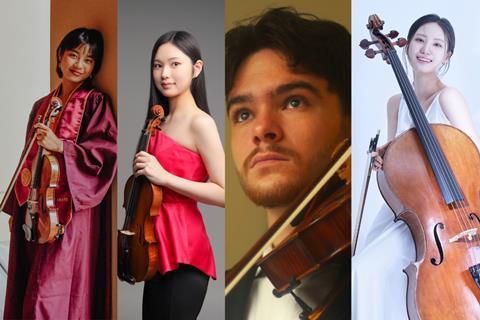
Ethan Jankowski’s String Quartet no.1 - Au delá de la Voûte étoilée will be performed at the Green Mountain Chamber Music Festival (GMCMF) on 14 July 2026 at the Elley-Long Music Center, Colchester, VT. It will be performed by the GMCMF Fellows Quartet comprising violinists Mei Liu and Eunbee Cho, violist Brian Jennings and cellist Jugyeong Kim.








No comments yet