







Ben Michaels examines the scores behind three newly commissioned works that appear on his new album for cello, by cellists, uncovering how distinctive musical voices can transform a single cello into an astonishing range of sound worlds
Discover more Featured Stories like this in The Strad Playing Hub
Today is the culmination of a project that has occupied me for the last few years - the release of for cello, by cellists; my album of newly commissioned solo cello music, written exclusively by cellist-composers.
It was evident how varied the pieces were going to be, right from the very beginning of my discussions with the six composers. In many ways this was expected, given that the artists I had chosen to imagine the works were so different. However, despite my time devoted to exploring new music, the enormous differences between each work – as well as contrasting subtle relationships to the instrument and discovered techniques – took me by surprise.
Somehow, the simultaneous freedom and focus of the project (an acoustic, solo cello piece of any length but only from cellist-composers) offered clarity in appreciating both the contrast between the pieces and the artists responsible for each.
Spending time interpreting these six scores has given me a new appreciation of each artist. Without any direct discussion in words, I feel I know more of their individual musical voices and personal relationship to the cello through the way they have written their music. Each score looks as different to me as the pieces sound.
It seems a shame that contemporary scores are often only seen by performers. Below, I show glimpses of three of the scores, to illustrate the originality of each composer.
Towards the Flame by Colin Alexander
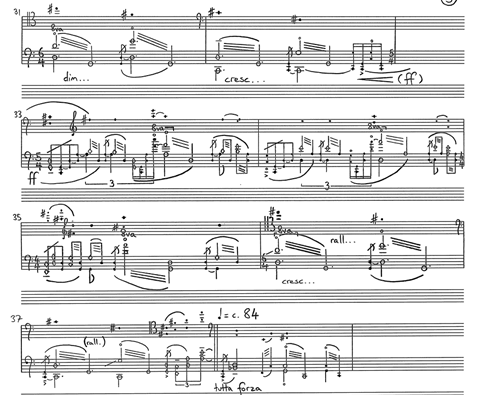
Towards the Flame by Colin Alexander, is a suite of four movements, depicting different stages of a fire. The score is both restrained and meticulous.
Looking at the score, it is clear that Colin’s imagination is driven by sound, and the piece is a masterclass in how to produce a rich, symphonic palette from a single cello. For instance, the passage above is played using open strings, harmonics, and across multiple strings in a way where the instrument happily continues to resonate.
Indeed the piece as a whole includes almost zero traditionally stopped notes – these would stop resonating the moment the left hand moves away. In addition, clever techniques including tremolo harmonics or playing near the bridge trick the cello into producing layers of stable overtones. The result of all these tricks is a fullness of sound that in normal circumstances would necessitate more than a single instrument.
Two other noticeable things about his score are that it is beautifully handwritten, and that it is across two staves. Both these things actually happen to tell us a little of Colin’s improvisatory creative process.
First, not many notes come out sounding as they look; Colin’s extensive use of harmonics result in notes sounding at a different pitch to where they are played and due to scordatura the cellos strings are tuned to atypical intervals. He uses a higher stave to confirm sounding pitches, and a lower to indicate where they are played. This technical complexity is no accident – Colin uses harmonics and scordatura to aid discovery when improvisating, finding new colours and melodies by chance, rather than being stuck behind a predictive technique.
Second, although meticulous handwriting of the score is extremely labour intensive, it is very much part of his creative process. After composing the pieces in sketches he talks of discovering and adjusting the piece in full, sitting for long periods to write it carefully from beginning to end. The physical writing of the score is a performance with an element of improvisation in itself.
Inila by Zoë Martlew
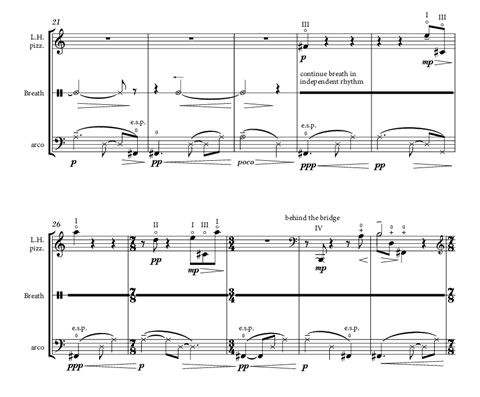
Inila by Zoë Martlew is a powerfully quiet piece, describing the fizzing silence of the forests and mountains of rural Iowa.
Zoë’s undefinable nature as an artist and performer is immediately visible from her score. In fact, the writing looks nothing like a solo cello score at all - perhaps closer to a percussion ensemble, or organ music. Written on three staves, she instructs the players left hand, breath and right hand independently, in direct conversation with each other.
In contrast to Colin’s exploration of the fullest sound of the cello using inherent harmonic overtones and resonances, Zoë’s imagination seems to push the boundaries of the instrument (and performer) as far away from tradition as possible - also searching for the instrument’s fullest sounds, but by any means.
Each stave of the score searches for new sounds from cello and cellist. The extract above includes the left hand independently stopping and pizzing harmonics all over the instrument, including behind the bridge. In addition, the strings are prepared before the performance by clipping clothes pegs to them and tuning adjusted with scordatura. The resulting strange dull microtonal resonances and quiet juddering clacks are more like a broken Mbira (finger harp) than string.
The bottom stave indicates explorations with the bow; over the piece the cellist is instructed to play on the clothes pegs, the body of the cello, the spike and all parts of the string, using both the stick and wood of the bow. Zoë defines new terms to guide this new world of sound production, including ‘e.s.p’ – extreme sul ponticello.
It is clear that the sounds in this piece live in white noise and silence (at one point marked pppppp!) - a space not traditionally associated with string instruments. Zoë discovers fizzes, hisses, scrapes and empty noises in an unbelievable variety of inventive, practical techniques. All are carefully orchestrated in a way that is possible for one cello and one cellist to achieve at once.
The middle stave indicates breath and in other parts of the piece shows finger percussion on the instrument, chanting or singing. The sounds from this indication are designed in such a way to extend and overlap with played noises and confuse the listener. In this extract, the breath is instructed in a way that imitates the noise of the pegs. Heard together they make a swirling cloud of white noise.
Mandala by Laura Moody
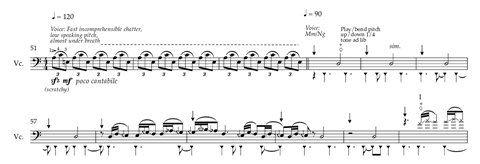
Laura Moody’s piece, Mandala, is a sonic representation of the experience of a mandala meditation. The piece is built from repeating segments of contrasting musical motifs. They represent the practice of mandala meditation itself - how the mind is occupied by allowing your eyes to follow the intricate shapes of a mandala drawing.
The score is dense with instructions and full of new symbols. In the extract above, arrows to indicate a specified percussive breath sound, inverted triangles to show an inventive gong-like bow pizzicato technique and descriptive text directs the use of the voice.
Much of the musical information in the score is embedded with choreography and circular movements. Sometimes, the choreography is specified, for instance all left hand pizz harmonics are directed to be followed by drawing a large circle with the left hand while they ring. In another part of the piece, the choreographed movements appear by physical necessity; circular bowing with the right arm, and large glissandi with the left hand produce two simultaneous large circular movements with each limb.
Just as in Zoë’s piece, Laura seems committed in pushing the cello into unusual palettes of unexpected, discovered sounds. However, in contrast to both the pieces above, it seems clear to me that Laura is also deeply interested in exploring the physicality of the performer, how bodies make music and how this can be used to enhance a performance.
The score is not simply an instruction for sound and musical intention, but also for communication of the cellist through physical gesture. Indeed, some parts of the score even remind me of notation for dance choreography; atypical symbols, descriptive text and sections left open for improvisation through repetition. The piece is a series of movements that happen to make sound, and I am pleased to have had my mind opened to this aspect of music making.
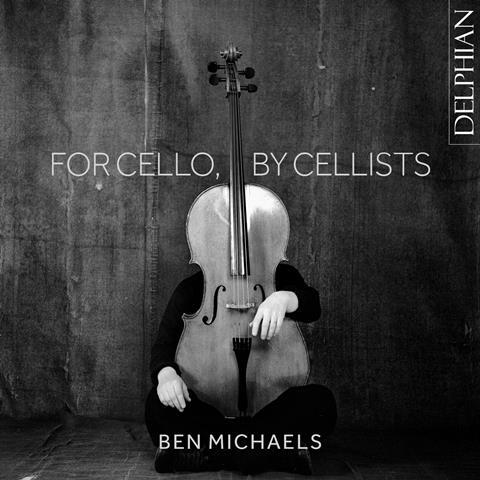
For me, the project is a celebration of the cello, and the variety of musical personalities it is able to empower. Every score is full of new techniques as each composer stretches the instrument to fulfil their own musical imagination.
However, my lasting impression of these six pieces is not their technical inventions, but how each composer is able to communicate their own unique voice using the same instrument - even when they aren’t the one performing.
As a performer, it reminds me that what I most appreciate communicated in music comes from honesty, not invention. Somehow, in an album recording music from other musicians, this project has reminded me of the value of playing as myself.
for cello, by cellists is released on 18 September 2026 on Delphian Records.
Read: For cello, by cellists: how six new cello pieces celebrate the versatile identity of the cello
Read: Cellist Colin Alexander: how I notate improvisations
Discover more Featured Stories like this in The Strad Playing Hub











No comments yet