



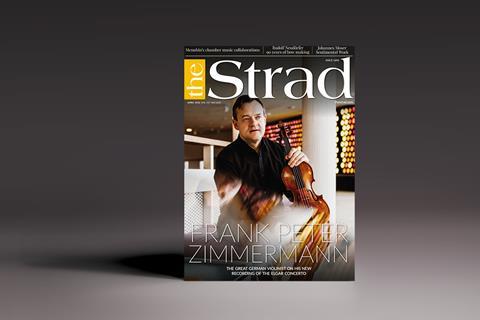



The German violinist on connecting with audiences and staying true to your convictions
Discover more Featured Stories like this in The Strad Playing Hub.
Read more premium content for subscribers here
It was a coincidence that most of my teachers were world-class quartet players. It meant that they were all people who respected others’ opinions and had the skills to treat students as colleagues with responsibilities. One of these tutors was Wilhelm Melcher of the Melos Quartet. During my youth, I was so impressed when I heard him play on stage, and he set the spirit for how I would go on to develop as a musician. I then learnt with Günter Pichler from the Alban Berg Quartet. He had extremely high standards but always with a deep humanity. I still remember coming into a lesson having prepared a Bach solo sonata, thinking my interpretation was so clever!
After I played, he just said: ‘Life has always been the same.’ By that he meant that even 300 years ago when the piece was written, the inner lives of people were the same as they are now. It made me assess how I relate to this musical language and how it concerns me. This is still relevant today when we play for audiences, whose inner lives will be nourished by the music we make. What you have to say is relevant to more people than you think.
Pichler also urged me to be surprised by the things that seem evident. It can be easy to get lost in what is familiar, but we need to find what makes a piece unique and precious. It is tempting for young players to think they have to play a Mozart concerto in a specific way, but remember that it was written by a young, exuberant composer – so we want to feel exuberant about it! I encourage young musicians to question old formats. This doesn’t mean betraying tradition but instead trusting that the message of the music is strong enough to cut through whichever way you present or interpret it.
One way to keep this freshness is to be creative in your practice. That time alone is such a treasure. It is a moment to try things out with no inhibitions. You dive into the score and make it part of your own being – both on a physical level and, of course, with all your heart.
Robert Mann of the Juilliard Quartet was another important teacher later on when it came to creative thinking, as was Eberhard Feltz in Berlin when I started teaching. Today, the balance of performing and discovering rarely performed repertoire and teaching keeps me continually learning.
Particularly in today’s accelerated world, it can be difficult for young players to find an inner meaning in what they do, and as teachers we must give them the confidence that it exists. I have often found that when you are driven by your own conviction rather than striving for external acclaim, everything becomes easier. Then you have the courage to do it, and you’ll do it well.
INTERVIEW BY RITA FERNANDES
Read: ‘We could all do with being a little less vain’ - Tanja Tetzlaff’s life lessons
Read: ‘You have to feel you’re worthy of standing on stage’ - Julia Fischer’s life lessons
Discover more Featured Stories like this in The Strad Playing Hub.
Read more premium content for subscribers here









No comments yet