







After a lifetime on stage, cellist Michael Reynolds reflects on the moment he realised it was time to set performance aside – and how stepping back has unexpectedly reshaped and deepened his life as a teacher
Read more Featured Stories like this in The Strad Playing Hub
When I was younger, I had always been puzzled by older musicians taking to the stage after the full flower of their performing careers had begun to decline. I had also heard many stories about great teachers who practically never played on stage or in lessons (and when they did, students kind of wished they wouldn’t).
For teachers as they aged, some of the usual symptoms were a gradual widening of the vibrato, increasingly questionable intonation, rough bow changes, shaky bow, and more frequent memory lapses. Or a combination of the above. It could get a little tricky when congratulating the performer after a concert. A few recommended comments: ‘how you played!’, ‘I loved your tempi’ and ‘mmph, you did it again!’ could come in handy.
There are of course also many examples of truly great teachers who never had much of a performing career (Ivan Galamian comes to mind) but who exerted tremendous positive effects on entire generations of students. I suppose that there are as many reasons for this career path as the day is long – stage fright, more modest physical talent, distaste for the performing business, or simply the draw towards pedagogy.
One of my greatest mentors was the legendary clarinettist Mitchell Lurie. We had the indescribably good fortune of meeting and performing with him at an alumni event for the Curtis Institute of Music where we had all studied. This meeting developed into a collaboration and friendship over many years, including a European tour and recordings of the Brahms and Mozart Clarinet Quintets among other projects.
A few embedded memories: as we were about to perform the Mozart Clarinet Quintet with him at Curtis, I noticed that he was standing backstage looking very calm and collected (we were all nervous as cats given the history in that hallowed hall). I sidled up to him and asked: ‘what’s your secret, Mitchell?’. He pondered for a moment and then said:
‘I always think of two things before I step out on stage: I look for something new in a piece I may have played 100 times, and I always give 100 per cent of what’s available’. I was certainly familiar with the second comment, having walked on stage many times either sick or exhausted – sometimes digging a little deeper in that state can achieve more profound musical results.
One thing that struck me in my many conversations with Mitchell was his insistence that we tell him honestly when we noticed things starting to slip. He had personally seen many colleagues insisting on continuing to perform sometimes well after their abilities had begun to diminish, and he had no desire to follow that slippery slope.
He therefore surprised all of us when we performed the Brahms clarinet quintet with him at a festival and he announced afterward that this was his final performance. We were quite saddened and somewhat puzzled, as we all agreed that it was one of the best performances we had had with him. He didn’t say much other than that he knew it was time.
In hindsight, I remember the moment when something wasn’t quite right for me on stage. A simple bobble at a bow change during that beautiful cello solo in the slow movement of the Brahms C minor Piano Quartet. I didn’t think much of it at the time; playing and performing had been easy for decades, so I figured that it was just the low humidity where we were performing.
Over time, these irregularities with the bow started to increase alongside some difficulties with upper position work, and I started down the long path of massage and physical therapy. That seemed like a logical direction to go given how much I was performing, and I surmised that it was simply overuse. Despite the benefits of therapies, I started having to combat an increasingly shaky bow arm.
A friend who was going through the same general experience suggested that I see a neurologist, which I did. The diagnosis was essential tremor. In hindsight, I shouldn’t have been surprised; my father’s side of the family has a history of a variety of neurological disorders including tremor and Parkinson’s. In my investigations, I soon learned that tremor and other neurological disorders are quite often hereditary.
Not quite ready to put the instrument down, I was told that gradually increasing amounts of the beta-blocker propranolol (the generic version of endirol – which we as performers often jokingly referred to as end‑it‑all) might keep me in the game a bit longer. This was later occasionally accompanied by a glass of wine for more high‑pressure events; this combination tended to do the trick, and I was able to perform regularly and fairly successfully for a few more years. The addition of wine tugged at my conscience; I had heard many stories of performers going down that slippery slope to combat nerves, often with negative effects on their health.
It finally occurred to me during Covid that the time had come for me to switch gears as a musician. I love to teach, and I had always played and demonstrated in lessons for 40 years. That said, I looked back at my experiences with such great teachers as Marta Casals and Karen Tuttle, who never played in lessons. I can honestly say that I learnt as much with them as I did with my teachers who demonstrated. Demonstration can actually be a bit of a crutch; it can potentially disguise the inability to describe the solution or best process for those natural players who never really had to think about how they made it all work.
This direction was not a straight line for me; I still occasionally pick up the instrument to demonstrate a phrase, describe a shift or other left-hand behaviour, or give a student a visual cue around fundamentals. One of the benefits of now really having to think through solutions descriptively is that I think I have become a better listener and observer. By focusing less on demonstrating and more on finding ways to effectively describe technical tools or musical character, I actually think I am becoming a better teacher.
By focusing less on demonstrating and more on finding ways to effectively describe technical tools or musical character, I actually think I am becoming a better teacher
I haven’t really noticed my students having a big problem with this transition; they often tell me that their previous teachers were not playing anymore or never were active performers. I’ve had the good fortune of having a fair amount of recording, which can give students some additional insights into some of my ideas around interpretation.
I also encourage students to listen to some of the great masters of previous generations like Heifetz or Casals. That reminds me of a story about Casals that he related: He had been mountain climbing when a rock fell and hit his hand. Casals’ first thought at that moment was ‘I don’t have to practise anymore!’. To our immeasurable benefit, he healed and continued to give all of us the gift of his great musicianship for many decades.
Do I miss practising and performing? Of course I do. I can’t say however that I miss those last few years where it really was becoming a struggle. That all said, I feel like that struggle has actually been a gift – it has encouraged me to listen and observe more carefully and to think more deeply about effective processes and the many pathways toward helping students to become better players and musicians.
And… I don’t have to practise anymore!
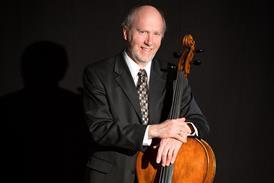
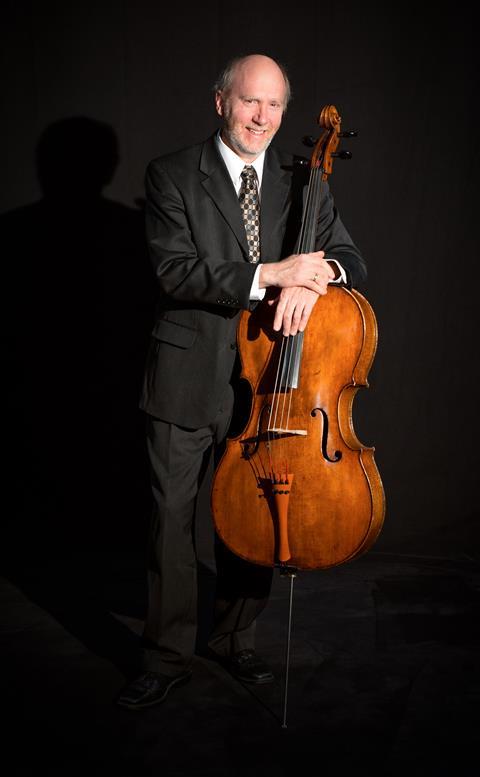
Michael Reynolds is Professor of Cello at Boston University. He enjoyed a 40‑year performing career of over 2,000 concerts worldwide as founding cellist of the Muir Quartet and as a soloist; accolades include a Grammy nomination, a Grammy, two Grand Prix du Disques, the Gramophone Award and a performance at the White House.



















No comments yet