
![[defs use this] CelebrationByDAddario_388 pc Denny Medley Random Photography](https://dnan0fzjxntrj.cloudfront.net/Pictures/274x183/5/0/9/43509_defsusethiscelebrationbydaddario_388pcdennymedleyrandomphotography_776141_crop.jpg)




In the first of two articles marking the 160th anniversary of the Polish luthier’s birth on 25 June 1866, Grzegorz Kaproń gives a brief overview of his life while Henry Riedstra examines a typical viola by the maker
Discover more lutherie articles here
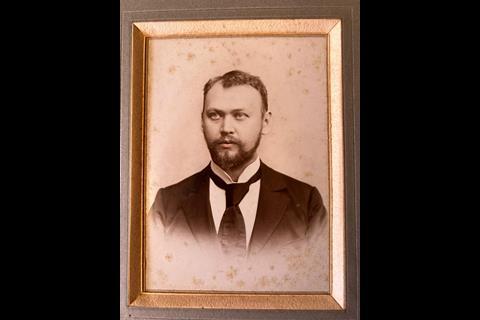
The year 2026 marks the 160th anniversary of the birth of Władysław Baczyński, one of the most significant Polish violin makers of the 20th century. In 1927, the Polish violinist and music teacher Edmund Giżejewski included him among the three most outstanding luthiers then working in Poland, along with Gustav Häussler in Kraków and Tomasz Panufnik in Warsaw. The Hungarian violinist and soldier Marczi Zöldy called him the ‘master of the violin and artist of the soul’. In tribute to this anniversary, we present here a brief overview of Baczyński’s life followed by an analysis of some of his instruments.
Władysław Piotr Baczyński was born on 25 June 1866, in Łodygowice, near Żywiec, Galicia. Around 1894, while a clerk in the Accounting Office (Branch VII) of the Imperial-Royal Railway Directorate in Kraków, he began studying violin making with Gustav Häussler. In 1904 he moved to New York, where he began working with Henry Richard Knopf. His innate abilities and the experience he gained in preserving the original violin masterpieces created by the Cremonese masters became the foundation for his creative work in Lviv, where he arrived in late 1906.
In 1910 he joined the emerging Association of Violin Makers of the Austro-Hungarian Monarchy (Verband der Geigenmacher der Österreichisch-Ungarischen Monarchie) based in Vienna. Two years later, he won the first prize and a gold medal for musical instruments at the international exhibition in Budapest. In 1913 he joined the Association of German Violin Makers (Verband Deutscher Geigenbauer) based in Berlin.
The dramatic events following the outbreak of World War I forced Baczyński to relocate temporarily to Kraków. However, he quickly returned to Lviv, where he continued his violin making work. After Poland regained independence, successive state institutions confirmed his professional qualifications.
Władysław Piotr Baczyński died on 9 June 1935 in Lviv. He was buried at the Lychakiv Cemetery.
During his lifetime, he crafted 283 stringed instruments with an old Italian sound, inspired primarily by the works of Stradivari, Amati, Guarneri ‘del Gesù’ and Giovanni Battista Guadagnini. As well as violins, this number included no fewer than eleven violas and at least six to eight cellos. Their finely carved scrolls inspire universal admiration.
1908 Viola
Form and construction
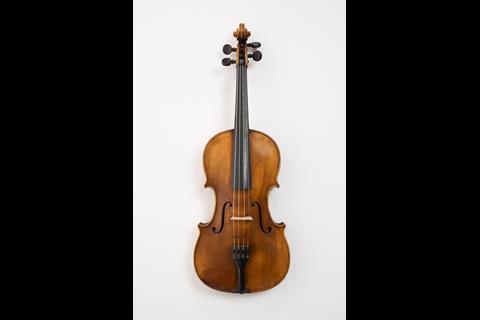
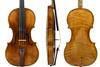
Baczyński indicated in his 1909 price list that his two sizes of violas are both Antonio Stradivari models. He describes one as a ‘regular’ format [396–8mm, 15 5/8 inches], and the other as ‘enlarged’ [418mm, 16 7/16 inches]. These formats, although inspired by Stradivari, are not meant to be exact copies. For instance, all extant Strad violas, including the ‘Mahler’ (1672), have a longer body.
The viola presented here has a 398mm body length whereas the contralto viola model that Stradivari constructed in 1690, and used for all his subsequent violas, varies from 411 to 414mm. The upper bouts of this Baczyński are 3 to 4mm wider than the ‘Tuscan Medici’ (1690), the ‘Archinto’ (1696), and the ‘MacDonald’ (c.1719), for example.
In contrast, his middle bouts and lower bouts are 4 to 6mm less than these Strads. His 210mm stop length (measured from the upper treble-side edge of the top plate where it meets the foot of the neck, to the inner nick of the treble f-hole) is also understandably 9 to 14mm less than that of these Strads. All these measurements were done with a tape measure. As for Baczyński’s ‘enlarged’ model (418mm) it is actually 4mm longer than Strad’s contralto violas.
Like the Cremonese, Baczyński appears to have used a precise internal mould. Similarly, according to luthiers who have examined the interior of his violins, the interior blocks and linings are usually of spruce and/or willow, although one has been found with walnut linings. Each of his four C-bout linings is securely fitted and glued into a slot that he carved out of the corner-blocks, in the same manner as Stradivari.
Characteristics
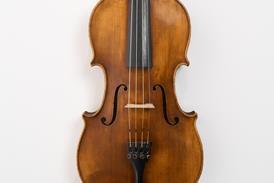
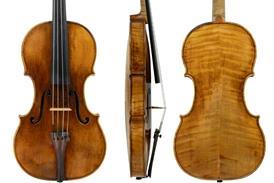
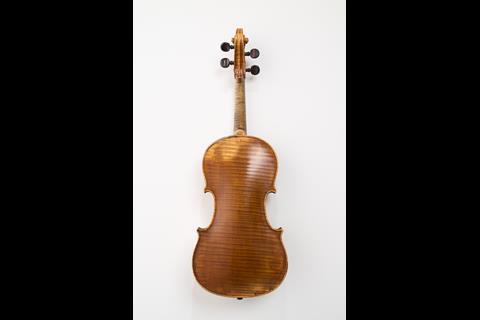
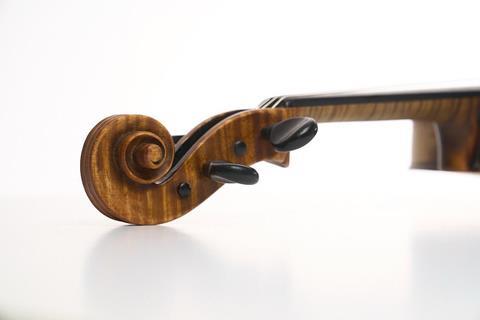
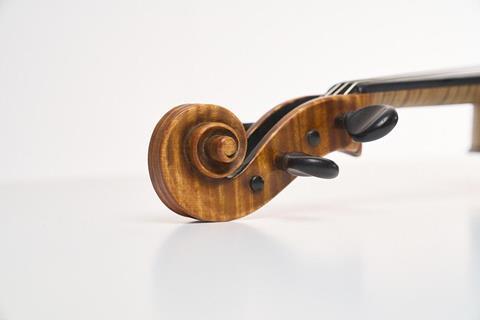
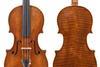
Like Stradivari’s scrolls (except for one), Baczyński made the 1/4-cut, flamed sycamore maple head on this viola in the style of a cello scroll. It has standard proportions. The deep fluting is quite smoothly finished, although there are some gouge marks on the outside of the spiral. The wood of the scroll and ribs matches that of the one-piece back with its attractive narrow flames descending to the right. There are no pins in the back.
The longitudinal arching of both the top and back is medium to low, the top being flattened somewhat in the central region. The lower wings of the f-holes have a light fluting that leads along the shallow edge channel to the rounded edges. The Strad model f-hole eyes are fairly well rounded. The nicks are quite small.
The fairly narrow purfling has a wider maple ‘white’ centre strip. In the somewhat hooked corners, the bee-sting directs one’s attention to their middle, but does not extend to the end of the corner.
Materials
The European curly ‘sycamore maple’ (Acer pseudoplatanus) that Baczyński used is a species that has been introduced to many places in Europe including the UK, as well as to North America, New Zealand and Australia, but is native to Central Europe from France to Ukraine, and south to Bosnia and Herzegovina. It is believed that he got it from the Carpathians near the present-day border of Romania and Ukraine. He may also have purchased wood from traders in Trieste (now in Italy), since he wrote about that city in his price list.
According to a family document, his top plates are made of at least 60–80-year-old resonant spruce that he and his son would look for in old churches. The two-piece spruce top of this viola has a fairly dense straight grain.
Label
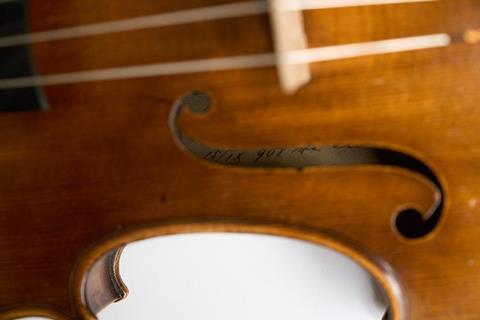
The label in this viola is in cursive writing. Translated, it reads: ‘Opus 68. Built by / Władysław Baczyński / 15 / IX 908 in Lviv’ (meaning it was completed on 15 September 1908).
Varnish
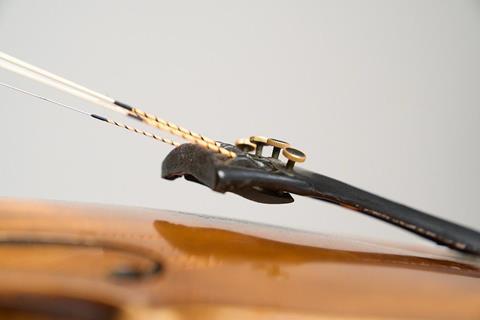
When this viola was made, Baczyński was only using oil varnishes. He didn’t start using spirit varnishes until after 1910. The thin varnish on this viola is light brown with a greenish tint. It has been worn down to a golden undercoat in various places where it has been lightly shaded from handling. In contrast, Stradivari always used an oil varnish, although, like Baczyński, he made a limited number of violas.
Thanks to Karine Baczyński, Sylwia Matuszyńska, Michał Micker and Ralph Schultz for their help with this article
All viola photos taken by Karol Adam Sokołowski







No comments yet