
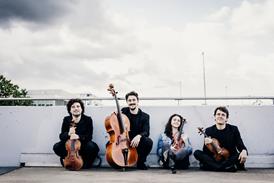



Richard Linnett reports back from a concert of string quartets by Philip Glass, held at Santa Fe’s Lensic Theatre on 4 October 2026
Discover more Featured Stories like this in The Strad Playing Hub
In his memoir Words Without Music, Philip Glass praises the music of Charlie Parker and Bud Powell as a ’flow of energy that seemed unstoppable, a force of nature.’ In mounting a full programme of Glass quartets, Brooklyn Rider proved the same can be said of Glass’s work.
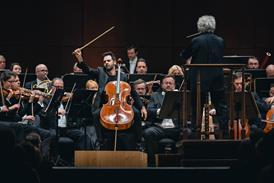
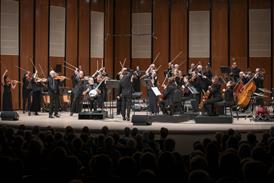
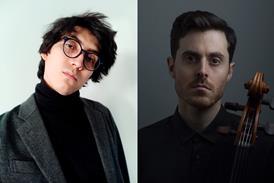
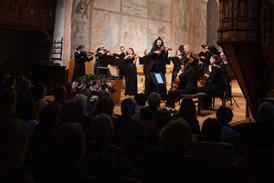
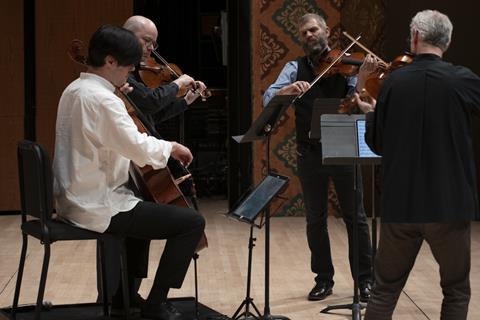
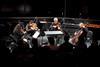
Temples of Resonance was the title of the 4 October show at the Lensic Theatre in Santa Fe, an exhilarating two-hour performance of six of the composer’s nine quartets. It served as marking the anniversary of Brooklyn Rider’s 20th year, while also anticipating the composer’s nonagenarian celebration (he turns 90 next year). Watching Brooklyn Rider perform with heart and soul was as much a full cup as hearing the extraordinary range of sounds they produced.
Violist Nicholas Cords, in his introduction of the programme, warned that if anyone in the audience had the slightest trepidation about attending a show of strictly Glass, they could be assured that yes, there would be the iconic Glassian repetition, textures and harmony, but ’across all this music, what results is a complex space filled with a wildly diverse range of human emotion and experience’.
Two of the quartets in particular stood out for their emotional impact, Quartet no.5, which the Riders played with a very deep, rich tone. Johnny Gandelsman on first violin and Colin Jacobsen on second (they swapped chairs later in the show) sounded like a locomotive roaring into a station in the second movement. Overall the piece flowed with lyricism and dramatic texture shifts that were aggressive but wound down to Buddha-like waterfalls of serenity.
The heartrending Quartet no.4 offered an elegiac tribute to the life of artist Brian Buczak, who died of AIDS at a young age. The second movement was eerie like a film noir, with Michael Nicolas on cello, driving the team through brooding rhapsodies.
This was the second programme of Santa Fe Pro Musica’s new season, which unfortunately got off to a halting start in their first programme the week before, featuring banjo master Béla Fleck. I attended the second night of the two-night Fleck programme, and it was clear there were timing miscues between the banjo artist and the Pro Musica orchestra.
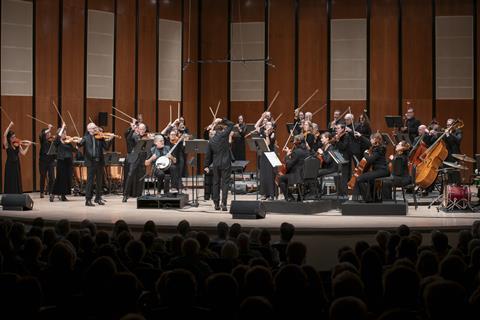
Additionally, Fleck’s instrument was inadequately amplified and was often drowned out, especially during Gershwin’s Rhapsody in Blue. Backstage after the show, Fleck admitted that he was not used to working with a conductor (violinist David Felberg in this instance) let alone an orchestra. It was obviously an experiment, and a brave one.
The theme of the new Santa Fe Pro Musica season is Democratic Vistas. Artistic director Colin Jacobsen’s ambition here is to highlight American music and composers, in a kind of populist jubilee. On paper, Gershwin and Fleck fit the bill, but Rhapsody in Blue, no matter how twangy and lavish, makes me instinctively reach for my seatbelt and prepare for a United Airlines flight, given its usage as the airline’s official theme.
Philip Glass, on the other hand, may not be quite as popular nor populist as Gershwin but his hypnotic work, as demonstrated by Brooklyn Rider’s stunning performance, is more nuanced and in many ways more human.
Photos courtesy Santa Fe Pro Musica.
Read: Staying power: US String Quartets
Read: Steve Reich at 90: Different Trains at the Glasshouse
Discover more Featured Stories like this in The Strad Playing Hub







No comments yet