







What can collaborating musicians learn from tennis players? Violinist and former junior tennis player Geneva Lewis shares how the mindset of adaptability, creativity and spontaneity can benefit players both in the concert hall and on the court
Discover more Featured Stories like this in The Strad Playing Hub
Growing up with a father who was a Wimbledon finalist, and as someone who competed in junior tennis when I was young, the similarities between tennis and violin performance have been a topic of fascination throughout my life. These similarities are characteristics and experiences that are shared in any pursuit of excellence within a craft. In order to be a serious tennis player or violinist, certain things are essential – strong work ethic, hours and hours of dedicated and purposeful practice, talent, access to quality equipment, coaches/teachers, etc. Beyond these fundamentals, I believe the experiences of playing tennis and music can be very alike.
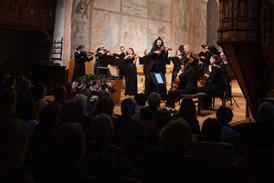
In my own life, the art of chamber music has shaped me the most as a musician. In any musical collaboration, whether it’s with one person or an orchestra, I try to approach the experience with a chamber music mindset. Many of the qualities that I love most about playing chamber music are also present within a great tennis match. There is such a psychological game in the way that you try to read and evaluate people – with limited cues – within a very short amount of time.
In tennis, you are constantly trying to assess your opponent in order to find and exploit their weaknesses. You need to develop an almost instantaneous reaction time – what strategic patterns do they prefer, where are they going to hit their next ball, and how? Are they more comfortable initiating, or reacting? How do they perform under pressure? What is their emotional state, physical state, mental state? How can you best respond in order to gain the edge on them?
In chamber music, I find it to be a very similar process, with the obvious difference being that the goal is to uplift your partner rather than compete against them. There is the same experience of trying to mind-read and follow the most subtle of cues. Where are they going to place their next note? What colour, timbre, pitch, volume, emotional world? How can you support that and predict it before it’s happened? How can you inspire them?
The transition from individual practice to collaborative work is also a similar process. In a chamber music collaboration (concerto playing included!), you spend a long time developing your interpretation, a process which includes imagining aspects of the music that someone else will be playing. You want to develop a deep and comprehensive understanding of the piece in order to best inform the way you want to play your part, and to figure out what the music means to you.This will allow you to go into rehearsal or performance with a clear point of view, and to hopefully be able to convince and inspire with the way you play.
Ideally, everyone else involved in the collaboration does that same work. This means that there will, of course, be some interpretive disagreements. When this happens, the least satisfying thing that can happen is that neither person is open, and the musicians stubbornly continue to play their part without change. This takes all the beauty out of collaboration – the curiosity, the spontaneity, the humility, the respect, the creativity.
In tennis, this is the equivalent of playing against a wall, or perhaps being the wall. Some players get out on court and play with the same strategy, the same game, no matter who the opponent is. The predictability makes their game far less effective, and much less entertaining to watch. What is fun to see is when both players are constantly changing and adapting. Although the players are competing against each other, it’s still a much better match when you can feel the players are totally locked in with each other, the same way you want to feel musicians engaging with each other.
Tennis is justifiably an art, and violin performance can feel very much like a sport. Both require the ability to perform under high pressure, dealing with nerves and adrenaline, and figuring out how to direct that energy in the most beneficial way. Both require the ability to stay focused and fighting throughout the entire performance - avoiding even short lapses is crucial, as well as developing the ability to recover quickly from a misstep. Although physical fitness has different contexts within the two, both require thoughtful caring for your body in order to perform at your best – creating the opportunity to feel physically good for each performance and match is crucial.
Tennis is justifiably an art, and violin performance can feel very much like a sport. Both require the ability to perform under high pressure, dealing with nerves and adrenaline, and figuring out how to direct that energy in the most beneficial way
Perhaps the main difference is that tennis exists within a more black-and-white world than music does. At the end of the day, what matters is who wins the match. It is purely result driven. This is something that cannot – and should not – exist within the music world. Yes, there are competitions, but there is no quantifiable way to compare musicians that isn’t highly subjective. The beauty of tennis, however, is not in the win. The beauty is in the way each player shapes their game. The most fun tennis to watch is unpredictable, creative, and superbly executed. The players I enjoy watching the most are those who have unique strokes, distinctive personalities, and yet are able to retain flexibility in their game.
These are the same qualities I love in a music performance – authenticity, beauty, uniqueness. Musicians who are simultaneously able to capture spontaneity and thoughtfulness. Emotional investment which is wholly committed, but not overwhelming to the point of overshadowing the music.
It can be easy for music to begin to feel result-driven and competitive for the musician as well, in performance and practice. There is so much pressure to execute as perfectly as possible – nailing passages, memorising the music without slipping, never having a blemish in the sound. Having an audience there magnifies this pressure greatly. While technique is an integral part of musicality, it serves as a tool for communication and expression, not as an end in itself. A musician’s own standards should be uncompromising, and the priority should always be in the creation of a meaningful artistic experience.
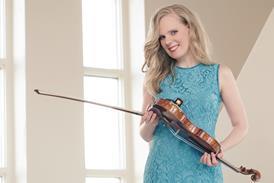
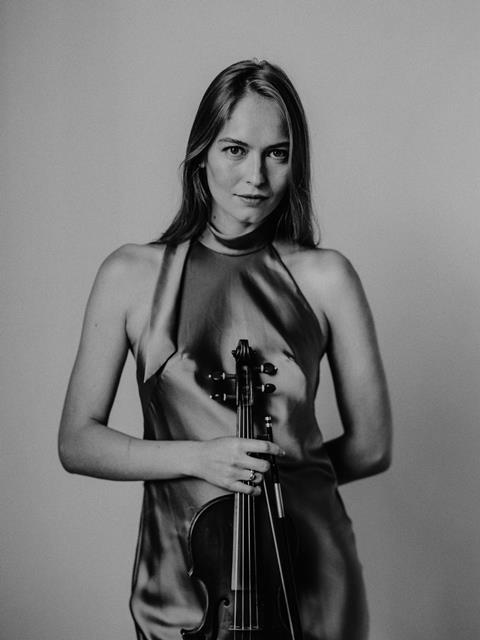
Geneva Lewis releases her debut album on 2 October on the Delos label featuring violin concertos by Barber and Glass and the recording premiere of ‘Partita for The Firebird’ by John Zorn (recording premiere). The recording, supported by Geneva’s 2022 Borletti-Buitoni Trust (BBT) Award, was made with the BBC Scottish Symphony Orchestra conducted by Gemma New. Watch the album trailer here:
Read: ‘A constant friend’: Thomas Bowes on a homecoming recording of Elgar’s Violin Concerto
Read: What can string players learn from tennis players?
Discover more Featured Stories like this in The Strad Playing Hub












No comments yet