







As he releases a new recording of Elgar’s Violin Concerto and five miniatures, violinist Thomas Bowes reflects on a lifelong relationship with the concerto, the emotional resonance of recording at Abbey Road Studio 1 and the camaraderie behind the project with Sinfonia Arcadiana and composer Eleanor Alberga
Discover more Featured Stories like this in The Strad Playing Hub
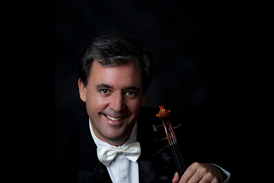
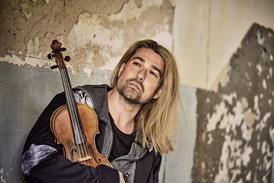
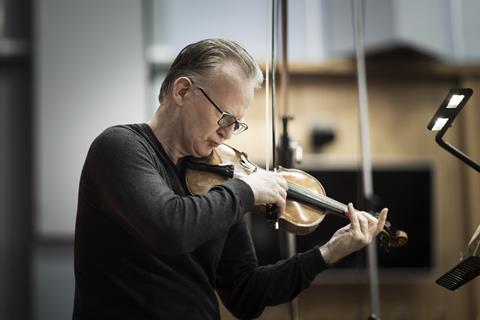
On 25 September, UK violinist Thomas Bowes releases a new album of Elgar’s Violin Concerto and five of Elgar’s shorter works, arranged for violin and orchestra by composer – and Bowes’ partner – Eleanor Alberga.
The album was recorded at London’s iconic Abbey Road Studios. Bowes is no stranger to the studios, given his career playing as a concertmaster and violin soloist for numerous film scores at the venue. However, this album holds a certain homecoming poignancy – Elgar recorded his violin concerto with Yehudi Menuhin in Studio 1 in 1932.
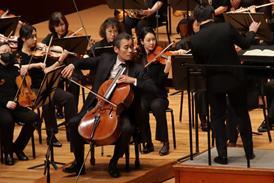
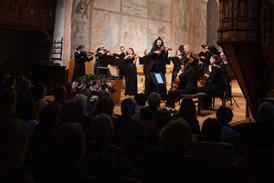
Accompanying Bowes on the album is the recently named collective Sinfonia Arcadiana, comprising London’s finest session musicians and Bowes’ colleagues, conducted by Nic Fallowfield.
Bowes spoke with The Strad about his lifelong journey with the Elgar Violin Concerto, recording the work in such a special venue, as well as working with cesteemed colleagues and his partner.
You’ve called Elgar’s Violin Concerto a ‘constant friend’ since your teens – how did that long relationship shape this recording?
I guess it gave me a kind of certainty as to what I wanted to say with and through this extraordinary piece of music. This length of time – my goodness, over fifty years! - has given the concerto every opportunity to really seep into my bones - both as a violinist and as listener or receiver.
I’ve done a great deal of reading about Elgar and his world, though I’d never say this was ‘research’ or anything like such an organised project. And I certainly didn’t have it under my fingers until I was in my thirties anyway. As my playing became a better vehicle, the concerto both shaped this growth and was in the end the recipient of a decent violinist I like to think – something I certainly wasn’t when I first got to know the piece.
Now that I’m in my sixties, the work moves me even more deeply than it did when I first heard it as a twelve-year-old – that sense of it being like a gigantic novel couldn’t really be grasped by the younger version of myself, though I must have sensed I was in the midst of a great story.
One of the overarching themes of the concerto, at least to my way of thinking, is that sense of the passing of time; what happens to us and the feelings we have for special others, as life moves on.
Perhaps this concerto is unique in its sense of using several time frames. It really is an epic canvas. I’ve always felt that the last movement is told much more in the present tense; as if the narrator of this great story of two previous chapters turns to us and acknowledges that all that has thus far been divulged, happened a long time ago.
The narrator is seemingly very active in the first movement, then perhaps more reactive in the second. But that moment in the finale when all the action and flamboyance of the preceding ten minutes or so seems to have solved nothing in terms of the bigger story is what allows the masterstroke of the whole work to happen.
The calling back from long ago of the tenderest of themes from the second movement, somehow making space for that utterly mystical and magical recalling of the past in the accompanied cadenza. And of course, it isn’t just a retelling of the past that is conveyed but how it feels to be in the grip of sudden vivid memory. We all know this feeling.
How did recording in Abbey Road Studio 1, where Elgar and Menuhin set down the concerto in 1932, influence your approach?
Well of course there was a sense of being in absolutely the right place. Like playing Britten at the Snape Maltings, tennis at Wimbledon, cricket at Lord’s – or what I imagine it’s like to hear Wagner at Bayreuth, it imbues everything with a sort of significance. If one is ready, all the forces are with you.
I’ve always felt that somewhere in the air at Abbey Road there is Elgar, that wounded boy from Worcester who seems to get inside all our hearts. He is, if you will, head ghost in Studio 1! And those so touching images of him in his seventies with the sixteen-year-old Yehudi Menuhin who could even then grasp all the suffering in the piece and all its adulthood. But that’s the beauty of music – it is not just understood in concrete analytic terms but perceived, and above all felt, on its own terms.
What did Sinfonia Arcadiana, comprising top film-session players as well as your colleagues, bring to the symphonic scale of this work?
Everything! There was a sense of being off the leash; everyone was very emotional. Additionally, I was surrounded by friends and those colleagues whose playing and personalities I know so well. That’s not often the case in the life of soloists, conductors and orchestras. But here everyone was in party mode.
There was also a slightly ‘end of term’ feeling as we were near Christmas – there were fairy lights in the control room I remember. That relaxed familiarity allowed me the luxury of reading to the band, before we set off, what Elgar had written about the concerto as he was writing it; ‘It’s awfully emotional…too emotional…but I love it!’.
So off we plunged into this huge river of a piece! Everything went in contrary motion to how film sessions usually have to be run; that is with short takes of pieces of music which can’t, of necessity, be more than a two or three minutes long and almost always tethered to a click and a time code – and then examined forensically as to how they work with the picture.
Here, we just tore into that opening tutti from the first read – and I’m told by editor and producer Stephen Frost that what you hear in the very first phrase is from that first take. But along with beautiful wind solos and incredibly tender playing from the strings it was perhaps the horns and brass who brought most of that essential feeling of Elgarian irresponsibility to everything. I mean the sound was so stirring and released that we were all just swept along immediately; me included. It was visceral.
How did your long partnership with Eleanor Alberga inform her new arrangements of Elgar’s shorter violin pieces?
I think initially Eleanor approached the notion of arranging these pieces with some trepidation. But she knew them all so well as violin and piano pieces – we played them many times years ago when we were touring constantly, and what she’d heard from me playing the violin parts must have stuck a bit. So, I think she fairly quickly realised that while she absolutely adores the pieces and is in awe of Elgar’s genius, it was pointless to be so reverential as to make mere transcriptions.
They are, I believe, Elgarian in the best sense as there is a bit of inventiveness in them with a streak of humour – and lots of love. I think they have a future and I’d love for them to get done all over the world.
Thomas Bowes’ album with Sinfonia Arcadiana of Elgar’s Violin Concerto and five of his celebrated miniatures in new arrangements by Eleanor Alberga is out on the Rubicon label on 25 September. Watch the video for ‘Sospiri’ below and find out more here: https://www.thomasbowes.com/elgar and lnk.to/ThomasBowes











No comments yet