










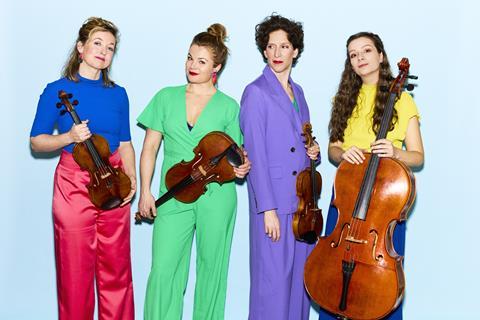
The ensemble speaks to The Strad about its recording of five world-premiere recordings by a diverse group of female composers and librettists
Discover more Featured Stories like this in The Strad Playing Hub
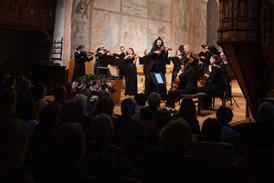
The Ragazze Quartet’s new album They Have Waited Long Enough brings together five world-premiere recordings of works by female composers and librettists.
Joined by soprano Katharine Dain, the album aims to give voice to women – who are often silent in history and mythology – to allow them to speak for themselves through their musical creation.
The album comprises songs by Aftab Darvishi, Annelies van Parys, Calliope Tsoupaki, Aida Shirazi and Saskia Venegas Aernouts on texts written by Gaea Schoeters, Ece Temelkuran and Nathalie Haynes.
The ensemble is joined by Raphaela Danksagmüller (duduk), Anna voor de Wind (clarinet), Osama Abdulrasol (qanun), Elif Canfezâ Gündüz (kemenche), Marianna Soroka (percussion) and Agata Kruszewska (percussion).
The Ragazze Quartet spoke with The Strad about the inspiration and process behind its new album.
How did the concept of giving voice to women from history and mythology shape the creative direction of They Have Waited Long Enough?
The idea of giving a voice to women from history and mythology shaped the project from the very beginning. It made us look closer at the way those stories have been passed down to us. Who gets to speak? We were not trying to recreate historical characters but we wanted to create space for their voices and for the possibilities within their stories.
For us, it was important that this was not simply a project about women, but a project created by women. That is why the collaboration between the Ragazze Quartet, soprano Katharine Dain, and the female composers and librettists was such an essential part of the concept – led by Wonderfeel director Tamar Brüggemann. Each composer was invited to create a new musical world, while the librettists approached these women from within, allowing them to become more complex than the roles history or mythology gave them.
We wanted to create space for women’s voices and for the possibilities within their stories
What was it like collaborating with five different female composers and librettists on a single album project? In addition to highlighting different women’s voices, how have their different cultures been represented?
Working with five different female composers and three librettists has been very inspiring. The diversity of the project is not something that was added afterwards; it is embedded in the music itself. The composers come from different cultural backgrounds, and those backgrounds naturally find their way into the sound worlds they create. You can hear this in the choice of instruments, musical colours, languages and references. That is why each piece asks a different approach from us – and we love that!
For example, Aftab Darvishi uses the duduk in Never Belonged, which tells the story of Circe. She connects the sense of otherness and timelessness with the sound of an ancient Armenian instrument. In Penelope, Calliope Tsoupaki brings in the qanun, creating associations with the Eastern Mediterranean and with memory, movement and the sea.
Aida Shirazi’s piece My Words Are Swallows about Kassia features the kemençe, while Saskia Venegas incorporates the Basque txalaparta into the story of Maria San Juan de Garonda in her piece named Sortzain. These instruments are not simply exotic colours; they become part of the emotional world of each woman. It has also been a joy learning more about these instruments and getting to know their players.
Why was it important for the Ragazze Quartet to record these stories now, and what do you hope listeners will take away from them?
It feels important to record these stories now because, although the women they portray belong to history or mythology, the questions they raise are very much alive today. Who gets to tell a story? Whose perspective becomes part of the canon, and whose is left out? And what happens when we allow ourselves to look again at stories we thought we already knew?
Unfortunately, we live in a world in which gender inequality remains a harsh reality. As an all-female ensemble, we feel deeply connected to women who face these challenges. We therefore consider it of great importance to use our platform – the stage – to let their stories be heard.
They Have Waited Long Enough is out now on Channel Classics. The Ragazze Quartet will perform the project throughout the Netherlands in September and October 2026, and in Berlin on 8 December 2026.












No comments yet