











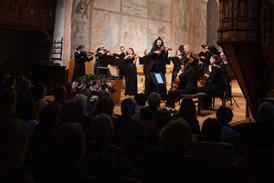






David Harrington of the Kronos Quartet speaks about the ensemble’s latest album honouring gospel legend and civil rights icon, Mahalia Jackson, as well as an upcoming multimedia world premiere exploring cultural histories, Three Bones

Discover more Featured Stories like this in The Strad Playing Hub.
The Kronos Quartet recently released its latest album, Glorious Mahalia, on Smithosonian Folkways. The project honours gospel legend and civil rights icon Mahalia Jackson and the pivotal role she playing in shaping Dr Martin Luther King Jr’s ’I have a dream’ speech.
Glorious Mahalia weaves together archival recordings of Jackson, including a 1957 Chicago performance and a 1963 interview with Studs Terkel, with newly commissioned compositions and a new interview recorded for the album with King’s speechwriter and lawyer, Clarence B. Jones.
In that interview, Jones recounts drafting King’s speech and the historic moment when Jackson called out, ’Tell them about the dream, Martin!’, prompting King to depart from his prepared text.
Across three suites composed by Stacy Garrop, Jacob Garchik, and Zachary James Watkins, the Kronos Quartet sets Jackson’s voice alongside a string quartet in a dialogue between past and present.
Violinist of the Kronos Quartet, David Harrington, spoke to The Strad about Glorious Mahalia, ahead of the ensemble’s latest large-scale project, Three Bones – a multimedia presentation exploring the histories of Indigenous, Gullah-Geechee, and Chinese American communities in the United States through an array of live performance, video, visual art, recordings, and environmental sound.
Glorious Mahalia places Mahalia Jackson’s voice in direct dialogue with new music and with today’s political moment. What drew Kronos Quartet to Mahalia Jackson at this particular time, and what do you hope listeners will hear differently about her legacy through this project?
Mahalia Jackson was a rare musician who combined the power of her soaring voice with a finely tuned sense of social justice. She proved that a singer on the world stage can reach deeply into the hearts of her listeners while also being a leader for equality. These qualities took her to the very center and the pinnacle of our civil rights movement.
The more I’ve learnt about Mahalia Jackson, the more I’ve wanted Kronos and our audience to benefit from the strength of her voice and the clarity of her sense of friendship. She and Studs Terkel recorded radio and TV shows together and became friends in the late 1940s during a time when contact across racial divides was rare and even dangerous in the US.
Mahalia also became MLK Jr’s favourite singer and close friend. This relationship would have a huge impact on our history. Mahalia Jackson showed all of us what the careful listening musicians are trained to do combined with an active, honest response to what is heard can transcend music.
I feel that when Mahalia Jackson called out during MLK’s speech ’tell them about your dream, Martin’ she taught every musician what our job is. Our real job is to use our training to listen to our friends, our society, our world and forcefully report what we hear.
Our real job as musicians is to use our training to listen to our friends, our society, our world and forcefully report what we hear
The album centres on the pivotal moment when Mahalia Jackson prompted Martin Luther King Jr. to speak about his dream, changing history in real time. How did working with archival recordings and Clarence B. Jones’s firsthand account shape your understanding of music’s power, not just to reflect history, but to actively influence it?
When I heard Clarence Jones tell the story of that moment during MLK’s speech when Mahalia Jackson stepped up to the plate as only a close friend could with her trusted voice pushing for something more vast than what she was hearing, I knew that MLK had the courage to be surrounded by music and musicians.
I also learnt that Clarence Jones, as MLK’s lawyer and speech writer, used his musical ability to hear MLK’s voice inside of himself. I’ve heard many composers speak of hearing music inside of themselves.
The next step to making a new piece of music is to transcribe what was heard. Clarence spoke of that – not writing the words so much as hearing MLK’s voice saying those words and then transcribing them.
It’s important to know that Clarence Jones, as MLK’s lawyer is the person to thank for getting ‘Letter From A Birmingham Jail’ out of jail. Without his courage and quick thinking that ’symphony of social justice’ would have been lost.

Your upcoming multimedia work Three Bones receives its world premiere at Carnegie Hall on 25 April, followed by its West Coast premiere at UC Santa Barbara. How does this project expand Kronos Quartet’s long‑standing commitment to storytelling through collaboration, and what can audiences expect from the way Three Bones brings different cultural histories into a shared sonic and visual space?
Three Bones is about listening. The three little bones that give us hearing can lead us to ways of observing the world we might have had no idea about.
I’ve wanted our Three Bones to bring together many threads Kronos has been exploring. What is a concert? Are there things we can learn in a musical setting that can move us to new places in the understanding of our time, our country, our role?
Not long ago my daughter, who taught third grade in the San Francisco Public Schools for many years, brought me a third grade book about Wong Kim Ark. Wong Kim Ark had an essential place in confirming birthright citizenship as the law of our country.
I had never heard of him in all my years. To find out from a little third grade book that this landmark legal case was centered in San Francisco, that the Chinese community here organised, hired the best lawyers and was able to change our system was inspiring to me. I had never heard of this case before. One thing leads to another.
There are so many other stories I’ve never learnt about. Maybe Kronos could make a work that could teach us new things about our country, help us establish relationships that grow from earlier work but also point to energised new futures.
It was three years ago that Three Bones began to take over my life. Can we include video elements? How about including some of our Fifty For The Future project, where we first encountered Gullah music through the work of Charlton Singleton and Navajo traditions in Raven Chacon’s music? How could our 1992 Pieces of Africa album figure in, or the work of Nina Simone or Edison Cylinder recordings?
Each panel of Three Bones should have a fabulous guest artist who could help teach us: Laura Ortman (White Mountain Apache Tribe composer, violin), Quentin Baxter (Gullah percussion), and Wu Man (Chinese pipa).
We feel so lucky to be joined by the work of knot artist Windy Chien, the poetry of Layli Long Soldier, the painting of video artist Jeffrey Gibson, the voices of Queen Qwet, Amelia Dawley and Bobby Seale, and the oral history of David Lei, to name a few.
Three Bones got bigger and became impossibly unruly in my imagination. I’d like to thank my fellow quartet members, Ayane, Gabriela and Paul for their organising ability, and for reining it in at a critical moment.
I have hoped Three Bones will bring together so much of Kronos’ work and take our audience into an experience that is the result of all Kronos’ earlier work, as we step toward an activist, uplifting future.
Glorious Mahalia is out now on Smithonian Folkways. Three Bones receives its world premiere at Carnegie Hall on Saturday 25 April, and to UC Santa Barbara on Saturday 2 May for its West Coast premiere.
Photo credit: Lenny Gonzalez.











No comments yet