













American cellist Seth Malone discusses how string instruments are being used in his father’s premiere of a completely unique work: The Lamentations of Jeremiah
Read more Featured Stories like this in The Strad Playing Hub
Out of the silence, a solo cello quietly presents a middle C – peaceful, sweet, tender, and delicate – before beginning a painful, violent slide to a high B. The note, while briefly drowned out by the blast of a trumpet, rings with fierce intensity before diminishing to a whispered sotta voce. A flute and clarinet begin to pass back and forth fragments of a developing modal melody, and the cello repeatedly interrupts with melancholic slides and intense vibrato before vanishing into thin air.
As the woodwind soloists finish their motif, the cello returns – this time with a full section to support – holding a solitary, vibrato-less note with the chilling quality that only sul ponticello can provide. As the rest of the string section fades in to create an unsettling, eerie cluster chord, the voices of four dozen women begin to echo a single, ominous word: ‘Eikhah.’
Gustav Mahler believed that a symphony must be like the world: it must contain everything. But how does a composer begin to express ’everything’ in a world described by poetry that portrays famine, destruction, and torture?
When the Gaza War began on 7 October 2023, American composer Ryan Malone happened to be just 40 miles away on a work trip in Jerusalem. Rockets flew across the sky, shrapnel plummeted to the streets below, and the noisy business of urban life came to a grinding halt. Jerusalem, the so‑called ’city of peace’ had transformed: left with an empty, eerie silence that could only be broken by the chirping of birds and the screeching of air‑raid sirens.
Being in Jerusalem during a time of war brought to mind the biblical book of Lamentations: five ancient poems that describe the city’s complete destruction in 585 BCE. By the following morning, the book’s opening text, ’How lonely sits the city once full of people,’ began to echo both in the silence of the city streets and in the composer’s mind.
From that moment, a new work was born: The Lamentations of Jeremiah.
Music history is full of dark pieces – each creating their own distinct sound world: the Passion music of Bach, requiems of Mozart and Verdi, symphonies of Shostakovich, Mahler’s tragic Kindertotenlieder, Penderecki’s nightmarishly‑cacophonous Threnody for the Victims of Hiroshima, Williams’ beloved soundtrack to Schindler’s List, and even historic choral settings of passages from the book of Lamentations itself by Tallis and Ginastera.
But in today’s era, where demand for listener attention has never been higher, how can one create a dark yet accessible sound world that’s able to touch the hearts of the largest audience possible?
What makes this two-and-a-half-hour orchestral oratorio particularly unique is how it features the complete poetic text in both modern English and the original Hebrew. For example, if the soprano soloist introduces a new section of text in English, the choir responds with the same phrase in the original text (that is, when they aren’t clapping, hissing, or shouting).
A one‑of‑a‑kind composition like this requires an equally one‑of‑a‑kind sound world. That’s where the string section comes in.
Today’s string players are well‑aware of the many extended techniques available to them: col legno, sul tasto, sul ponticello, slap pizzicato, flautando, ricochet, etc., all of which feature in the new oratorio. However, none of these are necessarily ’new.’ Rather, what must make the piece special lies with the individually‑drafted musicians from Oklahoma who face the task of playing in a manner completely different than they’ve played before.
A one‑of‑a‑kind composition like this requires an equally one‑of‑a‑kind sound world. That’s where the string section comes in
One recurring element in Lamentations is a continual use of slides and glissandi. Generally, string players refrain from excessive slides, especially when blending with an orchestra. But for this work, the composer requests string players to play the many written slides as ‘lugubrious’ as possible.
These slides serve multiple purposes. For one, they enable strings to more closely mimic the sound of crying, especially when combined with an array of vibrato speeds and widths. Second, they resemble the sound of war‑time sirens and alarms: the piece’s opening (described at the beginning of this article) is written to mimic the kind of atmosphere the composer experienced while in Jerusalem. Additionally, slides and glisses are, in general, more common to the kind of music performed in the greater Middle East.
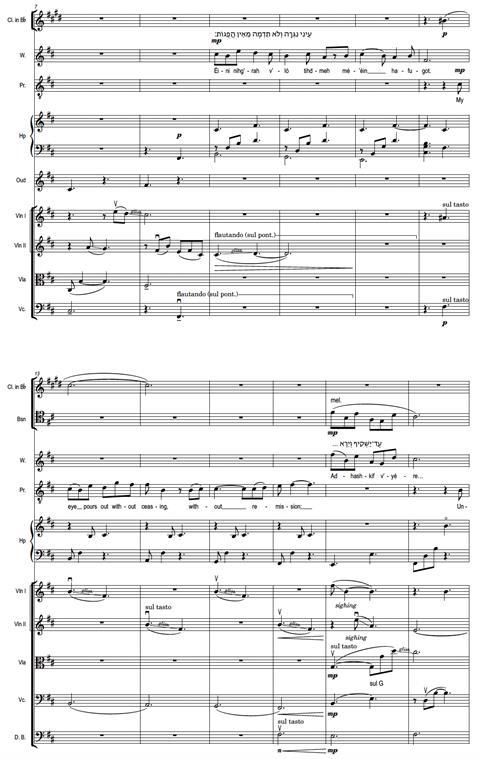
Malone has little experience with klezmer music – and even less with Arabic music: he does not advertise Lamentations as ’Middle Eastern.’ After all, even the best orchestral string players today are all too unfamiliar with Arabic music’s rich catalogue of microtonal modes (unlike Malone’s Iranian‑born audio engineer for the project). However, he does feature two quintessentially Arabic instruments, the oud and darbuka, prominently in the work. He doesn’t do this to create phony ’orientalist’ music for Western ears, but rather to create an altogether new sound world.
Every string player knows that their instrument doesn’t have just one voice, but four: one from each string. There’s nothing quite like the dark, husky tone of a violinist’s low G string being played high on the fingerboard. This special sound also features at many places in the oratorio.
At one particular moment in the piece, just before a touching a cappella movement from the choir, a solo cello reprises a motif two octaves high on the G string: a colour rare in cello repertoire.

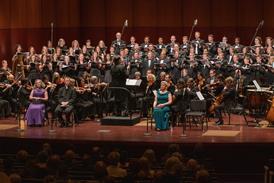
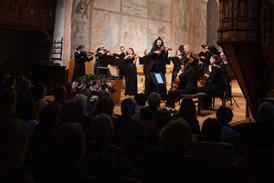
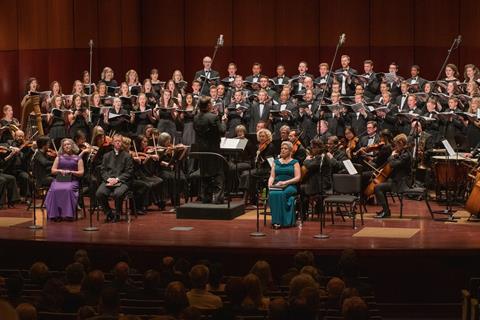
The orchestra drafted for the premiere isn’t large at all: single woodwind, single brass, two percussionists, and just over two dozen string players in total. It will be up to them to play with both the white‑hot intensity and somber delicateness the text demands. It’s not often that orchestral string players are asked to play in such a brazen manner.
But to create the ideal sound world for one of mankind’s darkest and most hauntingly‑beautiful pieces of ancient poetry, that’s just what Malone intends.
The oratorio premieres 26 April 2026, at Armstrong Auditorium in Edmond, Oklahoma, USA. An edited recording of the performance will be released soon thereafter, along with a mixed and mastered album available for streaming.













No comments yet