






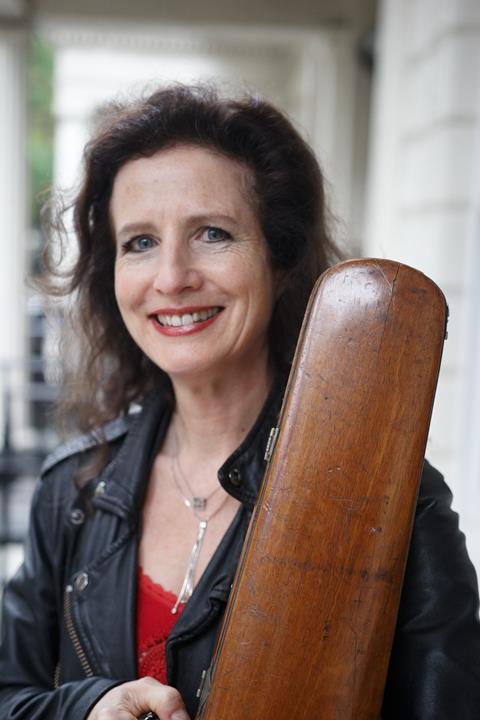
Madeleine Mitchell explores why so many composers gravitated towards the viola, and how the instrument shaped their creative voices
Read more Featured Stories like this in The Strad Playing Hub
Charles Wood (1866-1926), whose eight string quartets my London Chamber Ensemble Quartet has now recorded, played the viola. Growing up in a musically invigorating environment in the city of Armagh in the north of Ireland, he would have participated in musical soirées featuring chamber music as well as in music at the cathedral.
He incorporated Irish folk music in his quartets, combining this with skilled counterpoint. Some of the movements are viola led, such as the reel in the second movement of Quartet no.6 (1916) and the theme in the slow third movement of the ‘Highgate’ Quartet (1893) over a ground bass. Certainly the viola parts of his quartets are worthwhile.
This set me thinking about the many composers who played the viola: Bach, Haydn, Mozart, Beethoven, Stamitz, Schubert, Mendelssohn, Dvořák, Glinka, Paganini, Lalo, Respighi, Britten… Mozart preferred the viola, stating it was close to the human voice (though the same could certainly be said of the violin). He played viola in chamber music including his own ‘Kegelstatt’ trio as well as quartets and for me the pinnacle of the repertoire are his viola quintets.
Imagine hearing a quartet played by four composers: Mozart, Dittersdorf, Wanhal and Haydn! This is what Michael Kelly, the Irish operatic tenor described in his reminiscences from Vienna 1784. Telemann was an early pioneer who wrote one of the first significant viola concertos. Dvořák played viola in a music society orchestra in Prague, gaining significant experience and writing a two-viola quintet.
There are of course exceptions, but one could say the viola is less soloistic, more of a blending, mellow instrument and that it suits a composer’s personality – which is less about performing and more about working out the harmony and textures of a piece. Perhaps also, they didn’t have time to practise tricky first violin parts!
Three composers come to mind who were also professional viola players. Frank Bridge (1879-1941) was a member of the English Quartet from 1908-1915, moulding it into one of the UK’s foremost chamber groups who gave the UK premieres of both the Debussy and Ravel String Quartets. Bridge wrote five string quartets including an early one. (I was pleased to perform Bridge’s early viola quintet of 1901 at the Wigmore Hall and to make the first recording of this).
By 1918 he had all but given up playing, not wanting to be known as ‘the viola player who composed’. His pupil Britten observed in his 1947 broadcast that ‘Bridge’s inclination was instinctively towards the French tradition of skill, grace and good worksmanship’. Like the older Charles Wood, Bridge had studied with Sir Charles Villiers Stanford but Wood remained more in the Anglo-German tradition.
Paul Hindemith (1895-1963) premiered his own works (such as Trauermusik for viola and string orchestra 1936 ) as well as Walton’s Viola Concerto (Tertis having turned it down) and Milhaud. He founded the Amar Quartet, playing viola and touring Europe with an emphasis on contemporary music.
Rebecca Clarke (1886-1979) was internationally known as a violist and became one of the first female professional orchestral string players, selected by Sir Henry Wood to play in the Queen’s Hall Orchestra in 1913. Most of her compositions included the viola and much of her output was written for herself and the all-female ensembles she played in. Her RCM teacher, Stanford, had recommended she play the viola rather than the violin so she could absorb the harmony and textures from the middle of the quartet.
My first teaching job before becoming a professor at the Royal College of Music was head of strings at St Paul’s Girls’ School where Gustav Holst had been director of music and we had his viola – by the English maker Craske. I was fortunate to play this including during my time as violinist/violist in Sir Peter Maxwell Davies’ pioneering group, ‘The Fires of London’, (based on Schoenberg Pierrot Lunaire where the violinist also plays viola).
There used to be more of a tradition of musicians playing several instruments. Menuhin encouraged all his school’s pupils to play both violin and viola and I think as a violinist you learn a lot from playing the viola as well. Enescu played viola as well as being an outstanding violinist and pianist. Imogen Holst played the viola as did Elizabeth Lutyens who wrote six quartets and other chamber works with viola.
Among living composers there are Brett Dean (formerly a member of the Berlin Philharmonic Orchestra until 1999 and recently heard in a Prom of the Australian World Orchestra) and Sally Beamish. Sally said to me that ‘definitely being in the middle but also listening to the instruments behind me – sitting at the back of the violas in the Philharmonia right in front of the woodwind, learning orchestration from the inside’.
The violist Garth Knox, known for his work with the Arditti Quartet, is now also known as a composer and has written a series of eight concert studies called ‘Viola Spaces’ contemporary etudes which are useful in exploring extended techniques, and volume 2 – Viola Studies for Two.
Errollyn Wallen told me she ‘used to play the viola badly’ and that ‘I always look out for my violas’. Above all, playing the viola means being at the heart of things musically.
Playing the viola means being at the heart of things musically
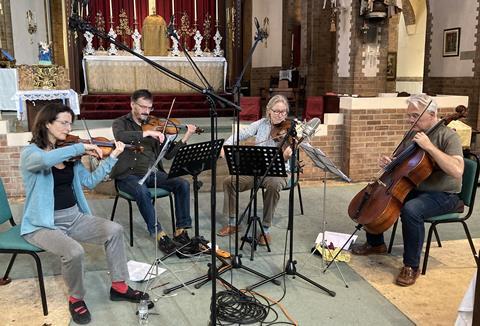
In The Well-Tempered String Quartet translated by D Millar Craig from Das stillvergnuegte Streichquartett 1936 by Ernst Heimeran, aimed at amateurs and humorously depicting the characters, there is an appendix of composers of string quartets which includes Charles Wood:
’The affection of music-lovers for Dr Wood and his chamber music is set forth in a note at the head of the edition of his string quartets….there is no striving for modernity; the quartets are all genuine chamber-music and all can be unhesitatingly commended’.
And yet we only heard of them as a result of our album Howells & Wood Quartets (2024), where Howells’ teacher was proposed as a companion work to his ‘In Gloucestershire’ (Earlier Version 1920). We have been very pleased to discover these eight inventive, satisfying quartets and bring them to the public.
The SOMM album with Wood ‘Highgate’ no.2, ‘Harrogate’ no.4 and the Variations on an Irish Folk Tune is released 15 May. The third and final volume of Wood Quartets will be released also on SOMM in January 2027. listn.fm/woodstringquartets









No comments yet