



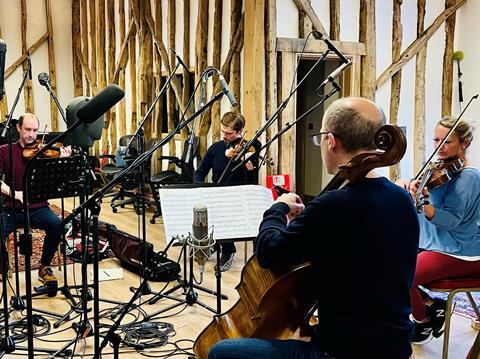
Violinist Jeremy Isaac from the Tippett Quartet reflects on its upcoming recital at the London Soundtrack Festival 2026, where the ensemble will perform two concert works by leading composers for film
Read more Featured Stories like this in The Strad Playing Hub
‘Music is the communicating link between the screen and the audience, reaching out and enveloping all into one single experience.’ Bernard Herrmann
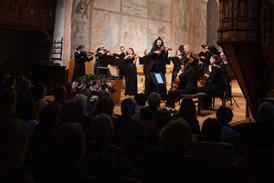
On the 9 April, we are delighted to perform two fantastic works at the London Soundtrack Festival: Christopher Gunning’s String Quartet No. 1 and Bernard Herrmann’s Souvenir de Voyages, with clarinetist Rob Plane.
Our programme opens with a work by Christopher Gunning (1944–2023). His music is widely recognised through BAFTA-winning scores for productions such as Middlemarch and Poirot, but his String Quartet No. 1 was one of his earliest concert works. Its four movements are all based on the three-note motif C–D–G, through which Gunning conveys human emotions: stress, joy, and poetic intimacy.
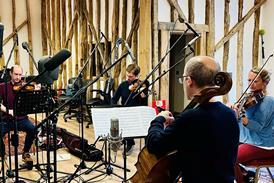
We have greatly enjoyed discovering this piece and adding it to our repertoire. The Festival itself was inspired by Christopher and was created to reflect the growing interest and enthusiasm for film, television, and game music. It also celebrates London as one of the world’s most important centres for soundtracks, with its legendary studios, musicians, facilities, and leading creative artists across all musical disciplines. This spirit of collaboration is particularly exciting for us as we feel equally at home in the studio and on stage. Bringing the two together is a real joy.
Bernard Herrmann provides an ideal example of how a composer organises sound. Our experience of performing the iconic Hitchcock film Psycho live to picture initiated our exploration of how to bring these notes originally written for film to a concert audience.
Subsequently, over the past two decades, we have been fortunate to work on some of the most prestigious Hollywood film scores by the likes of Michael Giacchino, John Powell, Alan Silvestri, Alexandre Desplat, and Howard Shore. Since 2019, we have also been the featured quartet on all the Knives Out films, working closely with composer Nathan Johnson.
We are able to include Souvenirs de Voyages in this programme due to the kind permission of Norma Herrmann, who we met in 2011 when she granted us access to the score. Norma is still alive today and has a wealth of anecdotes from this remarkable era of music and filmmaking. In fact, it is widely thought that the more joyful character of this mellifluous work was influenced by Herrmann meeting a young BBC researcher, then Norma Shepherd, who became his wife in November 1967.
Composed in January 1967, Souvenirs de Voyages features numerous literary connections, akin to a screenplay. The first movement reflects A. E. Housman’s pastoral tranquillity, interwoven with fierce winds. The second evokes an autumnal sunset off the coast, with Herrmann’s swaying, dreamlike rhythms for strings and sighing clarinet appoggiaturas rising like wave crests. The finale presents a love theme for violins, while clarinet calls represent nature’s charm before a serene coda.
Souvenirs de Voyages also provides an opportunity to explore the clarinet’s timbre, which Rob delivers with extraordinary skill. Herrmann’s integration of this additional voice within the quartet texture is remarkable. Each of the five voices must be present yet given space to breathe. Although there is no film to accompany this piece, understanding film scoring techniques helps both the performer and the audience to create a vivid picture.
Over our decades of playing this genre, we have drawn inspiration from the Hollywood Quartet. These musicians were leading players in major movie studio orchestras during the golden age of Hollywood in the 1940s and 1950s, maintaining their quartet career alongside. Their ability to combine warmth, colour, accuracy, and rhythmic precision with an intuitive understanding of musical architecture is something we continually strive to emulate.
In film music, one is part of a larger tapestry where all elements must align to succeed. To produce a lyrical tone with depth and blend, we focus on left‑hand intensity through fast, continuous narrow vibrato and the speed and contact of the bow. One of our most memorable reviews described our approach as ‘cogent, powerful, and life-enhancing’ with ‘bombproof’ intonation!
To produce a lyrical tone with depth and blend, we focus on left‑hand intensity through fast, continuous narrow vibrato and the speed and contact of the bow
With both Herrmann and Gunning, we are striving to create a truly special sound world and it is vital to make space for one another both technically and soloistically.
Exploring all aspects of a composer’s output is equally rewarding. Once immersed in the music, a voice begins to emerge, and there is often significant overlap between concert and film works. Understanding why something has been crafted for film frequently informs our approach to concert repertoire, and this shared language helps us to uncover deeper meaning. I will leave you with a quote from John Williams, which we believe applies to all composition:
‘Writing a tune is like sculpting. You get four or five notes, you take one out and move one around, and you do a bit more, and eventually, as the sculptor says, ”In that rock there is a statue – we have to go find it.”’
We too love that process of discovery – seeking something within the music and making it our own.
The Tippett Quartet performs Christopher Gunning’s String Quartet and Bernard Herrmann’s Clarinet Quintet ‘Souvenirs de Voyage’ (9 April) as part of the 2026 London Soundtrack Festival, London’s first-ever festival dedicated to celebrating the music of film, TV and games.












No comments yet