


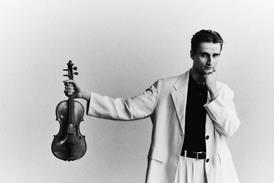











Schubert’s Arpeggione Sonata was one of the first pieces the Israeli violist learnt after switching to the viola – and the work has been close to his heart ever since

Discover more Featured Stories like this in The Strad Playing Hub.
Read more premium content for subscribers here
I can remember the first time I heard Schubert’s Arpeggione Sonata. I was eleven years old, and had only just made the switch from the violin to viola. Yuri Bashmet came to Jerusalem to give a recital, mostly of Shostakovich, but the Schubert was a part of it. It was one of the things that proved to me that I’d made the right choice! Hearing Schubert’s pure melodies on the viola was an inspiration, particularly the purity and simplicity of the minor melody in the first movement. I remember finding the sheet music soon after that, and trying to understand how to create a sound on the viola that could be close to what I’d heard that night. So it was one of the first pieces I ever learnt from scratch on the viola.
What’s interesting about the work, and also very difficult, is that Schubert’s lines are very musically deep and beautiful, but at the same time very pure and simple. The long phrases in particular are, in my view, very close to the human voice, and I realised that the viola probably has more tools and abilities within its range to give human expression to a piece like this.
While learning the piece, I remember that I had to improve my vibrato. The Arpeggione Sonata needs to have more than just a uniform vibrato, because almost every phrase has a different meaning and requires a new form of expression. I had to think about each line and how the vibrato would affect the sound: making it too fast means it doesn’t fit the tone, and if it’s too slow, then it sounds very heavy. It was an excellent exercise to make me understand the effects of vibrato, and on the other hand, the importance of my bowing. Those long phrases really made me careful with the bow arm, in a way I hadn’t been before: how to make the bow changes in a way that don’t cut the phrase.
My teacher David Chen talked to me a lot about bringing out the different characters within the music, especially in the first movement – the middle section needs a different ‘spice’ from the opening, for instance, which can come from using another kind of articulation. It might not be so easy for listeners to hear, but when playing the sonata, I find it’s easy for many parts just to sound the same – so the trick is to keep it all interesting.
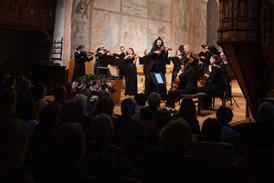
The first time I performed the Arpeggione Sonata in public was quite stressful, as it was broadcast live on national radio! I played it at the Jerusalem Music Centre, for a series called ‘Young Artists in the Centre’. I was 15 years old by then, and I think it went OK although I was more nervous than I’d ever been. Since then I’ve played it many times, often in an arrangement for string orchestra, but mostly with my good friend, the pianist Sunwook Kim. We recorded the sonata together in 2019 for Alpha Classics, and I remember finding that, for the third movement especially, the recording required yet another different sound. I’d been so used to playing the sonata in large halls that it took a while for me to adjust to performing in front of a microphone – it meant I could approach it in a more introverted way, inviting the listener into the music rather than blasting it into the hall! It was another good lesson for me: that one doesn’t need to push the sound so much, as the music doesn’t need it.
Having played the Arpeggione Sonata for more than 20 years, I think my interpretation has become a little simpler and more colourful. When I started, I may have been trying to play more like a brass instrument, and now I realise that the music doesn’t need that kind of sound. For me, Schubert’s music has a different kind of depth from that of Brahms, which somehow feels a little heavier on the viola. The trick is to find the specific quality of sound for each section of the piece – which could take someone a lifetime.
INTERVIEW BY CHRISTIAN LLOYD











No comments yet