








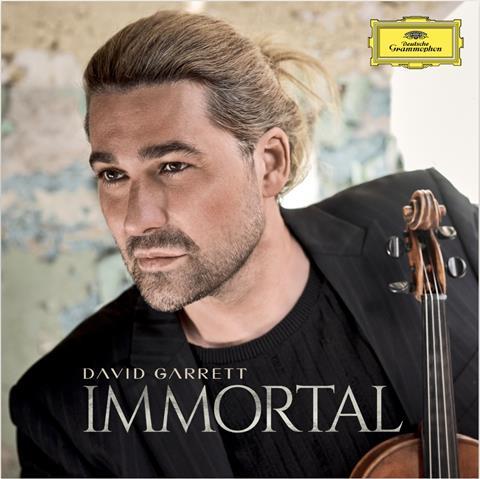
Ahead of the release of his new album Immortal, David Garrett speaks to Eric Wen about the Stradivari and Guarneri ‘del Gesù’ violins that have shaped his career, and why he has become an avid collector of fine instruments

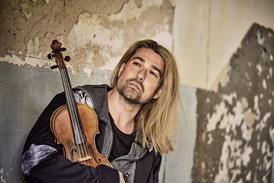
Violinist David Garrett. Photo: Ben Wolf
Explore more Featured Stories like this in The Strad Playing Hub
Due for release on Deutsche Grammophon in October, Immortal is the newest recording by versatile violinist David Garrett. An advance single from the album, on which Garrett performs an arrangement of Puccini’s ‘Nessun dorma’, came out this past June, together with a video in which he plays the aria against the backdrop of the Spree river in Berlin. Since beginning his recording career at the age of 13, with an album of Mozart concertos featuring Claudio Abbado and the Chamber Orchestra of Europe, David Garrett has become renowned for the ease with which he traverses musical genres. Together with major concertos by Beethoven, Brahms and Tchaikovsky, and a plethora of short violin encores, his wide-ranging repertoire includes a host of crossover arrangements of hits by such artists as Guns ’n’ Roses, Nirvana, Coldplay and Eminem.
Now the proud owner of two Guarneri ‘del Gesù’s, Garrett reveals his passion for the violins by this maker and his interest in violin collecting. Growing up among fine violins and cellos as one of the three children of Georg Bongartz, the proprietor of the Auction House Bongartz in Aachen, Germany, perhaps this was only natural. As Garrett recalls: ‘I grew up surrounded by instruments. From as early as I can remember, my dad would tell me about the different aspects of violins. He’d point out the specific attributes of the arching on German violins, the properties of French varnish, and so I just absorbed all this knowledge. As this was ingrained in me from the age of five or six, my relationship with the violin became part of my DNA.’
My first really great violin was a three-quarter-size J.B. Vuillaume that my father found
Reflecting on the access he’d enjoyed to so many violins from an early age, I ask Garrett about the instruments he played as he developed into a professional soloist. ‘My first really great violin was a three-quarter-size J.B. Vuillaume that my father found,’ he replies. ‘There are very few child-sized instruments by Vuillaume, so I was extremely lucky to have this while I was working with my first serious teacher, Zakhar Bron. My first full-size violin was another Vuillaume, a copy of the “Messiah”, which I played for just over a year. After that, my father acquired an 1838 Pressenda from Turin. When I was twelve, I was loaned the “San Lorenzo” Strad from 1718. This “golden period” Strad had an inscription on its bass rib and was the instrument during my time working with Ida Haendel and on which I made all my DG recordings.’
With his debut recording of Mozart, as well as all 24 Paganini Caprices and the Tchaikovsky and Julius Conus concertos on DG under his belt, Garrett seemed ready to embark on a full-blown solo career by his late teens. However, he decided instead to continue his violin studies at the Juilliard School. He explains: ‘After the legendary teacher Dorothy DeLay passed away, I had heard that Itzhak Perlman was going to take over her studio and I realised that the opportunity to work with such a giant was one that I simply couldn’t pass up.’
After spending a year at London’s Royal College of Music, Garrett went to New York where he majored in composition with Eric Ewazen and violin with Perlman. As Garrett recalls, ‘Besides playing the violin, I felt I needed further education in harmony, counterpoint, chamber music and piano. The more strictly structured programme at Juilliard was just what I needed at that time in my life.’
I ended up with a G.B. Guadagnini from Milan on loan for my time at Juilliard. This was more than good enough while I was working with Perlman
And what of the ‘San Lorenzo’ Strad that he was loaned during those years? ‘Although I took the Strad to New York when I first started studying at Juilliard, I wasn’t actively giving concerts. I felt it wasn’t fair to the instrument. I told the owner, “I’m not going to be performing for four years so I’m returning it because I want somebody else who’s more actively playing to have it.” Fortunately, I ended up with a G.B. Guadagnini from Milan on loan for my time at Juilliard. This was good enough – more than good enough! – while I was working with Perlman.’
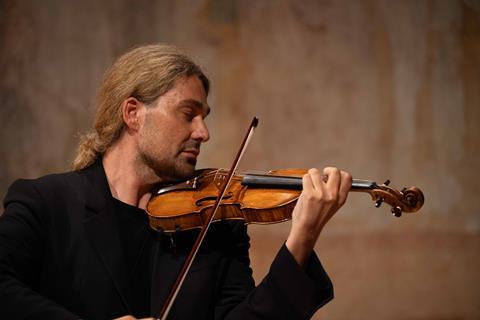
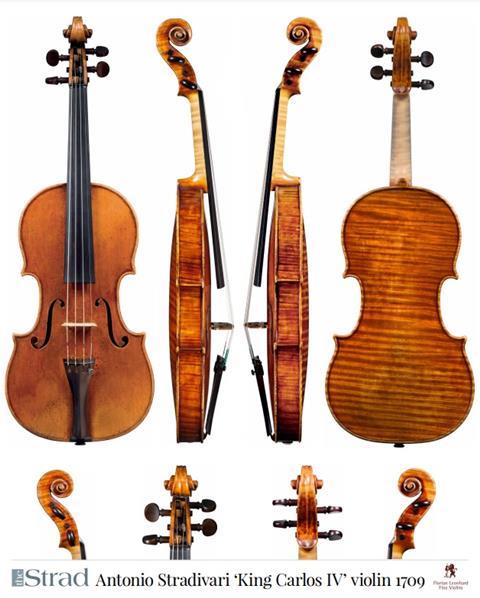
After completing his studies at Juilliard, Garrett made his first major investment with the purchase of a 1772 Guadagnini from Turin. On this violin he made several recordings for Universal, including the Mendelssohn Concerto. Unfortunately, this instrument was damaged by a freak accident when Garrett slipped and fell on icy stairs. (He had it restored soon afterwards, but eventually sold it.) A year later Garrett’s father happened to speak to the owner of the 1716 ‘Adolf Busch’ Strad, who offered the violinist a chance to buy it. As Garrett said in an interview at the time, ‘When I tried it, I took no more than three seconds to make up my mind. It was love at first sight.’ It was on this Strad that Garrett made his series of concerto recordings – the Beethoven, Brahms and Bruch no.1 – with Zubin Mehta. Although heartbroken about the damage to his Guadagnini, he says: ‘If I hadn’t broken it, I might never have found love with the Stradivari.’
I always had a dream of having a Guarneri ‘del Gesù’ as a counterpart to a Strad, like Huberman, Kreisler, Heifetz, Stern and Szeryng
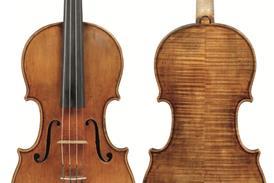
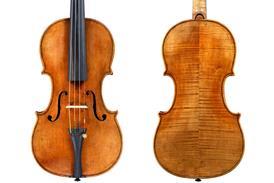
Until the advent of the Covid pandemic in 2020, the ‘Busch’ Strad was Garrett’s primary instrument. ‘During the three years of the pandemic, I focused less on playing, as did everyone else, and had time to reflect on things,’ he explains. ‘I always had a dream of having a Guarneri “del Gesù” as a counterpart to a Strad, like Huberman, Kreisler, Heifetz, Stern and Szeryng. So just when the pandemic was nearing its end, Peter Biddulph informed me that a “del Gesù” was coming up for sale at a public auction. This was the first “del Gesù” to come up for auction after many years, and it is truly a “player’s fiddle”.’ Indeed, according to Garrett, the violin was ‘a steal at US$3.4 million’! The instrument was listed as the ‘Pasquier’ Guarneri ‘del Gesù’ of 1736 when it was offered in early 2022 by the Paris auction house Aguttes, but Garrett explains that Charles Beare’s certificate dates it to 1737, and that it has subsequently been shown to date from 1734. It was once owned by the Italian violinist Gaetano Pugnani, under whose name Fritz Kreisler secretly published his well-known Praeludium and Allegro. Because of this connection, Garrett often refers to the instrument as the ‘Pugnani’ ‘del Gesù’.
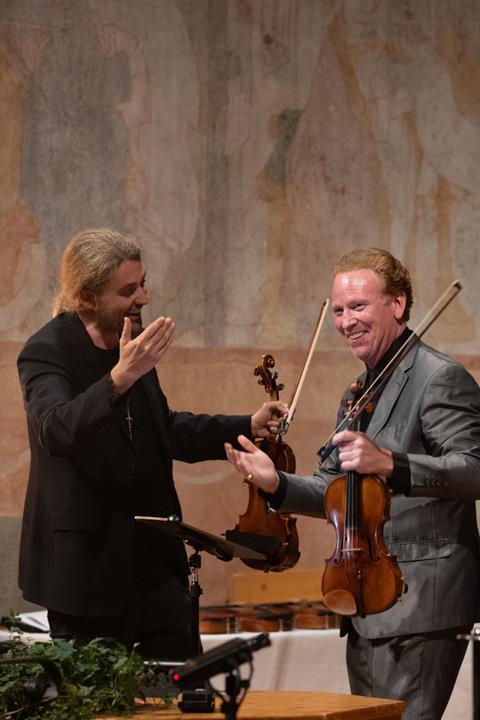
So, is the ‘Pasquier–Pugnani’ now his lifelong soulmate? Garrett says: ‘Curiously, the year after I bought my “del Gesù”, another one went up for auction at Tarisio in New York. The 1734 “Baltic” is a wonderful violin in fabulous condition and after I played it at Tarisio, I was debating selling everything in order to purchase it. Fortunately, a private individual heard me play on it. The buyer not only liked how I sounded on it but ended up loaning it to me! Although I still play my “Pasquier–Pugnani”, when I compare the two “del Gesù” instruments, the “Baltic” is a bit more powerful sound-wise and more visually attractive. For the past three years, the “Baltic” has been my primary concert instrument.’
I seem to have a photographic memory for the construction and varnish of old Italian instruments
Having dipped into buying his concert violin at an auction, Garrett has now developed a passion for violin collecting in general. In recent years he has purchased numerous other violins by makers such as Storioni, Sarafin and Landolfi, as well as the ‘Field’ Guarneri ‘del Gesù’ from 1726. As he explains, ‘I am curating a small collection of my own for the day when I no longer play. I go to every auction I can, and look at every instrument. Often I end up bidding on instruments that people are uncertain about. I suppose I’m a bit of a risk-taker, but I have a good eye, which many dealers can attest to. I seem to have a photographic memory for the construction and varnish of old Italian instruments. Sometimes I get lucky and pick up an instrument for way under its true value.’
Garrett’s deep passion for ‘del Gesù’ seems not to have abated. So, what makes a ‘del Gesù’ so particularly fascinating to him? He says: ‘I love his genius approach to sound, but also his sometimes bizarre, but also visually inventive models. He created so many different approaches to constructing the instrument. Remember, Strad was in his fifties when he created his “golden period” model. At that age, “del Gesù” was already dead. God only knows in what direction he would have gone if he had lived longer.’
Although now the proud owner of two ‘del Gesù’ violins, Garrett’s quest for the ideal is still open. As he confides: ‘I’m still looking forward one day to owning a late “del Gesù”.’










No comments yet